Consider creating a definitive ‘About Me page’. This is a space where you can tell the world who you are, what you do, where your interests lie, and link your online presences all together in the one place.
This one’s easy. I’ve got an about me page right here lornamcampbell.org/about-2/ I first posted this page in 2013 but because my job tends to change pretty rapidly I update it regularly. Looking at it today though I realise I could do with updating it again.
I also recently started keeping a google doc for short bios, because I’m always being asked for bios for one thing or another and tend to end up writing variations of the same thing over and over again.
I did used to keep an About.me page but I haven’t updated it for ages and since the system changed it now looks a mess so I should probably delete that account.
23 things is proving to be very useful for highlighting all these little digital housekeeping jobs that I never seem to get round to doing!
So Thing 4 is all about checking your digital security and privacy settings. This isn’t actually something I’ve done before but I’m glad I didn’t have any nasty surprises. I actually don’t use many apps, I tend not to link them together, I don’t turn on location services unless it’s absolutely necessary and I keep bluetooth off. That might make me sound very careful about my digital privacy and security but I have to confess, it has more to do with the fact that I have a rather old iPhone with hardly any storage capacity and crap battery life! In actual fact I’m a bit blase when it comes to this kind of thing so it would probably do me no harm to follow up with one of the recommended digital security courses.
Credit: Wowser, CC BY NC 2.0, https://www.flickr.com/photos/wowser/2915951282/
Thing 3 is all about your Digital Footprint …. I don’t often google myself but when I do, I do so with some trepidation. Thankfully if you google lorna m campbell you get a fairly innocuous footprint. The top six hits are:
My blog. Rather annoyingly it’s my old blog on wordpress.com, rather than my new blog on Reclaim Hosting.
And if you look for images you’ll mostly find me, or people I’ve worked with, or blogged about.
It’s all very professional as I’m well aware of the idea of digital footprints and the necessity of not letting the streams cross. Having said that, I am also rather conflicted about the whole concept of the digital footprint. I do allow a lot of my personal identity to bleed into my professional digital footprint as I see this as being an integral part of being an open education practitioner. However I also actively curate my digital footprint, I am careful about what I post where and I have some digital channels that I choose to keep private. But I still have very mixed feeling about this.
How much should we allow our professional identities dictate how we interact online? At what point does curating your digital footprint become a form of self censorship? Who regulates what is deemed to be acceptable and professional behaviour in which contexts? And as our personal and professional selves increasingly bleed together online, where do the boundaries of these regulations lie?
There are some really thorny issues here. I’m concerned that a lot of the complex issues around the control of online identity often get brushed under the carpet and I think that worries me more than having digital footprints that stray all over the internet. I’d be very interested to know what others think about this.
“If you never did you should. These things are fun and fun is good.”
The Cat in the Hat, Dr Seuss
I’m belatedly jumping on board with the University of Edinburgh’s 23 Things course, which is being facilitated by my colleague Charlie Farley in the Open Education Team. 23 Things for Digital Knowledge is a self-directed course that aims to
“expose you to a range of digital tools for your personal and professional development as a researcher, academic, student, or professional. The aim is for you to spend a little time each week over the semester, building up and expanding your skills.”
So, what do I hope to gain from 23 Things? Well, I use a whole host of social media channels routinely and I’m so familiar with them that perhaps I don’t give them the thought and consideration as I should. I have to confess that I’m pretty blasé about my social media presence, so I think one of the things I want to gain from this course is to step back and actually think about how I present myself online and engage with my peers. Also I want to see if I can actually finish the course. I very rarely sign up for online courses because I already have so many commitments above ad beyond work, and I hate starting something and not being able to finish it :}
I was aware of the University’s social media guidelines but I have to confess that I hadn’t actually read the handbook. I’ve read it now, a quick skim admittedly, and while a lot of it is common sense, there were one or two parts which made me go hmmm…..particularly the recommendation that staff or researchers “always obtain approval for any new personal social media presence.” I’m not entirely sure how necessary or realistic that is tbh. I was also a bit puzzled by “make sure you offer an equal level of service for members of our audiences who find social networks inaccessible.” What exactly does that mean if you’re blogging about work on a personal blog? Should I also make my blog posts available through another channel or in a different medium? I’m curious to know that this really means in practice.
Two teams from the University of Edinburgh were acknowledged in the ALT Learning Technologist of the Year Awards at the annual ALT Conference at the University of Warwick last week. The Open Education Team was placed third in the Team awards, with the team from Educational Design and Engagement being highly commended.
The ALT Learning Technologist of the Year Awards celebrate and reward excellent practice and outstanding achievement in the learning technology field, and aim to promote intelligent use of Learning Technology on a national scale.
Open Education Team
The Open Education Team is a virtual team within Information Services whose role is to coordinate open education and open knowledge activities across the University. The Team undertakes a wide range of activities that support staff and students to engage with OER, and help the institution to mainstream digital education across the curriculum. Initiatives run by the Open Education Team include the OER Service, Open.Ed, support for CMALT accreditation, engagement with Wikimedia UK and support for Open Scotland which raises awareness of open education policy and practice to benefit all sectors of Scottish education.
Accepting the award on behalf of the Open Education Team by www.chrisbullphotographer.com
Educational Design and Engagement
The Educational Design and Engagement team, which came into existence less than two years ago, supports University teaching and learning by providing a central hub for developing awareness, support for staff and students and leadership for e-learning service improvements. With a developing portfolio of 35 MOOCs with over two million sign ups globally, the team continues to grow. In the past year alone, supporting a 20% increase in online assessment submission institution-wide as well as over 10,000 ePortfolio submissions.
Stuart Nicol accepts the award on behalf of EDE by www.chrisbullphotographer.com
Melissa Highton, Assistant Principal Online Learning at the University of Edinburgh, said
“These awards recognise excellent achievement by the IS teams, they show that our work in open education and educational design is recognised and valued at a national level. I’m very proud of the teams and it was great fun to be at the ALT Conference when they received their award.”
Me speaking after receiving the award on behalf of the Open Education Team
ALTC used to be one of those conferences I only attended every second or third year, but over the last couple of years it really has become unmissable. Whether you attend in person or participate virtually, it undoubtedly provides the best way to get a broad overview of technology enhanced learning in the UK together with plenty of opportunity for in depth discussion around many of the issues currently affecting the sector. And this years conference Connect, Collaborate, Create co-chaired by Nicola Whitton and Alex Moseley, at the University of Warwick was no exception.
I’m not going to attempt to blog a summary of the conference, as the ALT team has already rounded up a whole host of excellent conference reports here Enabling the Connection, so I’m just going to pick out a few or my own personal highlights.
Lets get the team back together
I was delighted that ALT invited Rich Goodman, Chris Bull and I back to join Martin Hawksey and the conference social media team again this year. Live tweeting the conference keynotes from the official ALT account can be more than a bit daunting but it’s also an extremely rewarding experience and it was great to be joined this year by Kenji Lamb and Sandra Huskinson.
tweet tweet tweet – me & Rich Goodman by www.chrisbullphotographer.com
Trolls, myths, privilege and freedom
Josie Fraser’s keynote In The The Valley of the Trolls took an intelligent look at the thorny subject of trolling and didn’t shy away from addressing Gamergate head on. (By contrast, aside from a single comment about gender imbalance in the games industry, Ian Livingston failed to address the issue of representation, sexism and harassment in the gaming community.) Lia Commissar gave a highly entertaining keynote on Education and Neuroscience: Issues and Opportunities, which exploded a whole host of neuromyths common in education, ranging from learning styles and right / left brain thinking to the magical power of fish oils. Jane Secker’s thoughtful and thought provoking keynote Copyright and e-learning: understanding our privileges and freedoms touched on many issues that are of deep personal concern to me, including privilege, equality and the enclosure of our cultural commons. I actually found myself getting quite over emulsional while Jane was talking :}
Me fangirling Jane Secker’s keynote by www.chrisbullphotographer.com
The issues
Although I didn’t manage to get to nearly as many sessions as I would have liked, because I was running around doing so many other things, my impression is that some of the main issues to emerge from the conference this year were learning analytics, policies for lecture capture, and games in education.
Open education
It was great to see so many presentations on different aspects of open education, particularly at a time when there is so little external funding going into OER. My impression is that openness is slowly starting to become embedded across the sector, with more institutions starting to consider the sustainability of the resources their staff and students create. I gave a presentation Into the Open – a critical overview of open education policy and practice in Scotland and I’d like to say a huge thank you to everyone who provided enthusiastic comments and feedback.
ALT Scotland SIG
And talking of Scotland….we had a very successful meeting of the ALT Scotland SIG. It was great to see so many new faces! You can find out more about ALT Scotland and join out mailing list for updates.
Learning Technologist of the Year Awards
The University of Edinburgh was acknowledged twice in the Learning Technologist of the Year awards. The Open Education Team, which I work with, was placed third in the team awards and the Education Development and Enhancement team was highly commended. The awards were great fun and it was a real honour to join so many of the award winners from 2007 – 2016 on the stage.
ALT Learning Technologists of the Year by www.chrisbullphotographer.com
ALT Trustee
I’m delighted to have joined the ALT Central Executive Committee as a Trustee and look forward to hopefully making a positive contribution to the organisation.
Virtually Connecting
I took part in a great Virtually Connecting session with Fiona Harvey, Teresa MacKinnon, Nadine Aboulmagd and others. We discussed a wide range of topics including the risks and privileges associated with openness.
#altc #play
Despite patiently explaining to co-chair Nicola Whitton that I am #notagamer she insisted that I joined her team for the Actionbound School of Rock challenge. Yes really. I have to admit it was a lot of fun and we had the most awesome team. Also this happened…
It’s that time of year again! The ALT Conference is taking place at the University of Warwick next week. The theme of this years conference, which has a distinctly playful feel, is Connect, Collaborate and Create, and the conference is being co-chaired by Nicola Whitton and Alex Moseley. I’ll be joining the ALTC social media team again with my partner in crime Richard Goodman from Loughborough University and we’ll be live tweeting all five (count ’em!) of the conference keynotes. Chris Bull will be on hand again to photograph the conference and this year we’re also being joined by Kenji Lamb from the College Development Network and Sandra Huskinson, Loughborough University, who’ll be helping Martin Hawksey to livestream and broadcast the event.
Oh and the Open Education Team that I work with at the University of Edinburgh is up for the ALT Learning Technologist of the Year Community Choice Awards. If you’d like to vote for us, which would be super nice of you, you can send an email to LTAwards-vote@alt.ac.uk with the subject line #LTA6 or tweet a message with the hashtags #altc #LTA6.
Over the summer, the Learning, Teaching and Web Directorate here at the University of Edinburgh has been hosting nine student interns across five different departments and last week I went along to an event that showcased their work. All the students were really inspiring and spoke candidly and positively about their experience of working on their different projects. You can find out more about all nine internships here: The Power of 9: LTW Student Summer Interns, and also read some of the student’s own blog posts.
Martin Tasker developing OER for TES Connect, CC BY 2.0, Lorna M. Campbell
It seems unfair to pick out just one or two of the interns, as they all produced immensely valuable outputs, but I really want to highlight the work of Martin Tasker, who has been based here with the OER Team as our Open Content Curation Intern. Martin’s role has been to work with students and staff to repurpose collections of educational resources that engage with the wider community. These resources have been made available through TES Connect and the University’s own Open.Ed one-stop-shop for OER. The resources include:
Martin wasn’t the only intern that created open educational resources as part of their internship. Connie Crowe developed a script to create a playlist of all Creative Commons licensed content in the University’s media management platform Media Hopper, which can be accessed here: Media Hopper Open Educational Resources; and Annie Caldwell shared some beautiful pictures of the University’s learning spaces, taken while compiling an inventory of audio visual technology kits across 300 teaching rooms. Annie created a tumblr to record her internship here EdinburghUniExplorer and she as has also shared some of her gorgeous photographs under CC license on flickr here LST Photographs
Sorry, it had to be done :} I’m delighted that the Open Education Team at the University of Edinburgh where I work has been nominated for the ALT Learning Technologist of the Year Community Choice Awards, and y’know, if you feel that way inclined, you might like to vote for us. You can find out more about the Community Choice Awards here Finalists and Community Choice Voting and you can vote for us by sending an email to LTAwards-vote@alt.ac.uk with the subject line #LTA6. Or alternatively you can tweet a message with the hashtags #altc #LTA6. Those clever people at ALT have even set up a link to generate the tweet for you 🙂
The Open Education Team at the University of Edinburgh is a virtual team within the Information Services Group, Learning, Teaching and Web Services Division and our role is to coordinate open education and open knowledge activities across the University.
The team is made up of Lorna M Campbell, OER Liaison – Open Scotland, Stuart Nicol, Learning Technology Team Manager, Stephanie (Charlie) Farley, OER Advisor, Ewan McAndrew, Wikimedian-in-Residence, Jo Spiller, Head of Educational Design and Engagement, Eugenia Twomey, Student Engagement Officer, Anne-Marie Scott, Head of Digital Learning Applications & Media, Susan Greig, Learning Technology Advisor and Martin Tasker, Open Content Curation Intern.
You can find out more about our work in the video below which, you’ll be relieved to hear, is not filmed in the style of Trainspotting ;}
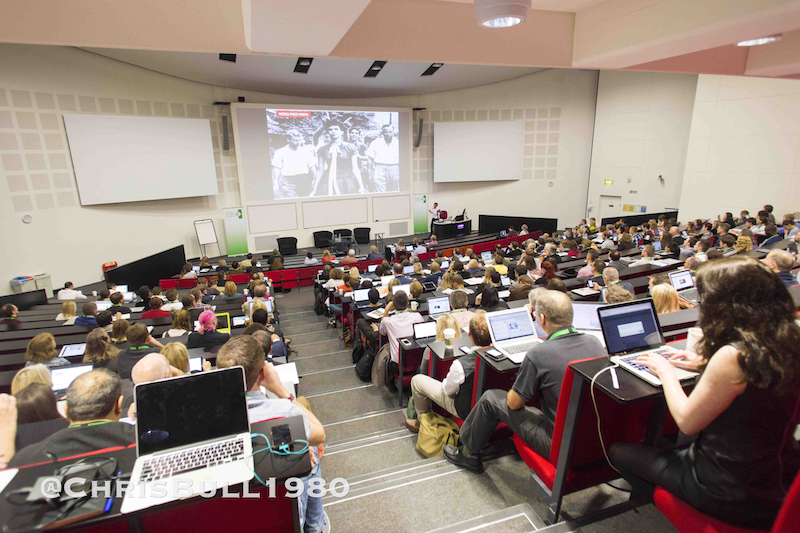
As I mentioned in my previous post, I’m absolutely delighted that #OER16 has won Wikimedia UK’s Partnership of the Year Award! The University of Edinburgh already building strong links with Wikimedia UK when Melissa and I started planning the OER16 Open Culture Conference with ALT and we were really keen that Wikimedia should have a presence at the event. These links were further strengthened when the University became the first in the UK to appoint a Wikimedian in Residence late in 2015.
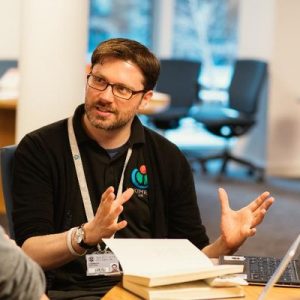
Ewan McAndrew, Wikimedian in Residence, University of Edinburgh
Wikipedia and the associated Wikimedia initiatives Wikidata, Wikimedia Commons, Wiki Source, etc represent the largest volume of open educational resources in the world and the Wikimedia and OER communities share a common goal to increase the quantity and quality of open knowledge so it makes good sense to bring them together.
Melissa and I were delighted by the response from Wikimedia UK and the Wikimedians in Residence when we invited them to participate in OER16 and many delegates commented over the course of the conference that they felt they learned a lot from their presence and that they made a really positive contribution to the event. So I’d just like to thank all those, from both the OER and Wikimedia communities, who worked so hard to make this collaboration a huge success.
Next year’s OER17 Conference, which focuses on the Politics of Open, will be co-chaired by Josie Fraser and Alek Tarkowski. As Josie is also a Trustee of Wikimedia UK I’m sure she will be keen to ensure that the relationship between the Wikimedia and OER communities continues to flourish.
Wikimedians in action at OER16 by Stuart Cromar
“As the Wikimedian in Residence for Museums Galleries Scotland, I usually work alone, or remotely. The opportunity to connect to the wider open knowledge community was fantastic – energising, informative and so very valuable. And we had 4 Residents in a room at once! This, you have to realise, is a rare thing indeed in the world of Wiki. I’ve worked primarily in open culture and heritage for the last 16 months, and one of the growth areas has been in the interface between education and culture…. So #OER16 seemed to me so prescient, so perfectly timed…”
~ Sara Thomas, Wikimedian in Residence, Museums Galleries Scotland
further the quantity and quality of open knowledge and enhance digital literacy, through skills training sessions and editathons, striving to embed open knowledge practices in the curriculum.
further the quantity and quality of open knowledge and enhance digital literacy, through skills training sessions and editathons, striving to embed open knowledge practices in the curriculum.