23 Things: Thing 9 Google Hangouts / Collaborate Ultra

I am woefully behind with 23 Things owing to work and annual leave so I’m going to try and catch up with a few quick and dirty posts.

Thing 9 is Google Hangouts and Collaborate Ultra and I did actually manage to dial into the live sessions Charlie ran a couple of weeks ago which were a lot of fun. I’ve worked remotely in one way or another for most of my career in ed tech, either working from home, working for distributed organisations, or working on projects with multiple international parters, so I’ve lost count of the number of remote collaboration tools I’ve used over the years.  Here’s a brief run down of the way I use some of the current crop of tools.

Skype

Still my favourite for one to one calls and personal conversations. I use Skype routinely on both my laptop and my phone and would be lost without it. I tend to use Skype for audio calls, text chat and transferring documents and images, it’s not often I make video calls.  The downside of Skype is that it’s still flakey with more than a few people, so I tend not to rely on it if there are more than about four people on a call. Also the way Skype updates its interface and randomly hides features is annoying as hell.

Google Hangouts

I can’t say I was impressed with Google hangouts in the early days.  I remember having a call with a Google project manager in the US not long after hangouts were launched and they insisted on using a telephone conference line rather than a hangout, which kinda spoke volumes. Initially I found them really flakey and in my experience there are often problems with scheduling and people getting into hangouts.   Having said that, things have improved, the interface is nice and clean, and once you’re in I find that hangouts are pretty robust. You can only have up to 10 people actively participating in a video hangout which is an obvious limiting factor, though you can have a much larger number listening in.  One nice feature is that you can stream hangouts directly on to Youtube which makes them a useful broadcasting tool. Here’s a link to an ALT Community Call which essentially involved Martin Hawksey interviewing me in a hangout and streaming it directly on to Youtube. So I tend to find hangouts are useful for project meetings, small committees, and broadcast interviews.  Also filters and ponies.

Google Hangout interface

Susan Greig channelling her inner Elsa in a Google Hangout

Google Hangouts with ponies

Not many collaboration tools offer ponies as standard

Collaborate Ultra

I’ve been using various incarnations of this tool since the dawn of time and it’s never been exactly user friendly.  Anyone else remember the days of having to install Java before you could run the damn thing? No, not that version of Java, this version of Java. *sigh*  However there’s no denying that Collaborate is very useful indeed for more formal online collaboration, particularly webinars and online lectures, which may have a large audience.  In my experience you need at least two people to run a successful Collaborate webinar, one doing the talking and one watching the chat window, and if you’ve got someone else acting as administrator then that’s even better. Of course to use Collaborate Ultra you need a subscription, but if you have access, it’s a very useful tool indeed.

Collaborate Ultra interface

Collaborate Ultra – no ponies


Manifestos, Mòds and the Future of Gaelic in Scotland

Last week was the October school holidays so I took my daughter home to the Outer Hebrides to visit family.  My trip coincided with the Royal National Mòd which was held in my home town of Stornoway this year so I was able to go along to some of the Mòd fringe events.

On Wednesday I was at the Council Chambers in Stornoway to hear Mr John Swinney, Deputy First Minister and Cabinet Secretary for Education and Skills, present the Angus Macleod Lecture on The Place of Gaelic in Modern Scotland.  (I’ve already written a more comprehensive blog post about the Minister’s lecture for the Open Scotland blog here.)  In a wide ranging and really rather inspiring talk Swinney reiterated the government’s commitment to Gaelic stating

“Gaelic belongs to Scotland, hostility to Gaelic has no place in Scotland and we should all unite behind the effort to create a secure future for Gaelic in Scotland.”

National Library of Scotland, Digitised with permission of An Comunn Gàidhealach

National Library of Scotland, Digitised with permission of An Comunn Gàidhealach

In questions after the lecture I also had an opportunity to ask Swinney for his thoughts on the role of ICT in supporting Gaelic education.  He answered by re-stating the Government’s commitment to providing 100% network connectivity throughout Scotland and went on to highlight the importance of education technology in broadening the coverage of education provision and ensuring that Gaelic education can reach greater numbers of learners than ever before.  In addition he also emphasised the new opportunities that ICT affords young people in the Highlands and Islands, enabling them to expand their education and skills, and seek new careers without having to leave the Gàidhealtachd.

The second fringe event I went to was Manifestos, Mòds and Music, a fascinating talk by Jennifer Gilles on the National Library of Scotland’s digitised Gaelic collections. Jennifer presented a short history of An Comunn Gàidhealach illustrated by a whole host of items from the Library’s collections, ranging from publications and periodicals, to Mòd programmes and ephemera, printed music and even recipe books.  I confess I was particularly fond of the “Celtic Terms of Invective” column from one of An Comunn’s early 1900’s periodicals. You can find a short Storify of Jennifer’s talk here.

Jennifer’s talk was followed by a showing of the a 1942 film The Western Isles. Set in Harris, the film depicts scenes of island life during World War II, as a family anxiously awaits news of their son after his ship, the Atlantic Queen, is sunk by a German submarine in the Mid Atlantic. The son, admirably played by a 14 year old motor mechanic from Harris, successfully skippers the lifeboat back to the Hebrides and returns to his family. It was fascinating to recognise many of the places that appeared in the film and many Hebridean families, mine included, can relate similar tales of heroism from the both the Merchant and Royal Navy during the Second World War.

The Western Isles

Ian Mac Néill Ghiolais in The Western Isles

23 Things: Thing 8 Facebook

Thing 8 is Facebook and here is a cautionary tale….

I have not been a Facebook user for a couple of years now, but that is more by accident than design.  I first started using Facebook in 2007, primarily to chat with work colleagues outside work and to keep in touch with various friends and family.  I used it fairly consistently over the next seven years, though to be honest it was really starting to annoy me. In addition to Facebook’s high handed attitude to privacy I found the targeted advertising intrusive, sexist, and annoying.  (No Facebook, for the millionth time, I do not want to loose weight or go on a diet. Please fuck off.)

Anyway, in 2013 I was made redundant by the University of Strathclyde where I had worked for sixteen years.  My entire online identify was tied up with an institutional e-mail address which I was told would be deleted 3 months after my contract was terminated. Needless to say, untangling all my accounts and subscriptions from my Strathclyde e-mail address was a significant task, but I did it, and I now use a non-academic e-mail address to subscribe to my social media accounts. I’m not going to make the same mistake twice.

A couple of years later the hard disk on my mac and my iphone died within a couple of weeks of each other and when I replaced them and went to log back into Facebook I discovered that not only had I forgotten my password (yeah, go on, laugh) my account was also still associated with my Strathclyde address which had long since been deleted.  That meant that I couldn’t get my password reset and I was locked out of my account.  Needless to say I was pretty pissed off, but really I had no one to blame but myself.  I did eventually discover that there is a way to reset your account by passing keys back and forth to nominated friends but I never quite got round to requesting the keys to be sent and, before long, I realised that I didn’t actually miss Facebook at all. I quite happily washed my hands of it and moved on.

Since then I have actually remembered my password (you’re still laughing, aren’t you?) but I haven’t reactivated my account because I don’t miss it, I don’t want it, and I certainly don’t want it associated with the social media accounts I do actually use.  I suppose I should really just go and salvage anything that’s worth keeping and then delete the whole account but somehow I never seem to get round to doing that.

I’ll leave you to draw your own conclusions from this cautionary tale :}

Facebook timeline

Maritime Masculinities Conference Registration

Registration is open for the Maritime Masculinities conference which takes place at St Anne’s College Oxford on the 19th and 20th December.

Register for Maritime Masculinities

Maritime Masculinities covers the period from 1815 – 1940, which saw the demise of the sail ship, the rise of steam and oil-powered ships, the erosion of British naval and maritime supremacy during two world wars, the advent of the Pax Britannica, and the emergence of popular navalism through the press, popular literature, photography and film.  Panels will cover a wide range of topics and themes including: material culture and technology, bravery and honour, memory and nostalgia, race and empire, visual culture, life stages, homosociability, and sexualities.  A full conference programme will be published shortly.

The conference features a wide range of international speakers from the UK, USA, Canada, Italy, Germany and Sweden, along with keynotes from leading international scholars Professor Joanne Begiato, Oxford Brookes University, Dr Mary Conley, College of the Holy Cross, and Dr Isaac Land, Indiana State University.

Professor Joanne Begiato has worked on the role that representations of military and maritime masculinity played in the formation of masculine identity in the eighteenth and nineteenth centuries. She is particularly interested in the part played by material culture and emotions in disseminating and fixing ideas about manliness.

Dr Mary Conley’s research areas include the intersection between empire, navy, and manhood in British society; imperialism and post-colonialism; maritime history; and the history of gender, family and childhood. She is particularly interested in issues relating to boys’ culture and sodomy.

Dr Isaac Land has written about masculinity and the Royal Navy in a variety of contexts, including patriotism, popular politics, spectacle, empire, nostalgia, autobiography, domestic violence, and religion. He will present a keynote on “Dibdin’s Ghost in the Age of Ironclads”.

Further information about Maritime Masculinities is available from the conference website https://maritimemasculinities.wordpress.com/ and on twitter @MMasculinities.  Emails can be directed to maritimemasculinities@gmail.com

Maritime Masculinities is supported by Oxford Brookes University, Portsmouth University and the Society for Nautical Research.  The conference is being organised by Prof Joanne Begiato, Dr Steven Gray, Dr Isaac Land and Ms Lorna M. Campbell.

Sailors at capstan

Sailors and an accordion player on board Magdalene Vinnen (no known copyright restrictions)

Gaelic Wikimedian Opportunity – Tha sin direach sgoinneal!

The National Library of Scotland and Wikimedia UK yesterday announce that they are recruiting a Gaelic Wikimedian to promote the Scottish Gaelic Wikipedia, Uicipeid.  The Gaelic Wikimedian will work throughout Scotland to promote the Gaelic language by training people to improve or create resources on Uicipeid.  This will include deliver training and events in the Western Isles, Highlands and central Scotland.

Uicipeid logoThe Gaelic Wikipedian will be responsible for designing and delivering a range of activities which will encourage young Gaels to improve their language skills through editing Uicipedia. They will deliver events and workshops and work with Gaelic organisations and communities to increase knowledge about Uicipedia and increase its size and usage. They will support the development of open knowledge and open licenses and prepare progress reports to assess the impact of their work on the development of Uicipeid.

~ WMUK and National Library of Scotland are hiring a Gaelic Wikipedian

As a Gael, a member of the Wikimedia UK Board and an advocate of open education this is a project that is very close to my heart.  I was born and brought up in Stornoway in the Outer Hebrides but sadly I have very little Gaelic.  I can talk fluently to sheepdogs and very small children, but that’s about it!  I am typical of a generation whose parents and grandparents thought there was little point in passing on their language to us.  My father and my granny spoke a lot of Gaelic to me until I was about five but once I started school the Gaelic stopped, and during the 1970’s and early 80’s there was very little provision for Gaelic medium education in the Hebrides. I did one year of Gaelic in secondary school but that was it.

I now have a daughter of my own and as soon as she was old enough to start nursery I decided I wanted her to have the Gaelic medium education that was not available to me.  She is now in in her sixth year at Gaelic school, fluent in the language, and loving every minute of her education.  She also rolls her eyes in embarrassment at my woeful language skills but I can live with that.

Like many school kids, whenever my daughter is doing research for her school projects, Wikipedia is her first port of call, which obviously is something I encourage. She finds the information and references she needs and then carefully translates what she has learned into Gaelic.  It’s a bonus to find an article written in Gaelic in the first place.   It goes without saying that if Uicipeid could be expanded it would be an enormously important resource for Gaelic medium education, not just for primary school children to find facts, but for older students to gain valuable digital literacy skills.

Not only is this a wonderful opportunity for a Gaelic speaker to get involved with Wikimedia and the open knowledge community, the project also promises to be of enormous value to Gaelic teachers and learners and, perhaps most importantly, the future generations of young Gaels.

You can find out more about the post from Wikimedia UK, WMUK and National Library of Scotland are hiring a Gaelic Wikipedian and Obraichean Gàidhlig, Gaelic Wikipedian.

And here’s my own little contribution to Uicipeid, a photograph of Stornoway, uploaded to Wikimedia Commons and  tagged in Gaelic 🙂

Stornoway Harbour

Steòrnabhagh, Eilean Leòdhais

23 Things: Thing 7 Twitter

I first signed up for twitter in April 2007 and I’ve been tweeting pretty much continually ever since; over 23,000 tweets and counting! It’s no exaggeration to say that, in terms of work, I would be lost without twitter.  Twitter has become so fundamental to my work and my identity as an open educational practitioner that I genuinely don’t think I could do my job without it.  Twitter is my workspace, it’s my office, it’s where I hang out with friends and connect to colleagues all over the world.  It’s where I pick up news, find new ideas, and listen to fresh perspectives. It’s where continuous professional development happens.  It’s where I learn. As someone who works remotely a lot of the time, twitter enables me to be part of a global connected community of open education practitioners.

Live tweeting ALTC

Live tweeting ALTC by www.chrisbullphotographer.com

Twitter is also an invaluable tool for communicating and disseminating educational events all kinds of. It’s second nature for me to live tweet every event I attend and if I can’t get online, I feel a bit lost. I find that live tweeting helps me to process what I’m listening to and the 140 character limit means I have to synthesise the ideas as I go along. Sometimes I get invited to live tweet events, such as the ALT Conference and the Day of Digital Ideas, in a more official capacity. Live tweeting in an official capacity requires a slightly different approach to live tweeting from my own account.  When I live tweet on behalf of an event organiser I try to keep my tweets as factual, neutral and representative as possible.  If I’m tweeting personally, I tend to tweet the points that interest or irritate me, adding my own thoughts and comments along the way. It feels  quite different. If you’re interested in finding out more about how to use twitter to amplify academic events, here’s a presentation I gave at the Day of Digital Ideas at the University of Edinburgh: Using Social Media to Amplify Academic Events.

Despite the fact that twitter is such an important channel for me, I actually use very few twitter tools. I have tweetbot installed for occasions when I want to manage multiple accounts but I prefer to use the generic web interface.  I do have a couple of lists set up, but I very rarely use them, I prefer not to filter as I love the random serendipity of my twitter feed.  The only twitter tools I use with any regularity are Storify, for collating event tweets, and Martin Hawksey’s fabulous TAGs for archiving and visualising tweets associated with event hashtags.

Although I think of twitter as a work channel first and foremost, I tend not to filter what I tweet.  I don’t just tweet about educational technology, I tweet about all kinds of things that interest me – naval history, poetry, sexuality and gender,tattooing, art, politics, rugby, whatever.  These things are all part of my real life identity, so they’re part of my online identity too.

My twitter feed

Enhancing Learning and Teaching Through The Use of Digital Technology

[Previously posted at openscot.net]

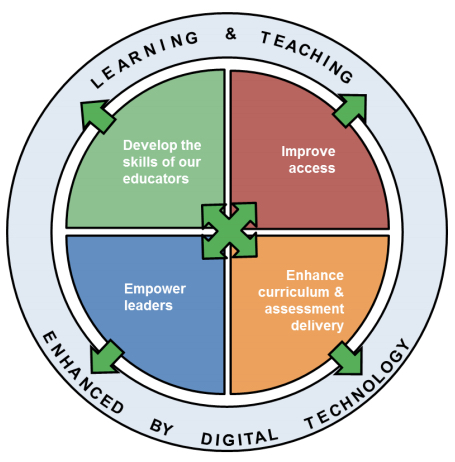
Last week the Scottish Government launched their new digital learning and teaching strategy for Scottish schools: Enhancing Learning and Teaching Through The Use of Digital Technology. The strategy outlines:

“a comprehensive approach to deliver the increased effective use of digital technology in education and bring about the equity of opportunity that is the key focus for this government.”

Key themes to emerge form the strategy are closing the attainment gap, developing digital skills, embedding technology right across the curriculum, and using digital technology to improve the assessment process.

The strategy is structured around four strategic objectives that will replace the existing five ICT in education objectives.

  • Develop the skills and confidencescotgov_strategy of educators in the appropriate and effective use of digital technology to support learning and teaching.
  • Improve access to digital technology for all learners.
  • Ensure that digital technology is a central consideration in all areas of curriculum and assessment delivery.
  • Empower leaders of change to drive innovation and investment in digital technology for learning and teaching.

The strategy emphasises that all four objectives must be achieved in order to realise the overarching vision for Scottish Education:

  • Excellence through raising attainment: ensuring that every child achieves the highest standards in literacy and numeracy, set out within Curriculum for Excellence levels, and the right range of skills, qualifications and achievements to allow them to succeed; and
  • Achieving equity: ensuring that every child has the same opportunity to succeed, with a particular focus on closing the poverty-related attainment gap.

The strategy also outlines what Scot Gov and Education Scotland will do to deliver this vision and identifies action plans for each strategic objective as follows:

Objective 1: Develop the skills and confidence of educators in the appropriate and effective use of digital technology to support learning and teaching.

  • Ensure Professional Standards for Registration and for Career-Long Professional Learning reflect the importance of digital technology and skills.
  • Ensure that all Initial Teacher Education (ITE) providers instil the benefits of using digital technology to enhance learning and teaching in their students, in line with GTCS Standards for Registration.
  • Ensure that a range of professional learning opportunities are available to educators at all stages to equip them with the skills and confidence to utilise technology appropriately and effectively, in line with the GTCS Standards for Career Long Professional Learning.
  • Ensure that a range of professional learning opportunities are available to educators at all stages to equip them with the skills and confidence to utilise technology appropriately and effectively, in line with the GTCS Standards for Career Long Professional Learning.

Objective 2: Improve access to digital technology for all learners.

  • Continued national investment into initiatives that support digital access in educational establishments.
  • Provide guidance at a national and local level around learner access to digital technology.
  • Promote approaches to digital infrastructure that put users’ needs at the heart of the design.
  • Encourage and facilitate the development of partnerships that will improve digital access and digital skills development opportunities for our learners.

Objective 3: Ensure that digital technology is a central consideration in all areas of curriculum and assessment delivery.

  • Ensure aspects of Curriculum for Excellence relating to the use of digital technology and development of digital skills are relevant, ambitious and forward looking.
  • Support, develop and embed approaches to assessment that make effective use of digital technology.
  • Support, develop and embed approaches to assessment that make effective use of digital technology.

Objective 4: Empower leaders of change to drive innovation and investment in digital technology for learning and teaching.

  • Ensure that the vision laid out in this strategy is adequately captured in Professional Standards, self-evaluation guidance and inspections of educational provision in Scotland.
  • Support leaders and decision makers to lead change in their local contexts through accessing and sharing relevant research in order to identify effective approaches to the use of digital technology in education.

Implications for Open Education

The Scottish Government has clearly placed raising attainment and achieving equity at the heart of its digital learning and teaching strategy. While it is encouraging that the strategy acknowledges the potential of digital technology to enrich education, enhance learning and teaching, equip learners with vital digital skills and lead to improved educational outcomes, it is disappointing that it does not acknowledge the significant role that open education can play in achieving these objectives. Although this may be regarded as something of a missed opportunity to place openness at the heart of the government’s vision for education in Scotland, it is to be hoped that the new strategy lays a firm foundation on which to build evidence of the role that open education can play in closing the attainment gap, developing digital skills, improving the assessment process, creating new opportunities for learners, supporting social inclusion and expanding equitable access to education for all.

Links

Enhancing Learning and Teaching Through the Use of Digital Technology documents: http://www.gov.scot/Publications/2016/09/9494/downloads

23 Things: Thing 6 Accessibility

Thing 6 is all about web accessibility and it’s a thing I have had a very on and off relationship with over the years. Despite the fact that I am fully signed up to the belief that accessible design is good design for all, I think I probably pay less attention to accessibility online than I did ten or fifteen years ago. When I used to build websites for other people, I made a point of trying to ensure they were as accessible as possible within the constraints of the web browsers of the day. It’s a long time since I actually built a website though, most of the content I now put on line appears on blogs or social media platforms which come with their own user interface or stylesheets. Consequently I’ve got very blase about accessibility because the design of the user interface is usually beyond my control.  However I know I’m just being lazy and there is a lot more I could be doing to make sure my blogs are accessible, so it was really interesting to run one of my blogs through the Web Accessibility eValuation Tool.

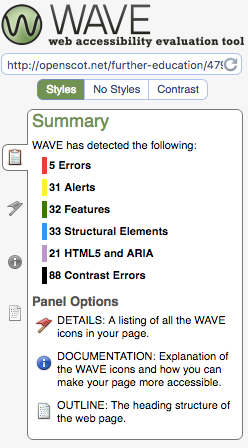
wave_outputThe blog I chose was the Open Scotland, a simple WordPress blog running on Reclaim Hosting and you can see the results here.  To be honest most of the errors and alerts didn’t surprise me as they relate to heading abuse and images without alt text.  One thing that did surprise me though is that justified text is problematic.

“Large blocks of justified text can negatively impact readability due to varying word/letter spacing and ‘rivers of white’ that flow through the text.”

This made me very sad, because I love justified text and I justify all my blog posts and documents.  I will have to try and wean myself off justification, starting here today.  I still think unjustified text looks messy though.

Also as an aside, when I used to work in technology standards development I had a very peripheral involvement in some of the web accessibility standards groups.  I was never actually a member of any of the working groups but I was occasionally called in to comment on metadata issues. Negotiating consensus in standards working groups is never an easy task but in the accessibility groups it could be particularly fraught, so kudos to all those to worked hard to bring these standards to fruition.

23 Things: Thing 5 Diversity

“A lot of communication online is now via the mode of emoji/emoticon images. Traditionally these have been displayed as a yellow standard, but recent releases of more diverse emoji choices have raised a number of conversations. Read the two articles on reactions to the Apple and Facebook release of diverse emoji/emoticons in 2015 and 2016. Now consider the emoji alternative Bitmoji
Thing 5 

To be honest I’m not big on avatars and emjois.  I used the same twitter avatar (a rather fetching picture of the back of my head) for nine years and only got round to changing it a couple of months ago :}  I also don’t use emojis very often so I’ve never really given much thought to who they may or may not represent.  Now I stop and think about it though, that lack of regard is a clear reflection of my own position of privilege.  I may not use emojis, but if I ever wanted to, it wouldn’t be difficult to find plenty that would broadly represent me.  So the article about the furore surrounding Apple’s multicultural icons certainly gave me pause for thought.  It also made me think of the recent news articles about Rayouf Alhumedhi, a Saudi teenager living in Germany who has submitted a proposal to the Unicode Consortium’s emoji subcommittee for the inclusion of hijab and keffiyeh wearing emojis. Motherboard quoted Alhumedhi as saying

“Emojis can seem like a trivial topic but people use emojis to represent themselves and their lives. When the different couples and different skin tone emojis were added there was a huge buzz, and this was because people finally felt represented and acknowledged, which is the same case with the headscarf emoji.”

Rayouf Alhumedhi

Rayouf Alhumedhi

There are several things I find really inspiring about this story. Firstly it’s about choice and empowerment.  Here is a young woman who felt she lacked representation online and took it upon herself to change that.  And secondly it’s about diversity and engagement with standards bodies.  The way that Alhumedhi went about creating an icon that represented herself was by submitting a proposal directly to the formal standards body that governs unicode emojis.  That takes some doing.  I worked with technology standards bodies for many years, though admittedly not the Unicode Consortium, and to say that women are underrepresented in these bodies would be something of an understatement. I got so used to being the only woman in the room that I stopped even noticing and I don’t think I ever encountered a woman of colour in any of the standards working groups I was involved with over a period of about fifteen years.  So more power to Alhumedhi for taking her campaign for representation straight to the body that governs the standard.  If we had more people like Alhumedhi involved in the the development of standards and software perhaps the web would be a more diverse and inclusive place and companies like Apple wouldn’t find themselves in such a mess when it comes to dealing with issues of race, representation and diversity.

Links
The Hijab Emoji Project
The Unicode Consortium
Unicode Emoji Subcommittee