2024 End of Year Reflection

It’s become a bit of a tradition for me to share an end of year reflection in January, I always intend to do this in December, but it never happens, so January it is. I’ve been in two minds whether to write one this year though because 2024 did not go as expected.

View from the ward

At the beginning of the year I woke up one morning and couldn’t feel my hands properly. That was the start of the rapid onset of a bewildering and debilitating range of symptoms. After numerous scans, tests, and two hospital admissions, I was eventually diagnosed with a rare autoimmune disease. It’s not curable, but it is treatable, with a lot of medication and mixed success.  I’ve been lucky to be more or less fit and healthy for most of my life, so to suddenly lose the ability to do so many things that I previously took for granted has been challenging to say the least.  I can no longer dance, sew, or wear my fancy shoes, writing is a challenge, walking is slooooow some days, and traveling any distance without assistance is difficult. Having to slow down has forced me to recenter and I’m still trying to figure out what life will be like from this point on, who I’ll be when I can no longer do so many of the things that make me who I am.  There’s very little data about how this condition is likely to progress, hopefully things will improve once we get the medication right, but who knows?  I’m just trying to take it as it comes. 

Despite all of the above, I’m still working with the OER Service at the University of Edinburgh. I’m immensely grateful to my colleagues for their support, and to my managers who have put adjustments in place to enable me to keep working from home. I really miss going over to the office in Edinburgh, but the four hour round trip is beyond me for the time being. I never thought I’d miss that Scotrail commute but here we are. 

OER24 Conference

MTU Cork

At the beginning of the year, before things took a turn for the worse, I went to the OER24 Conference in Cork with our OER Service intern Mayu Ishimoto, to present a paper on Empowering Student Engagement with Open Education.  It was great to be there with Mayu and there was a lot of interest in her experience as a student working with the OER Service. The highlight of the conference for me was undoubtedly Catherine Cronin and Laura Czerniewicz’s inspiring keynote, The future isn’t what it used to be: Open education at the crossroads, which explored their own lives and experiences as open educators and the possibilities generated by their profound and timely Higher Education for Good.  You can read my reflection on the the conference here OER24: Gathering Courage. Also! MTU has some really interesting architecture.

Their Finest Hour

Their Finest Hour project came to an end in June with the launch of the University of Oxford’s online archive of 25,000 new stories and artefacts from the Second World War, all of which have been shared under open licence.  I’m very proud that our Edinburgh collection day gathered and contributed 50 stories and many hundreds of photographs, thanks to the incredible work of project intern Eden Swimer.  You can read Eden’s thoughtful reflection on his internship here Reflections on ‘Their Finest Hour’.  I nominated Eden for an ISG Recognition Award in September and was delighted that he won the award for Student Staff Member of the Year. 

Learning Analytics

A fair chunk of my time last year was taken up with setting up and acting as business lead for a new learning analytics project. As part of the university’s VLE Excellence programme, the project aims to identify the learning analytics data available in Learn and other centrally supported learning technology applications, and enable staff and students to access and use it to support their teaching and learning.  It’s a long time since I’ve been involved in anything related to learning analytics so it’s been interesting to get my head back into this space again, particularly as the project is focused on empowering staff and students to access their own learning analytics data..  

EDE to DSDT

In October we had a small restructuring at work and my team moved from Educational Design and Engagement (EDE) into a new section, Digital Skills, Design and Training (DSDT). I’ve really enjoyed working in EDE over the last 5 years, and we’ll continue working closely with many of the services there, but I’m also excited about the opportunities the new section will bring.  I’m particularly looking forward to working with our Wikimedian in Residence again and exploring new open textbook projects with our Graphic Design Team.

AI and the Commons

I’ve been dipping my toes back into the murky waters of ethics, AI and the commons and have written a couple of blog posts on the ethics of AI in relation to OER and contested museum collections. 

All the other stuff…

Because my health has been so ropey, I’ve had to step back, hopefully temporarily, from most of the additional voluntary work I do, including assessing CMALT, sitting on award panels, contributing to City University of London’s MSc in Digital Literacies and Open Practice, and attending policy events.  I really miss the connections these activities used to bring so I’ve been trying to focus more on reconnecting through social media networks…. 

…which has been “interesting” given the hellscape of most social media platforms these days. I’ve barely used facebook for over a decade, though I still have an account there, primarily for finding last cats (long story). Twitter was always my main social media channel, I’ve had an account there since 2007, and it’s where I found my open education community. Seeing twitter degenerate into a fascist quagmire has made me so angry, however it was still a wrench to leave.  In March we mothballed the femedtech account, I stepped back from my own account later in the year, before finally deleting it. This was one of my last retweets. It seems fitting. 

I’ve been slowly migrating to Bluesky and Mastodon over the course of the year and it’s been great to start building new and old communities there. I like the different pace of the two platforms.  Bluesky feels like the place to keep up to date with news and events, while Mastodon provides space for slower, quieter, thoughtful conversations. 

This enforced slowing down, together with the changing social media landscape, has also prompted me to start blogging again. I hadn’t abandoned this blog completely but I’d definitely got out of the habit of writing here regularly. It’s been good to take the time to think and reflect again, and to try and express some of that reflection in words. At the end of the year I wrote a post about Slowing Down which really seemed to strike a chord with people. Across all these different spaces, it feels like little dormant shoots of community are reemerging. We need these human connections now more than ever. 

Beginnings and Endings

On a personal level September was a month of beginnings and endings. My daughter went off to university and it’s been great to see her stretch her wings and find her people. It’s also been illuminating to see the university’s systems from the student side.

In September we had to say goodbye to our beloved cat Josh.  He was magnificent, and he was my best boy, despite his habit of going round the neighbourhood scrounging for food and pretending to be a stray. He turned up twice on a local lost cats facebook group.  The shame.  I miss him terribly. 

Josh 2014 – 2024

I also had to say goodbye to our family home in Carriegreich on the Isle of Harris. This was my grandparents and then my father’s home and I spent a lot of time here during my childhood.  This is where I learned how to cast a line, set an (illegal) net and row a boat, collect the eggs and feed the sheep, tell a guillemot from a razorbill, pick up Russian klondykers on the ancient shortwave radio, and keep an eye out for the grey fishery protection vessels sliding out of the mist.  It’s where I spent hours wandering over the croft and the shore lost in other worlds. I very rarely remember dreams, but I still dream about this house and this shore.  We had hoped to visit the house one last time, but sadly that wasn’t possible because Josh was so unwell.  We said goodbye to Josh and to Carriegreich within the week.

Carriegreich

To try and make some sense of where I am now, I’ve been re-reading Ursula Le Guin’s Tehanu.  It’s always been one of my favourite Le Guin books, I love the writing and the pacing and the fact that it centres the experiences of an older woman finding her place and her power in a changing world through the different phases of her life. 

“Tenar sighed. There was nothing she could do, but there was always the next thing to be done.”

I’m not sure what I’ll be doing next, but I am sure there will always be something to be done. 

Open Education and AI: Proselytisers, prophets and poets.

I’ve been dipping my toes back into the debate about open education and AI over the last few weeks.  I stepped back from this space earlier in the year both for personal reasons and because I was getting a bit dispirited by the signal to noise ratio. It’s still a very noisy space, more so if anything, but there are some weel-kent voices emerging that are hard to ignore.

David Wiley laid out his stall last month in the webinar Why Open Education Will Become Generative AI Education, and his views have been predictably polarising. There have already been several thoughtful response to David, which I can highly recommend reading: 

I don’t want to repeat the very pertinent points that have already been made, but I do want to add my concerns about the staring point of David’s argument which is

“the primary goal of the open education movement has been to increase access to educational opportunities. The primary strategy for accomplishing this goal has been to increase access to educational materials. And the primary tactic for implementing this strategy has been to create and share OER.” 
~ Why Generative AI Is More Effective at Increasing Access to Educational Opportunity than OER

This is certainly one view of the open education movement, (which is by no means a homogenous entity), but open education isn’t just about goals, strategies and tactics, there are other perspectives that need to be taken into consideration.  I find this content centric view of open education a bit simplistic and reductive and I had hoped that we’d moved on from this by now.  I would suggest that the primary purpose of open education is to improve knowledge equity, support social justice, and increase diversity and inclusion. While content and OER have an important role to play, the way to do this is by sharing open practice. 

This slide in particular made me pause…

Leaving aside the use of the Two Concepts of Liberty, which is not unproblematic, I’m presuming “users” equates here to teachers and learners, which is a whole other topic of debate. It’s certainly true that open licences alone don’t grant the skills and expertise needed to engage in “high-demand revise and remix activities”, but I’m not sure anyone ever claimed they did? And yes GenAI could be a way to provide users with these skills, but at what cost? There’s little discussion here about the ethical issues of copyright theft, algorithmic bias, exploitation of labour, and the catastrophic environmental impact of AI. Surely a more responsible and sustainable way to gain these skills and expertise is to connect with other teachers and learners, other human beings, and by sharing our pedagogy and practice? While there’s a certain logic to David’s hypothesis, it doesn’t take into account the diversity of practice that can make open education so empowering. 

Aside from the prediction that Generative AI Education will save / replace / supersede OER, I couldn’t help feeling that there is still an underlying assumption that OER = open textbooks. (This was also an issue I had with one of the keynotes at this year’s OER24 Conference) It shouldn’t need saying, but there are myriad kinds of open resources above and beyond open textbooks.  What about student co-created OER for example? It’s through the process of creation, of gathering information, of developing digital and copyright literacy skills, of formulating knowledge and understanding, that learning takes place.  The OER, the content created, is a valuable  tangible output of that process, but it’s not the most important thing. If we ask GenAI to produce our OER, what happens to the process of learning by doing, creating and connecting with other human beings? 

This issue was touched on by Maren Deepwell and Audrey Watters in the most recent episode of Maren’s brilliant Leading Virtual Teams podcast.  It’s been really inspiring  to see Audrey re-enter the fray of education technology criticism.  We need her clear incisive voice and fearless critique now more than ever.  

Touching on the language we use to talk about AI, Audrey reminded us that “Human memory and computer memory are not the same thing.” And in her The Extra Mile newsletter she says:

“I do not believe that the machine is or can be “intelligent” in the way that a human can. I don’t think that generative AI and LLMs work the same way my mind does.” 

This very much called to mind Helen Beetham’s thoughtful perspective on ethics and AI at the ALT Winter Summit last year where she said that “generative”, “intelligence”, and “artificial” are all deeply problematic concepts.  

“Every definition is an abstraction made from an engineering perspective, while neglecting other aspects of human intelligence.”

Towards the end of the podcast, Maren and Audrey talked about the importance of the embodied nature of being and learning, how we tap into such a deep well of embodied knowledge when we learn. It’s unthinkable to outsource this to AI, for the simple reason that AI is stupid. 

The embodied human nature of learning was also the theme of Marjorie Lotfi’s beautiful six-part poem, Interrogating Learning, commissioned by Edinburgh Futures Institute for the inaugural event of their Learning Curves Future of Education series. Marjorie weaves together the voices of displaced women and, I believe, speaks more deeply about what it means to learn than any disembodied “artificial intelligence” ever could. 

What have you learned?

When asked this question how will a woman answer?

For a moment she’s back in her mother’s belly
a heart beating out a rush of cortisol
or a warm dream of sleep listening through a barrier of skin and blood
before even her own first breath.

And then the day she’s born
blinking at the bright of daylight, candle, bulb,
hearing the low buzz of electric
and the sudden clarity of a voice she knows already.
Learning it again.

There have been a thousand things to learn in every day I’ve been alive,
the woman thinks,
and I am 53 this year.

2023 End of Year Reflection

Posting an end of year round up at the end of January might seem a bit daft, but I’m already one step ahead of last year, when I posted my end of year reflection in February! 

The beginning of the year was a succession of real highs and lows.  UCU entered a long phase of industrial action which came at a particularly challenging time for me as January and February is usually when I’m preparing for Open Education Week and the OER Conference.  However I also took some time out for a trip to New York with friends, which turned out to be one of the high points of my year. 

Open Education Week

For Open Education Week we ran a webinar that celebrated 10 years of open course development at the University of Edinburgh and shared the open course creation workflow that we’ve developed and refined over the years. 


OER23 Conference

It was great to see the OER Conference returning to Scotland in March when it was hosted by UHI in Inverness.  Inverness is a place that is very close to my heart as it’s the main city in the Highlands and it’s also were we used to go on holiday when I was a kid.  Inverness is still a stopping off point on the journey home when I go to visit family in Stornoway so I had a slightly weird feeling of nostalgia and home-sickness while I was there, it was odd being in Inverness and not traveling on further north and west. 

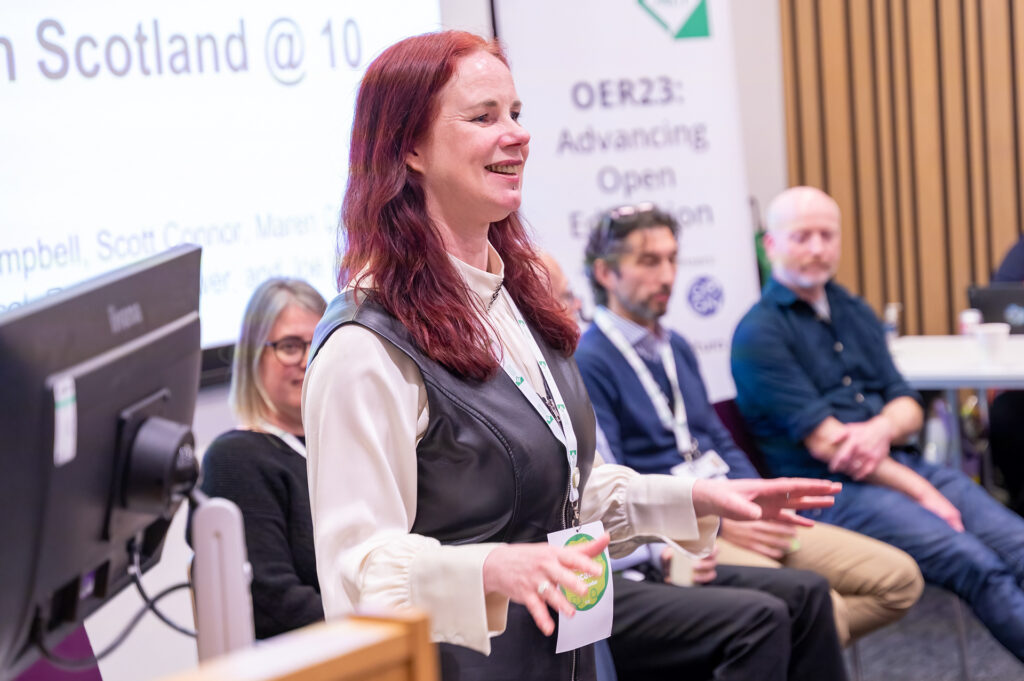
One of the themes of this years conference was Open Scotland +10 and Joe Wilson and I ran a number of sessions including a pre-conference workshop and closing plenary to reflect on how the open education landscape in Scotland has evolved over the last decade, and to discuss potential ways to advance open education across all sectors of Scottish education. 

Photograph of Open Scotland Plenary Panel at the OER23 Conference.

Open Scotland Plenary Panel by Tim Winterburn.
Here, the closing Panel Plenary session

Generative AI

Like many working in technical, educational and creative sectors I found it impossible to ignore the discourse around generative AI, though I hope I managed to avoid getting swept up in the hype and catastrophising.  In July I wrote an off-the-cuff summary of some of the many ethical issues related to generative AI and LLMs that are becoming increasingly hard to ignore: Generative AI – Ethics all the way down.  I appreciated having an opportunity to revisit these issues again at the end of the year when I joined the ALT Winter Summit on Ethics and Artificial Intelligence which provided much food for thought. Helen Beetham’s keynote Whose Ethics? Whose AI? A relational approach to the challenge of ethical AI was particularly thoughtful and thought provoking. 

Student Interns

Much of the summer was taken up with recruiting and managing our Open Content Curator student interns.  It’s always a joy working with our interns, their energy and enthusiasm is endlessly inspiring, and this year’s interns, August and Mayu, were no exception. I suggested it might be fun for them to interview each other about their experience of working with the OER Service and, with the help of our fabulous Media Team, they produced this lovely video. 


I was delighted when August and Mayu were shortlisted for the Student Employee of the Year Award in Information Services Group’s Staff Recognition Awards, in acknowledgement of their outstanding work with the OER Service and their wider contribution to ISG and the University. 

Their Finest Hour

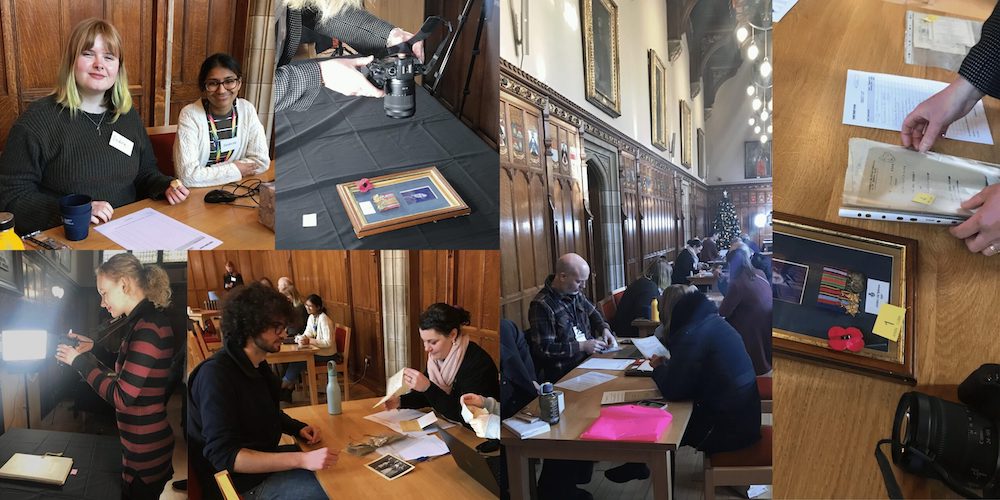
The OER Service welcomed another student intern in the summer, Eden Swimer, who joined us to help run a digital collection day as part of the University of Oxford’s Their Finest Hour, a National Lottery Heritage funded project at the University of Oxford, which is collecting and preserving the everyday stories and objects of the Second World War. Organising and running the digital collection day proved to be a huge undertaking and we couldn’t have done it without the help of 26 volunteers from across ISG and beyond who committed so much time and energy to the project.  


The digital collection day took place in Rainy Hall, New College at the end of November and it was a huge success. Over 100 visitors attended and volunteers recorded over 50 interviews and took thousands of photographs, all of which will be uploaded to an open licensed archive that will be launched by the University of Oxford in June this year.  It was a deeply moving event, many of the stories recorded were truly remarkable and the visitors clearly appreciated having the opportunity to share their families stories.  In some cases these stories were being told by the last surviving relatives of those who had witnessed the historic events of WW2 and there was a real sense of preserving their experiences for posterity. 

Their Finest Hour digital collection day by Fiona Hendrie

The collection day was covered by STV and you can see a short clip of their news item here: Second World War memories to be preserved at university collection day

Publications

It was a privilege to work with co-authors Frances Bell, Lou Mycroft, Guilia Forsythe and Anne-Marie Scot to contribute a chapter on the “FemEdTech Quilt of Care and Justice in Open Education” to Catherine Cronin and Laura Czerniewicz’s timely and necessary Higher Education for Good: Teaching and Learning Futures. 

“Quilting has always been a communal activity and, most often, women’s activity. It provides a space where women are in control of their own labour: a space where they can come together to share their skill, pass on their craft, tell their stories, and find support. These spaces stand outside the neoliberal institutions that seek to appropriate and exploit our labour, our skill, and our care. The FemEdTech-quilt assemblage has provided a space for women and male allies from all over the world to collaborate, to share their skills, their stories, their inspiration, and their creativity. We, the writers of this chapter, are five humans who each has engaged with the FemEdTech Quilt of Care and Justice in Open Education in different ways, and who all have been active in the FemEdTech network.” 

I was also invited to submit a paper to a special open education practice edition of Edutec Journal.  Ewan McAndrew, Melissa Highton and I co-authored a paper on “Supporting open education practice: Reflective case studies from the University of Edinburgh.”

“This paper outlines the University of Edinburgh’s long-running strategic commitment to supporting sustainable open education practice (OEP) across the institution. It highlights how the University provides underpinning support and digital capability for OEP through central services working with policy makers, partners, students, and academics to support co-creation and active creation and use of open educational resources to develop digital literacy skills, transferable attributes, and learning enhancement. We present a range of case studies and exemplars of authentic OEP evidenced by reflective practice and semi-structured ethnographic interviews, including Wikimedia in the Curriculum initiatives, open textbook production, and co-creation of interdisciplinary STEM engagement resources for schools. The paper includes recommendations and considerations, providing a blueprint that other institutions can adopt to encourage sustainable OEP. Our experience shows that mainstreaming strategic support for OEP is key to ensuring inclusive and equitable quality education and promoting lifelong learning opportunities for all.”

Writing this paper was an interesting experience as Edutec is a research journal that expects evidence to be presented in a very particular way.  As a service division, we support practice rather than undertaking academic research, so the case studies we present are based on authentic reflective practice rather than empirical research, however it was useful to think about this practice from a different perspective. 

Wikimedia UK

In July I was awarded Honorary Membership of Wikimedia UK in recognition of my contribution to the work of the charity during my six years as a Trustee. When my term as a trustee came to an end, I was hoping that I’d have more time to contribute to the Wikimedia projects.  That hasn’t quite happened, I didn’t manage to do any Wikipedia editing in 2023, but I did enjoy taking part in Wiki Loves Monuments again.  I also digitised some pictures I took of the Glasgow Garden festival way back in 1988 and uploaded them to Wikimedia Commons to share them with the fabulous After the Garden Festival project, which is attempting to locate and archive the legacy of the festival. 

Teddy Bears Picnic, sponsored by Moray District Council. CC BY, Lorna M. Campbell on Wikimedia Commons.

ALT

I made short-lived trip to the ALT Conference in Warwick in September.  Unfortunately I  had to leave early as I came down with a stinking cold. I was really disappointed to have to miss most of the conference as it was outgoing CEO Maren Deepwell’s last event and I was also due to receive an Honorary Life Membership of ALT award. It was a huge honour to receive this award as ALT has been a significant part of my professional life for over two decades now.  You can read my short reflection on the award here: Honorary Life Membership of ALT. 

For almost three decades Lorna has been a champion of equitable higher education and an open education activist. Lorna ‘s lifelong commitment to and passion for equality and diversity clearly is evident in her work, yet Lorna tends not to push herself forward and celebrate – or even self-acknowledge – her many achievements. 
~ ALT press release.

Kenneth White, 1936 – 2023

I was deeply saddened to hear of the death of Kenneth White in August.  Despite being an avid reader of Scottish poetry, and having studied Scottish Literature at Glasgow University for a couple of years, I hadn’t come across White until my partner introduced me to him in 2002.  His absence from Glasgow’s curriculum, and indeed his relative obscurity in his homeland, is striking given that he was a graduate of Glasgow University who went on to become the chair of 20th century poetics at Paris-Sorbonne. White, however, has always been a writer who divides the critics, particularly in Scotland. A poet, writer, philosopher, traveller, and self-identified transcendental Scot, White founded the International Institute of GeoPoetics and was a regular visitor to the Edinburgh International Book Festival, where I was fortunate to see him read.  To say that White’s writing, particularly his meditations on openness and the Atlantic edge, had a profound effect on me, is something of an understatement. This blog is named after the title of White’s collected poetic works and his lines frequently find their way into more unguarded pieces I’ve written.  I’ll leave you with a few words from the man himself. 

Image of the coast with the words of Scotia Deserta by Kenneth White.

Keep Yourself Warm

I was so very, very saddened to hear of the death of Scott Hutchison, singer and lyricist of Frightened Rabbit today. I only came across the band a couple of years ago but I was deeply moved by Scott’s songs. He was a phenomenally talented writer and his songs uniquely captured the struggles so many face with alienation, depression, isolation and addiction.  Scott faced all these demons in true Scottish style; with scathing wit, self-effacing humour and heartbreaking poetry. Seeing the outpouring of grief today, it’s clear that his songs helped many people who couldn’t find the words to speak for themselves.

I saw Frightened Rabbit play live a couple of times, I heard them bring the house down in Barrowlands in December 2016, and just a few months ago I squeezed into a rammed Academy for the 10th anniversary tour of The Midnight Organ Fight.   One thing really struck me about that last gig, half way through the set the band played Poke, a very poignant, very grown up song about the kind of break up we’ve all been through. What was really striking about that song, on that night, was that the sound of the audience singing suddenly changed and for those glorious 3 minutes it was the voices of all the women in the crowd that raised the rafters. I think I may have shed a tear, I’ve certainly shed more that a few today.

Rest well now Scott and keep yourself warm.

Frightened Rabbit, Barrowlands Ballroom, December 2016. CC BY, Lorna M. Campbell

The Cost of Freedom – What is Open?

Another gem from The Cost of Freedom project, this time by Richard Goodman (@bulgenen), my partner in crime from the ALTC-2016 social media team.  I was chuffed to bits when Rich decided to write something for the project.  You can read his poem What is Open? here.

As part of disquiet Junto Project 0202 Text-to-Speech-to-Free Rich’s poem has also been recorded by Michel Banabila who created this amazingly atmospheric remix.

Links