Other Voices

This piece was originally posted on femedtech.net

I’m not entirely sure where I’m going with this post, tbh I’m not even sure what it is I’m trying to say, but I have a gut feeling that something needs to be said about the historiography of the open movement. Who is it that writes that history? Whose voices do we choose to amplify? Whose contributions do we remember and celebrate? Whose are forgotten and silenced? How do we acknowledge the contribution of individuals whose personal ethics and politics are often at odds with our open feminist practice? I’m talking about the saints and messiahs, the ideologues and homesteaders, the founding fathers and benevolent dictators. Men who have played an undeniable role in shaping concepts of openness in the domain of technology, but whose personal ethics may be wildly out of tune with many of the values we hold dear in the open education community; equality, diversity, inclusion, social justice.

As a sometime-historian, this is a dilemma, and I realise that even by writing this post I’m perpetuating the narrative that certain individuals are central to any understanding and history of open. I also realise that much more thoughtful writers than me have examined the history of openness and technology through a nuanced and critical lens. Audrey Watters has written extensively about our collective amnesia when it comes to the history of ed tech, and Mar Hicks has published widely about how women suffered the double ignominy of first being discarded by the UK computer industry and then being written out of its history all together.

Of course it’s possible to acknowledge the importance of ideas, while purposefully “forgetting” where they came from, to retain the ideas, but write their authors out of history. But I’m really uneasy about separating the message from the messenger like this, because I think our beliefs are, to a greater or lesser degree, codified in our ideas. Our ideas are shaped by who we are, by our personal ethics and belief systems, by our view of the world around us.   If we purposefully forget where some of the ideas that have shaped our concepts of openness have come from, and how they have been formed, we run the risk of sleep walking into a future where open education is for the few not the many, and where openness simply reinforces real world injustices and inequalities.

Following the lead of writers like Audrey and Mar we need to construct our own diverse and inclusive narrative and historiography of openness. We need to understand how people’s views are reflected in their work and we need to approach them critically and reflectively. We can’t write people out of history, and nor should we attempt to do so, but we can choose whose voices we amplify, whose we listen to, whose we hear. And we also need to learn to listen to the silences, to identify whose voices have been elided and excluded from narratives of open.   We need to be thoughtful and critical and open minded. We need to listen to other voices.


Some comments on this blog post from twitter:

Open Practice and Invisible Labour

This piece was originally posted on femedtech.net.

Something has been niggling at me for ages now. Something about digital labour and open education. I’ve been struggling to figure out how to frame this and what I’m trying to say, but Martin Weller’s thoughtful blog post on gatherer calories and invisible artefacts and Frances Bell’s subsequent comment gave me a starting point.

On the blogging calories front, there have been 6 guest OER19 posts so far, with 11 authors, all women

Catherine Cronin has eloquently reminded us that openness is a continually negotiated space, a constantly negotiated practice. We all experience openness differently, from different perspectives and different positions of privilege and discrimination. For some of us, open education is part of our job, for some it’s our research, our field of study, for some it’s a philosophy, an ethos, a personal commitment, for some it’s political. For many it’s all of the above.

I am privileged to be able to work in the area of open education and I also regard myself as an open education practitioner. My open practice is expressed in different ways; I read, I write, I comment, I blog, I participate in the femedtech network, I contribute to Wikipedia. It’s a practice that extends far beyond the bounds of my job and I have no complaint with that, quite the opposite in fact, I appreciate this blurring of my institutional role with my personal commitment to openness. That’s part of my privileged experience of openness. However the blurring of these boundaries also raises issues of digital labour.

We all have a deep personal commitment to our practice, to equity and openness, we all want to be good citizens of the open community, making a positive contribution to the commons, but when do the hours that we willingly devote to open education start to become unacknowledged, invisible digital labour? And as both Frances and Martin have pointed out, so often those that go the extra mile are those who are marginalised in some way, women, people of colour, early career researchers, those employed on precarious contracts. At what point does personal commitment become unwitting exploitation of labour?

These are problems that exist right across academia of course and open education is far from immune. How much does the open community rely on invisible digital labour? How far does it exclude those who are unable or unwilling to contribute their labour for free? And how do we mitigate this?

This thread from @HEreflections1 caught my attention on twitter last week:

One of the most pernicious aspects of stress, anxiety and burnout in education is that it often starts with individuals who work longer hours through enjoyment and an ethic of care. But at some point the organisation captures this as core work which has to be done.

As a result the enjoyment, the agency is lost and the stress begins to grow, leading eventually to hate and/or exhaustion in some cases. And it creeps up on people so that they blame themselves. This is the failure of the system, and any discussion of well-being or

expert groups focusing on happiness misses the point completely. What starts with dignity and vocation is smashed by performativity, by human as resource, and by an inability to see education as a community.

The point that particularly struck me was this:

What starts with dignity and vocation is smashed by performativity

And this was echoed by Laura Czerniewicz during this week’s OER19 preview webinar when she cautioned that

“Good intentions can undermine themselves with unintended consequences.”

When so much of our open practice is mediated through social networks there is sometimes a pressure to always be “on”, to always be commenting and contributing, to always to be seen to be doing. And it was this that prompted me to ask this question in our femedtech OER19 Open Space

If there a performative aspect to openness, what does it achieve and how?

I don’t have an answer to this question, and I’m not even sure I know where I’m going with this yet, but I do think we do need to be able to balance our agency as open practitioners and citizens of the global open education community with cognisance that it is our digital labour that sustains that community at both the personal and institutional level.

Inspiring students, pioneering women and virtual dragons

February and March are always busy months for Open Education and this year was no exception, with the University’s Festival of Creative Learning, Open Education Week and International Women’s Day all coming back to back.

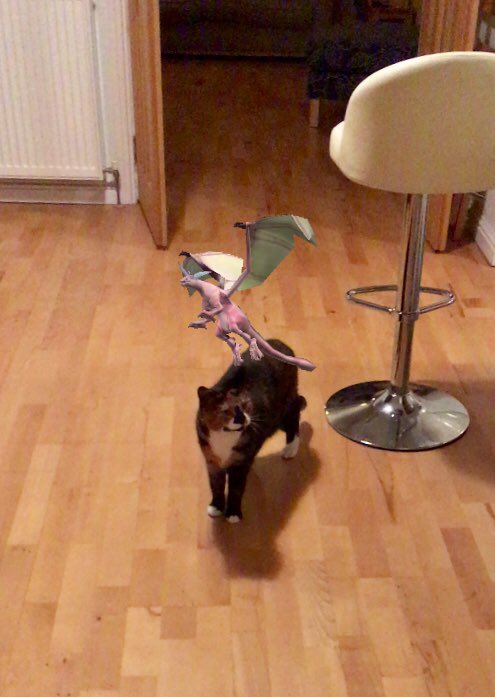
Niko is unimpressed…, CC BY, Lorna M. Campbell

The fun and games kicked off with Festival of Creative Learning in mid February.  My OER Service colleague Charlie ran a really fun and thought provoking 23 Things for Digital Confidence workshop.  The workshop challenged us to explore how we engage with technology in creative ways and we also got to play with some really cool augmented reality toys.  Oh, and there were dragons!  I took them home but I don’t think my cat was very impressed :}

Later in the week I helped to run a Get Blogging! workshop with Karen, Lila and Mark from DLAM, which guided students through the process of setting up a blog on Reclaim Hosting and provided them with some pointers on the benefits of blogging and topics they could write about.  I don’t usually get to work directly with undergraduate students so it was a really rewarding experience.  Their enthusiasm was infectious and it was great to see how proud and excited they were to leave at the end of the day with their very own brand new blog.  The fabulous feedback the students left was just the icing on the cake.  My slides from the day are here: Why Blog?

At the beginning of March we celebrated Open Education Week, I’ve already written a post about the activities we planned over the course of the week, and they all went really well.  We curated eight blog posts from staff, students and graduates on the Open.Ed blog over the course of the week, each bringing a unique perspective on engaging with open education. You can read a round-up of of these posts here.  I particularly like this quote from Martin Tasker, our very first Open Content Curation Intern, who is now building a career as a software engineer.

“In an age where where the world is both more connected and less trusting than ever, the onus is on institutions such as universities to use their reputations and resources to promote open education. As well as benefiting the public, it benefits the institutions themselves – there’s little better in the way of marketing than having potential applicants having already experienced some learning at your institution.” 

I’ve often quoted Martin’s Open Content Curation blog posts when I talk, and I’m sure I’ll be quoting his Open Education Week blog post, Reflecting on the Importance of Open Education, too.  

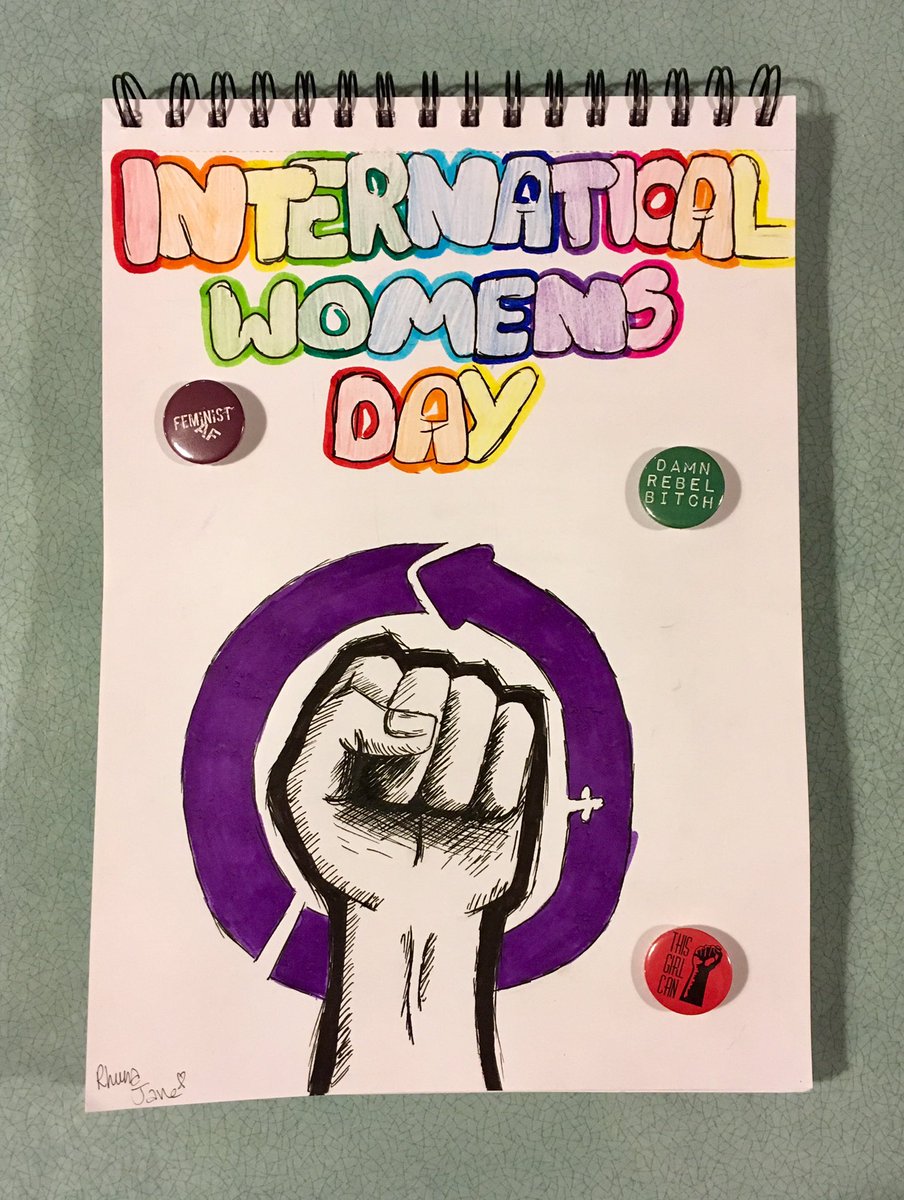
My daughter’s contribution to International Women’s Day, CC BY SA, RJ McCartney

International Women’s Day fell at the end of Open Education Week and Information Services marked the event by hosting a Women of Edinburgh Wikipedia Editathon and naming the Board Room in Argyle House after Brenda Moon, the first woman to head up a research university library in the 1980s, and who played a major role in bringing the University into the digital age. I spent part of the day updating the Wikipedia entry I’d previously written about Mary Susan McIntosh to include information about her work as a Women’s Rights Advocate campaigning for legal and financial rights for married and co-habiting women, defending the right to sexual expression, and arguing against censorship of pornography.  

The following week I was off down to UCL for their Open Education Symposium.  It was a privilege to be invited to share the University of Edinburgh’s strategic approach to Open Education, and it was great to hear about some of ways that openness is supported across UCL.  I particularly enjoyed hearing a group of Arts and Sciences BASc students reflecting on their positive experience of engaging with Wikibooks.  Their comments reflected those of our Edinburgh student who have participated in Wikipedia assignments and editathons. 

Somehow, in amongst all that, there was also several ALTC submissions, the launch of femedtech.net, and my daughter’s 13th birthday.  How the hell did that happen?! 

Sustainable Support for OER

This blog post was originally posted on Open.Ed as part of a series of posts for Open Education Week 2019. 

Sustainability is key to supporting open education and OER, and one factor that lays the foundations for sustainability is aligning the value proposition for OER with an organisation’s institutional mission and strategic vision.

At the University of Edinburgh, we believe that supporting OER is squarely in line with our institutional mission and vision to provide the highest quality learning and teaching environment for the greater wellbeing of our students, challenging the boundaries of knowledge, and making a significant, sustainable and socially responsible contribution to Scotland, the UK and the world.

In 2016 the University launched an OER Service, based in Information Services Group, to support the institution’s new OER Policy.  This policy, which encourages staff and students to use, create and publish OERs to enhance the quality of the student experience, was approved by the University’s Learning and Teaching Committee, situating OER directly in the domain of teaching and learning.  Both the policy and the service are part of the University’s strategic vision for OER which is founded on traditions of the Scottish Enlightenment, excellent education and research collections, and the University’s civic mission.

At the University of Edinburgh one of the key value proposition for OER is that it mitigates the risk of what Melissa Highton, Director of Learning, Teaching and Web services division, and the architect of the University’s OER vision, has referred to as copyright debt; the cost and risk accrued when copyright of teaching and learning resources is not cleared and they are upload to institutional systems.

In order to develop a sustainable approach to address this issue, the OER Service focuses on developing digital skills, copyright and information literacy for staff and students in schools and colleges across the University.  The OER Service embeds digital skills training and support in the institution’s strategic initiatives including lecture recording, academic blogging, VLE foundations, MOOCs and distance learning at scale, to build sustainability, enhance digital literacy, and minimise the risk of technical debt. 

The wide range of digital skills development activities supported by the OER Service includes online courses such as the award winning 23 Things for Digital Knowledge, playful learning initiatives such as Board Game Jams and Gif It Up!, workshops including Blogging to Build Your Professional Profile, and student internships.  All the digital skills training materials we create for these activities are made available as CC BY  licensed open educational resources from our Edinburgh’s OERs showcase.  We hope you find these resources useful.

Happy Birthday Wikipedia!

Wikipedia turns 18 today!  Hurray!  I hope it doesn’t go out and get completely hammered and wake up in the morning with no memory of how it got home.   To celebrate this momentous occasion, Wikimedia UK has asked us all to tell them why we value Wikipedia.

  • What does Wikipedia mean to you?

The power of open knowledge at your fingertips!

  • Why do you think people should value Wikipedia?

Used correctly, Wikipedia is an invaluable source of open knowledge.  It’s one of the few truly open and transparent sources of knowledge and information on the web.  Its very existence is a testament to human ingenuity and perseverance, and a challenge to those who seek to manipulate and restrict access to knowledge and information.

Also it’s dead handy when you need to know the population of villages in Fife.

  • What would you say to someone to encourage them to become a Wikipedia editor?

Wikipedia is an amazing achievement but we still have so much work to do.  The encyclopaedia is a reflection of the world and the people who edit it and as such it mirrors all our inequalities, prejudices and power structures.  If we want Wikipedia to be more diverse, more inclusive and more representative, then we need to encourage more people, and specifically more women and minorities, to edit.  Now more so than ever, open knowledge is far too important to be left in the hands of the few.

Ewan McAndrew, our fabulous Wikimedian in Residence at the University of Edinburgh, often reminds us that the number of Very Active editors (i.e. more than 100 contributions in a given month) on English Wikipedia is just over 3,000, which is roughly equivalent to the population of a small village in Fife.  Anstruther for example.  Imagine the sum of all knowledge being left in the hands of Fifers?!  Perish the thought!  You know what you have to do….Edit!

Anstruther from Kirkyard, CC0, Poliphilo, Wikimedia Commons

Disclaimer: I’m sure Anstruther is lovely.

Wiki Loves Monuments 2018

Smailholm Tower, by Keith Proven, Wikimedia Commons, CC BY-SA 4.0

Tomorrow marks the start of Wiki Loves Monuments, Wikimedia’s annual photography competition, which runs throughout the month of September. The rules are simple, all you need to do is register a Wikimedia Commons account, take an original picture of a scheduled monument or listed building, and upload it to Wikimedia Commons using this interactive map. In addition to the overall prizes for the best UK entries, this year there are new prizes, sponsored by Archaeology Scotland, for the best three images of Scottish monuments. There are also going to be prizes for the photographer who uploads the largest number of images of monuments that are not currently represented on Wikimedia Commons.  For further information you can contact Wikimedia UK’s Scotland Coordinator Sara Thomas.

The best thing about Wiki Loves Monuments, is that anyone can enter. You don’t need a fancy camera, you don’t need to be a history geek, and you don’t even need to go out of your way to photograph historic monuments, most of us pass dozens of listed buildings on our way to and from work every day. All you need to do is check the map for monuments near you, take a snap with your phone, upload it to Commons and voila!

I had great fun taking part in the competition last year and managed to upload 184 images, just a fraction of the amazing 1,351 uploaded by colleagues from the University of Edinburgh during the competition.  Most of the pictures I entered were old holiday snaps, and though I may not have won any prizes, it really is the taking part that counts.  It’s great to be able to make a contribution to the Commons. It’s also nice to see some of these open licensed pictures taking on a life of their own after the competition. My picture of Culzean Castle, which appears on the Wikipedia page about the film The Wicker Man, has now been viewed over 28,000 times.  And a picture I took of the Circular Records Hall at the National Archives of Scotland featured in an article in Atlas Obscura.

I’ll be raking through my old holiday snaps again this year, but I’ve also got a whole bunch of new pictures ready to upload that I took during my summer holidays in Galloway and the Outer Hebrides. Some of these pictures are places I have a real personal connection to; houses I passed every day as a child, my old school, the church that witnessed all my family’s births, deaths and marriages, the clock tower that’s all that remains of the building where my mother went to school in the 1940s, the castle where my granny worked as a cook. Others are monuments I stumbled on by accident, like the tiny Arts and Crafts church in Galloway, or snapped from the side of the road, like Cardoness Castle. I even have a picture of a 16th century cats paw print from Glen Luce Abbey chapter house!  I wonder where it will end up?

Cat's paw print from Glenluce Abbey Capter House

Pangur Ban? Cat’s paw print from Glenluce Abbey Chapter House. CC BY SA, Lorna M. Campbell

Open.Ed at RepoFringe18

Way back at the beginning of July my lovely OER Service colleague Charlie and I had a 10X10 presentation accepted for the the Repository Fringe conference. We agreed that I would write the talk and Charlie would go along and present on the day.  Alas disaster struck and poor Charlie came down with a nasty bug, so our fabulous Wikimedian in Residence Ewan McAndrew stepped in to save the day and present on our behalf.  Not All Heroes Wear Capes.  So here I am (very) belatedly posting the script and slides from that presentation.

The University of Edinburgh’s OER Service is based within information Services and provides staff and students with practical advice and guidance on creating, finding and using open educational resources.  Charlie Farley and Lorna Campbell run a wide range of workshops and initiatives within the University and beyond, and also maintain Open.Ed which provides a one stop shop to access open educational resources produced by staff and students across the university.  The University does not have a single OER Repository, instead we have multiple repositories across the institution for different kinds of content and we believe in sharing our open resources where ever they will be found most easily, e.g. Media Hopper Create, flickr, Vimeo, Sketchfab, TES, etc.

OER Mission, Vision and Policy

  • Provide the highest quality learning and teaching environment for the greater wellbeing of our students
  • Make a significant, sustainable and socially responsible contribution to Scotland, the UK and the world.
  • OER Vision draws on history of the Edinburgh Settlement, excellent education and research collections, traditions of the Enlightenment.
  • OER Policy encourages staff and students to use, create and publish OERs to enhance the quality of the student experience.

At Edinburgh we believe that open education is strongly in line with our institutional mission to provide the highest quality learning and teaching environment for the greater wellbeing of our students, and to make a significant, sustainable and socially responsible contribution to Scotland, the UK and the world, promoting health and economic and cultural wellbeing.

Our vision for OER builds on our excellent education and research collections, traditions of the Scottish Enlightenment and the university’s civic mission.   In addition to the OER Service, this vision is backed up by our OER Policy which encourages both staff and students to engage with the use and creation of OER and open knowledge, to enhance the quality of the student experience while at the same time making a significant contribution to the cultural and digital commons.

OER for Digital Skills

OER can help to develop digital skills for both staff and students. 23 Things for Digital Knowledge is an award winning, open online course, adapted from an open course developed by the University of Oxford.  23 Things is designed to encourage digital literacy by exposing learners to a wide range of digital tools for personal and professional development. Learners spend a little time each week, building up and expanding their digital skills and are encouraged to share their experiences with others.  All course content and materials are licensed under a CC BY licence and the University actively encourages others to take and adapt the course. The course has already been used by many individuals and organisations outwith Edinburgh and it has recently been adapted for use by the Scottish Social Services Council.

OER for Equality and Diversity

OER can make a significant contribution to diversifying the curriculum.  A number of studies, including the National LGBT Survey released by the Government today, have shown that lesbian, gay, bisexual and transsexual health is not well-covered in Medical curricula, however knowledge of LGBT health and of the sensitivities needed to treat LGBT patients are valuable skills for qualifying doctors.

Using materials from the commons, a project at the University of Edinburgh, LGBT+ Healthcare 101, sought to address the lack of teaching on LGBT health within the curriculum through OER.  The project remixed and repurposed resources originally created by Case Western Reserve University, and then contributed these resources back to the commons as CC BY licensed OER.  New open resources including digital stories recorded from patient interviews, and resources for Secondary School children of all ages, were also created and released as CC BY OER.

OER for Knowledge Exchange

Open access makes research outputs freely accessible to all. It allows research to be disseminated quickly and widely, the research process to operate more efficiently, and has the potential to increase use and understanding of research by the wider public.  However it is not always easy for those outwith academia to know how to access these outputs, even though they are freely and openly available.   In order to address this issue, we’ve created a series of open educational resources in the form of video interviews and case studies called Innovating with Open Knowledge.  These resources are aimed at creative individuals, private researchers, and entrepreneurs to provide guidance on how to find and access the open outputs of Higher Education.  The resources focus on developing digital and data literacy skills and feature case study interviews with creative individuals and entrepreneurs engaging with the University of Edinburgh’s world class research outputs.

OER and Co-creation 

We believe strongly in engaging both staff and students in the co-creation of open education and one hugely successful example of this is the School of Geosciences Outreach and Engagement course.  Over two semesters, students develop an outreach project that communicates an element of GeoSciences outside the university community.  Students work with schools, museums, and community groups to create a wide range of resources for science engagement. Students gain experience of science outreach, public engagement, and knowledge transfer while working in new environments and developing transferable skills to enhance employability.  A key element of the course is to develop reusable resources which are then repurposed by our Open Content Curation Interns to create OER that are then shared online through Open.Ed and TES where they could be found and reused by other teachers and learners.

e.g. The Sea-Level Story, http://open.ed.ac.uk/the-sea-level-story-geoscience/

Open Content Curation Student Interns 

Open Content Curation student interns play an important role in OER creation at the University.  These fully-paid interns help to repurpose and share resources created by staff and other students while at the same time developing their own digital literacy skills. We’re now in the third year of this internship and the feedback we’ve received from the students has been nothing short of inspiring. This is Tomas Sanders who worked as our Open Content Curation Intern last year, and who then went on to run a successful Wikipedia editathon for Black History Month with the student History Society.


OER for Playful Learning

The OER Service also runs a wide range of events that develop playful and creative strategies for finding and reusing open licensed content.  Board Game Jam is a popular workshop that leads groups through creating, licensing, and sharing an OER board game using digitised images from the University collections.  It’s a fun and creative way to teach copyright and open licensing by stealth.   GifItUp is another workshop that provides an introduction to creating GIFs using free and open tools and openly licensed and public domain images.  It teaches colleagues how to find and use open licensed public heritage content and encourages discussion of the ethical responsibilities we as creators have towards those materials.

OER for Creativity

Eric Lucey was a pioneering biologist and film maker at the University of Edinburgh whose film collection from the 1950s and 60s has now been made available under open license by University’s Centre for Research Collections. With help and guidance from the OER Service on open licensing and content reuse, students from Edinburgh College of Art and the Edinburgh Film Society have created film poems from the Lucey collection for the Magma Poetry journal.  And we’ve also released open film snippets from our MOOC content that can be reused in a wide range of creative contexts.

These are just a few examples of how the OER Services encourages staff and students at the University of Edinburgh to engage with and contribute to a wide range of open content collections, while enhancing their own digital skills and contributing resources back to the digital commons.

Circular Records Hall on Atlas Obscura

I was quietly chuffed a couple of weeks ago when one of my photographs was featured in Atlas Obscura, and even more so, because the picture in question was one that I uploaded to Wikimedia Commons as part of the Wiki Loves Monuments competition last year.  See?  Good things happen when you contribute to the Commons.  You can read the Atlas Obscura article here: General Register Building of the National Archives of Scotland, and the original image is available on Wikimedia Commons here: General Register Office, Circular Record Hall.

I actually snapped this picture during a consultation meeting on the Scottish Government’s Digital Educations strategy a few years ago and as far as I ca recall it was taken on an ancient beaten up old iPhone.

Reflections on CELT Symposium 2018

I was delighted to have the opportunity to visit NUI Galway last week for the annual CELT Symposium. It was the first time I’d been to Galway, but it reminded me a lot of a (much!) bigger version of my home town of Stornoway in the Western Isles so it felt a bit like home away from home.

The theme of this years symposium was Design for Learning: Teaching and Learning Spaces for Higher Education and, as always, it was a really thought provoking and engaging event. Although I’ve never been to CELT before I always follow the conference hashtag on twitter so it was great to be invited to participate in person this year. I’m not going to attempt to summarise the entire symposium, but I do want to briefly mention a few highlights.

Alastair Blyth, Senior Lecturer in the Department of Architecture at the University of Westminster, opened the conference with a keynote on Re-imagining Learning Spaces in Higher Education. Alastair noted that conversations about space are never just about space, they’re conversations about pedagogy, curriculum, technology, time and most importantly people. Learning is a social process, so learning spaces need to be learner centred and inclusive, and they need to enable collaboration between both students and teachers.  Alastair also highlighted the important civic function of universities, which blurs the boundary of public and private space.  This is a function that has always been central to the University of Edinburgh and indeed the university’s civic mission is written into the institution’s vision for open eduction.

Lorna Campbell & Donna Lanclos, CC BY-SA 2.0, Catherine Cronin

Anthropologist Donna Lanclos also gave a really inspiring keynote on supporting active learning pedagogies through creative physical spaces.  Creating the space is just the starting point, staff need time to develop a curriculum that maximises the effectiveness of active learning spaces. Experimenting with teaching in this way can be unsettling for students, as it’s a different model of authority. Teachers that are comfortable in active learning spaces, are comfortable with the realisation that they are not the main point of the learning experience.  Research shows that active pedagogies and active teaching and learning strategies break down inequalities in student success. If we choose not to adopt these approaches, then it becomes a social justice issue.  Donna cautioned against asking students what they want from libraries and learning spaces; instead, ask them what they do, where they go, ask them about their own learning spaces. We need institutional spaces that facilitate collaborative learning, we can’t just send our students to Starbucks. Donna also introduced us to the wonderfully icky concept of Sticky Campuses – campuses that students want to come back to.

Another session that really captivated me was Catriona Carlin‘s lovely talk about designing biodiverse spaces to feel joy and inspire learning. Catriona reminded us that the outdoors isn’t just for ecologists, the outdoors enables people to think outside the frameworks that constrain them, allowing them to notice, observe and think.  A timely reminder for us all!

Given the Symposium’s focus on physical teaching and learning spaces, I was a little worried that my closing keynote, The Soul of Liberty,  on digital open learning spaces, might be a little off the mark, so I was really encouraged by all the positive feedback I got from participants on twitter both during my talk and after I posted the transcript here on my blog.  It’s particularly gratifying to see such a positive response to our Open Content Curation Student Interns and the Wikimedia in the Classroom initiatives led by our wonderful Wikimedian in Residence Ewan McAndrew.  I’d also like to give a little shout out to Alice White, WiR at the Wellcome Library, and my colleague Anne-Marie Scott, whose gorgeous photographs of the Processions collaborative art work I used in my slides.

I’d just like to finish by thanking Catherine Cronin and Ian McLaren for inviting me to the Symposium and to all at NUI Galway who worked so hard to make it such a welcoming and engaging event. Tapadh leibh a huille duinne!

The Soul of Liberty: Openness, Equality and Co-creation

Transcript and slides from my keynote at the CELT 2018 Design for Learning Symposium, NUI Galway.

The theme of today’s conference is designing teaching and learning spaces to facilitate active learning, collaboration and student engagement however my experience lies not so much in physical spaces but in online and digital spaces and specifically open education spaces situated within the open knowledge landscape. I currently work for the Open Education Resources Service at the University of Edinburgh, I’m a Board member of both the Association for Learning Technology and Wikimedia UK, and a member of Open Knowledge International’s Open Education Working Group, and all these organisations are part of the broad Open Knowledge landscape.

What I want to look at today is what we mean when we talk about openness in relation to digital teaching and learning spaces, resources, communities and practices. I also want to highlight the boundaries that demarcate these open spaces, the hierarchies that exist within them, and look at who is included and who is excluded. And I want to explore what we can do to make our open spaces more diverse and inclusive by removing systemic barriers and structural inequalities and by engaging both staff and students in the co-creation of our own teaching and learning experience.

I don’t want to get too hung up on semantics, but I do want to start off by looking at a few definitions. What do we mean if we talk about openness in relation to digital education and open knowledge? This is a question that has been posed numerous times, in numerous contexts by independent scholar and technology journalist  Audrey Watters who, in a 2015 post titled “What Do We Mean By Open Education?” asked

“What do we mean when we use the word? Free? Open access? Open enrollment? Open data? Openly- licensed materials, as in open educational resources or open source software? Open for discussion? Open for debate? Open to competition? Open for business? Open-ended intellectual exploration? Those last two highlight how people can use the word “open” in education and mean not just utterly different things, but perhaps even completely opposite.”

Like Audrey, I don’t have a simple answer to these questions because, as Catherine Cronin reminded us in her thoughtful 2017 paper Open Education, Open Questions, “openness is a constantly negotiated space”. It’s critically important to appreciate that open means very different things to different people, and that our perspective of openness will be shaped by our personal experiences and the privilege of our vantage point.

Continue reading →