
A few pictures from the EADTU Conference in Paris last week.
Back Aboard
 I’m very pleased to be able to announce that, as of last week, I am once again gainfully employed as Cetis Assistant Director at the University of Bolton. I’ve been rather in limbo since the University of Strathclyde terminated all Cetis contracts in July so I’m more than a little relieved to be back aboard. However I’m also little sad to be rejoining Cetis without my former Strathclyde colleagues Sheila MacNeill and Martin Hawksey who have taken up new posts at Glasgow Caledonian University and ALT. I wish them all the very best in their new roles and hope that we’ll have opportunities to work together again in the future.
As some folk move on, others move in, and I’m very pleased to welcome Brian Kelly as a new member of the Cetis team. Brian, who worked with UKOLN for many years, has a long association with Cetis so it’s great that he has been able to join us. I’m sure he’ll make an invaluable addition to the team.
My management role with Cetis will be changing slightly as a result of Cetis restructuring, but I will continue working in many of the areas I’ve been actively involved in recently including open education technology, policy and practice. I’m also looking forward to getting involved in some new areas of research and development and will be actively pursuing new work, so if you’re interested in collaborating please feel free to get in touch. I’ll carry on working closely with Phil Barker, my partner in crime at Heriot Watt University, and hope that we’ll have some interesting new projects to take forward soon.
Open Glasgow Data Sets
Open Glasgow, part of the Future City Glasgow project funded by the UK Government’s Technology Strategy Board, has now released 82 84 open data sets covering many aspects of city data. The data sets, which cover a wide range of domains including transportation, environment, health, demographics and education, can be downloaded from a public data platform, http://data.glasgow.gov.uk, where users can search for data sets based on submitting organisation, group, tag, format or license. The individual data sets are available in a wide range of different formats, and while I’d quibble whether pdf data can really be regarded as “open” in any sense of the word, many of the data sets are available in more open formats. The vast majority of the data sets are licensed under the UK Open Government Licence, though some use other licences including the Glasgow Open Government Licence, the Open Data Commons Attribution Licence and Creative Commons licences.
At present there is only one data set relating specifically to the education domain, colleges and universities funded by the Scottish Funding Council, but with the Open Glasgow team encouraging other public, private, academic and voluntary organisations to open and share their data via the platform, I hope that we will see more open data sets relating to Scottish education in the not to distant future.
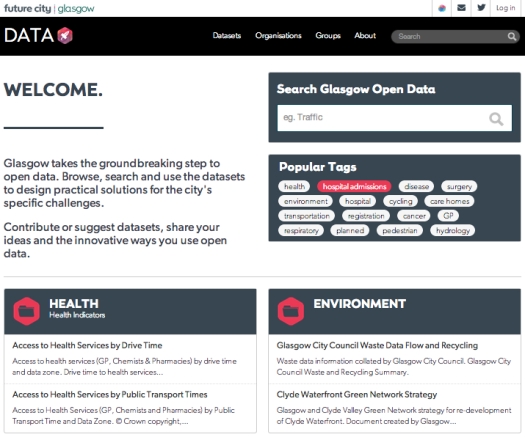
Glasgow Open Data Platform
Alison
It was with great shock and greater sadness that I heard yesterday about the sudden and untimely death of our friend and former CAPLE colleague Alison Carmichael. I can remember when Alison first came to the department, she fitted in so well that it was like she had always been there. Alison was an integral part not just of the CAPLE administrative team, but also of the academic and social life of the department and she was one of the people that made CAPLE such a great place to work. Our colleague Cherie Woolmer summed her up perfectly when she described her as “an absolute professional who made time for hilarity.” Alison always had time to smile and laugh, and she kept her own, and everyone else’s, spirits up through the difficult days of the CAPLE review and closure. No matter how difficult things got, Alison was always smiling. And of course she was always, always sparkly and fabulous. It’s hard to believe that she’s gone, but I know that we will all remember her with a smile. My thoughts are with Alison’s family and friends.

Susan, Alison and Sarah
White Horses for Ada Lovelace Day
Today is Ada Lovelace Day, the annual celebration of women in science, technology, engineering and maths. I try to write something for Ada Lovelace Day every year, but I don’t always manage it. Four years ago, pressed for time, I just blogged a list of all the unique and inspiring women who I’d worked with in the domain of educational technology since 1997. Looking back on the list now, it’s sobering to reflect how many of these women have now left the field, moved into other domains, or sadly passed away.
Julie Allinson, Helen Beetham, Kerry Blinco, Rachel Bruce, Joanna Bull, Gayle Calverley, Jackie Carter, Lisa Corley, Sarah Currier, Jenny Delasalle, Susan Eales, Suzanne Hardy, Rachel Harris, Rachel Heery, Nancy Hobelheinrich, Sarah Hollyfield, Allison Littlejohn, Sheila MacNeill, Sue Manuel, Moira Masey, Lisa Mattson, Mhairi McApline, Sarah McConnell, Lou McGill, Celeste McLaughlan, Liddy Neville, Solvig Norman, Chris Pegler, Sharon Perry, Sarah Porter, Jean Ritchie, Tish Roberts, Laura Shaw, Christina Smart, Amber Thomas, Li Yuan, Su White, Lara Whitelaw, Heather Williamson, Vashti Zarach, Linn van der Zanden.

White Horses.
Haiku Print by Lou McGilll
Many of us are still hanging in there, and of course I’ve been lucky enough to work with many more inspiring women since creating this original list, but there’s no denying that the last four years have been tough for everyone working not just in educational technology, but in academia more widely. However if the last few years have taught me anything, it’s just how resilient, creative and adaptable my female colleagues* can be when it comes to facing the continued uncertainty that is afflicting the sector.
To my mind, nothing illustrates this adaptability and creativity better than this picture. This lovely art work is by Lou McGill, who I first met many moons ago working on a Jisc funded Digital Libraries in the Classroom project at the University of Strathclyde. Lou worked on a number of Jisc funded projects before taking up a post as Programme Manager with Jisc itself. Some years later Lou left Jisc and she now works as an education technology consultant and runs her own art gallery, Life’s Little Ironies, in Whithorn. I had the pleasure of catching up with Lou recently at a pop-up gallery she ran at the Wigtown Book Festival, we talked about everything from education technology, to art, to local history and I came away with with this lovely art work and, perhaps more importantly, lots of good ideas.
Many of the women listed above have gone on to achieve wonderful things both in and beyond the domain of education technology and that is certainly something to celebrate.
*To be fair, my male colleagues have had it just as tough, and have had to be equally creative and resilient to survive. Respect to them too.
SQA to explore the potential of Mozilla Open Badges
“We believe that the infrastructure promotes and supports greater flexibility for learning and the recognition of achievement.”
– Joe Wilson, SQA
Following two years of discussions, SQA has announced that it will work in partnership with the Mozilla Foundation and the Scottish Open Badges Group to support the adoption of Open Badges across a range of Scottish education sectors. Rather than being a top down project, SQA’s announcement represents a “commitment to be open about open badges” which will hopefully encourage more traditional parts of the education sector to engage with innovative open approaches to recording achievements and accomplishments.
Press release as follows…
SQA investigates opportunities with Mozilla’s Open Badges
SQA has announced its intention to investigate the opportunities presented by an innovative approach to displaying individuals’ learning accomplishments online.
SQA is working in partnership with Mozilla, a non-profit organisation dedicated to the democratization of the web, to explore the benefits to learners that can be achieved through their Open Badges.
Mozilla’s Open Badges project intends to make it easy to earn, issue and display digital badges that recognise and communicate individuals’ skills and achievements.
The badge project infrastructure allows individuals to display their real-world skills and achievements in online environments – such as social media profiles – in way that may help with future career and education opportunities.
Joe Wilson, Head of New Ventures at SQA, said: “We believe Mozilla’s Open Badges project enables greater flexibility for learners to demonstrate their achievements. Open badges have the potential to allow individuals to display the accomplishments they make along each step of the learner journey, and receive recognition for a single skill or packages of learning that cover a number of skills in relation to a particular task.”
Joe continued: “SQA will work with Mozilla to explore how we can adopt Open Badges. We will encourage our partners to investigate how they could benefit from adopting open badges to support learners across Scotland in addition to the recognition we offer teachers and college lecturers through our CDP courses and training we will explore how we can integrate open badges into our certification processes.”
Erin Knight, Senior Director of Learning and Badges at Mozilla, said: “We are really excited that SQA, as Scotland’s national awarding and accreditation body, is actively exploring how best to implement Open Badges as a means to give learners and institutions the opportunity to demonstrate their skills and accomplishments through digital badges.”
Joe will be speaking at the Mozilla Festival in London on Saturday 26 October about SQA’s work with Mozilla.
CEN Learning Technologies Workshop Online Consultation Meeting
I’ve being working in the domain of learning technology and interoperability standards for over ten years now, and during that time I’ve worked with a number of standards bodies including IMS, BSI, DCMI, IEEE and ISO SC36. However the first standards body I ever worked with was the CEN/ISSS Learning Technologies Workshop when I joined the Taxonomies and Vocabularies Project as an independent expert in 2001.
The European Committee for Standardisation’s Information Society Standardisation System (CEN/ISSS) was formed in 1997 to provide a focus for CEN’s ICT standards activities. There are currently 12 formal Technical Committees and around 17 less formal Workshops in the domain of ICT.
CEN describe the purpose of the Workshops as follows:
“This open process aims at bridging the gap between industrial consortia that produce de facto standards with the limited participation of interested parties, and the formal European standardization process which produces standards through consensus under the authority of CEN member bodies. CEN WSs are flexible structure that benefits from the openness and consensus that are key values of CEN.”
The outputs of CEN Workshops are published as CEN Workshop Agreements (CWAs) which are disseminated freely and openly. CWAs can be regarded as pre-standardisation documents, reports and specifications. Within the Learning Technology Workshop, some of these CWAs are produced as a result of EU funded projects, but others have been produced on a voluntary basis by members of the workshop.
Although I haven’t personally been involved with the Workshop for a number of years, Cetis has remained an active participant and several of my Cetis colleagues regularly attend meetings and contribute to Workshop activities. Simon Grant has been a notably active Workshop participant in recent years, during which time he was involved in the development of the Integrating Learning Outcomes and Competences (InLOC) specification which was published as CWA 16655 1-3 in July this year. The InLOC CWA documents can be downloaded from CEN here.
Having been involved in a number of standards bodies over the years, I have always found the Learning Technology Workshop to be admirably open and inclusive. The Workshop is open to all interested parties and any member can propose or contribute to an activity, provided they have the time and resources to participate. Although there has been limited financial support for EU funded projects, a huge amount of valuable work has been carried forward on a voluntary basis by members of the Workshop. And perhaps most importantly, the outputs of the Workshop, the CWAs, have been made available freely and openly.
The development of open learning technology standards is largely driven by the goodwill of technical experts and educational practitioners who contribute their time, energy and expertise on a voluntary basis, and I have always felt that it is important for standards bodies to promote open development processes and to disseminate open outputs. Consequently it’s of considerable concern that a serious disagreement has arisen between CEN and the Learning Technology Workshop regarding the free and open dissemination of the Workshop’s CWAs. In a nutshell it appears that CEN have suggested that only CWAs produced by EU funded projects can be made available free of charge. This position suggests that CWAs produced by unfunded voluntary projects should no longer be published as free open documents and calls into question the viability of the Workshop in its current form.
As this issue remains unresolved, the latest meeting of the Learning Technology Workshop has been cancelled and the Workshop Chairs have called a public online consultation meeting on the 15th of October to discuss the future of the Workshop. If you have any interest or involvement in the creation of open standards and specification within Europe, or a commitment to the development of open education technology, I would strongly encourage you to attend.
Minutes and documents relevant to this issue can be fond on the Workshop wiki here: http://wiki.teria.no/display/cenwslt/
See in particular:
Minutes of the 54th CEN WS/LT Meeting June 25th Brussels
Summary of meeting between the CEN Management and the WS/LT Chairs 24th September
Opening Up Education
It’s been another encouraging week for open education with the launch of the European Commission’s Opening Up Education initiative.
The Communication on Opening Up Education
“sets out a European agenda for stimulating high-quality, innovative ways of learning and teaching through new technologies and digital content.”
The initiative aims to increase the use of digital content and resources in education, address inequalities in the use of ICT in schools across member states, to ensure that universities are ready to face the “digital challenge”.
Opening up Education focuses on three main areas:
- Creating opportunities for organisations, teachers and learners to innovate;
- Increased use of Open Educational Resources (OER), ensuring that educational materials produced with public funding are available to all; and
- Better ICT infrastructure and connectivity in schools.
The initiative will be supported by a number of funding initiatives including Erasmus+, Horizon 2020 and EU Structural Funds.
In addition to launching the Opening up Education initiative the Commission have also launched the Open Education Europa portal, a “gateway to European innovative learning”.

Open Education Europa
The portal allows users to search for a wide range of open educational content including courses, MOOCs and resources. Search results can be filtered by subject, level, language and Creative Commons licence type. Although I’m usually pretty sceptical about the “lets build a giant portal” approach to managing and distributing open educational content, it’s great to see a truly multilingual resource. It’s also good to find Jisc funded resources there, including Jorum and Humbox, there may be others, but I haven’t had a chance to have a good look yet. Users also have the option of signing up to Open Education Europa to share blogs, events and groups, and the portal also provides access to a range of papers, news reports, articles etc. There’s also a rather fun European MOOC scoreboard. Look, Spain are winning!

European MOOC Scoreboard
I’ve been following the Opening Up Education initiative for some time and I’m already very encouraged by the Commissions commitment to open education, open licences and open educational resources. I very much hope that the UK will be able to engage with Opening Up Education and build on the success of the Jisc / HEA UK OER Programmes.
Links:
Opening Up Education press release: Commission launches ‘Opening up Education’ to boost innovation and digital skills in schools and universities
European Commission Communication: Opening up Education – Innovative teaching and learning for all through new Technologies and Open Educational Resources (pdf)
Scottish Learning Festival
Earlier today I made a brief foray to the Scottish Learning Festival for the first time. I don’t usually attend the event as I’ve never worked directly with the school sector, but this year I thought I would take the opportunity to go along to the panel on Gaelic medium education and to hear Cabinet Secretary Mike Russell’s keynote.
Although I was born and educated in the Outer Hebrides, I am not a native Gaelic speaker as I’m very much part of that generation whose parents and grandparents thought there was little reason to pass the language on to their children. Despite my own poor knowledge of the language, we decided to send our daughter to Sgoil Ghàidhlig Ghlaschu so she would have an opportunity to learn the language and benefit from a bilingual education. She’s now in her third year of full immersion Gaelic medium education and has taken to it like a tunnag to water! Consequently it was very encouraging to hear that HMI have gathered evidence of the positive impact of full immersion Gaelic medium education. The importance of preschool Gaelic medium provision was also acknowledged, as was the need to engage the wider community in Gaelic education. There was also a lovely case study about the enhancement of Gaelic medium education in Balivanich school on Benbecula, which specifically referred to the positive impact of pupils coming to the school who did not speak English as their first language. The ability of these children, from Poland, Latvia and Russia, to quickly learn English, and their enthusiasm to also learn Gaelic, was a great encouragement to local children.

Full house for the Cabinet Secretary’s Keynote
“Diversity may be the hardest thing for a society to live with, and perhaps the most dangerous thing for a society to be without.”
Introducing the Robert Owen Award for Education Innovation, Russell quoted Owen and spoke at some length about his legacy
“To train and educate the rising generation will at all times be the first object of society, to which every other will be subordinate”.
The Social System, 1826
Other initiatives Russell announced included the creation of a new College for Educational Leadership and a review of the Curriculum for Excellence to be carried out in 2015 by the Royal Society of Edinburgh and OECD.
Despite claiming that the drive to improve Scottish education from “good” to “great” should transcend politics, I couldn’t help feeling that Russell’s keynote had a distinctly political slant. However I certainly can’t disagree with his assertion that “Scottish education needs to get better at gathering in and using data”. Sounds like another strong incentive to further the development of learning analytics techniques!
A Good Week for Open Education?
Because I am a true believer in the power of reusable, repurposeable, remixable open content I have repurposed part of this blog post from an e-mail David Kernohan sent to the OER-Discuss mailing list earlier this week titled “A big week for open learning in the UK”. Cheers David! 🙂
There’s certainly been an explosion of activity in the open education space this week; in addition to the announcement of the winners of the Reclaim Open Learning Contest, the publication of the BIS Maturing of the MOOC report, and the launch of FutureLearn, all of which David mentioned, this week also saw higher education institutions in Wales announce their support for open education principals, the Open Knowledge Conference, which took place in Geneva, featured a panel on Open Education, and, back in the UK, Jorum relaunched. Okay Jorum actually relaunched last week but it still good news so lets not be pedantic!
Welsh HEIs Adopt Open Educational Principals
To my mind this is possibly the most significant and encouraging development of the week. Times Higher Education reported than the vice chancellors from Wales’ eight universities would be committing to adopt open educational principles to support open education practice and the use of open education resources. The aim of this initiative is to encourage universities to share content, mostly in the form of lecture notes and course materials, which can be reused across the sector and beyond. The resources will be hosted by individual institutions but a dedicated portal will provide access to these materials and act as “showcase doorway”. In an e-mail to OER-Discuss, Hayden Blackey, Prifysgol De Cymru, confirmed that Higher Education Wales had agreed to a “common statement of principals which will be available form their website shortly.” You can read the full THE article here: Welsh universities commit to sharing course material online
I’m hugely encouraged by this very positive step taken by the Welsh Higher Education sector, this is exactly the kind of commitment we hoped to encourage through the Open Scotland initiative. I sincerely hope that Scottish Higher Education is taking note, and will be inspired to follow suit.
Reclaim Open Learning Innovation Contest
Congratulations to DigiLit Leicester and Phonar Ed at Coventry University, who won two of the five prizes awarded at the Reclaim Open Learning Innovation Contest. The contest, which is sponsored by MacArthur Foundation, the Digital Media and Learning Hub, and the MIT Media Lab, aims to embrace a model of open learning that focuses on the use of openly licensed reusable content and collaborative modes of peer to peer learning.
The Maturing of the MOOC
The Department of Business, Innovation and Skills published their literature review of massive open online courses and other forms of open distance learning: The Maturing of the MOOC by Stephen Haggard. So far, I have only had time to briefly skim the review, but it looks like it will be a valuable addition to the growing corpus of reports, commentary and data relating to all aspects of MOOCs. It’s also great to see that the review makes frequent reference to the Cetis whitepaper by Li Yuan and Stephen Powell MOOCs and Open Education: Implications for Higher Education.
FutureLearn Launch
FutureLearn launched with much fan-fair and equal parts enthusiasm and cynicism from the ed tech community. I’m not going to say too much about the launch as so many blog posts and reports have already covered that ground. On balance the first courses look rather interesting, though I am curious to see how they will distinguish themselves from other MOOC offerings. I still find it rather disquieting that the whole FutureLearn brand seems to be predicated on exclusivity, which rather calls into question their commitment to openness. Of course this is a criticism that can be levelled at other MOOC providers, but it does rather beg the question, can you be open and exclusive? I really don’t know the answer to that.
David’s e-mail to OER-Discuss kicked off a very interesting discussion on FutureLearn’s decision to include the following prohibition in their Code of Conduct :
“As the FutureLearn community’s first language is English, I will always post contributions in English to enable all to understand, unless specifically requested to do otherwise.”
Kate Bowles has written a thoughtful blogpost about this issue here: For all to understand, and you can follow the OER-Discuss conversation here.
New Jorum Launches
I’ve been involved with Jorum since it was just a glimmer of a proposal in the project team’s eye so it’s great to see that the service has come this far, and is continuing to go from strength to strength. Jorum relaunched at the beginning of the month with a new look and a host of new features that will make it easier for users to search for and select resources. In addition, new reporting features have been added to provide access to resource usage data that can be viewed and exported in a range of formats. And last, but by no means least, the long awaited Jorum REST API, which will provide direct access to content usage data and metadata, will be released in October.
Open Knowledge Foundation Conference
I wasn’t able to attend the OKFN Conference in Geneva, but I followed as much of the live stream as I could online. I was very pleased to see that one of the topics covered by the conference this year was Open Education. Doug Belshaw facilitated a panel that included Jackie Carter of Mimas and Mathieu d’Aquin of the Open University, which looked at facets of open education – resources, data and culture.
