

Jisc RSC Scotland Open Education Joint Forum
(Cross posted from Open Scotland)
Earlier this week I was invited by Jisc RSC Scotland to attend their Open Education Joint Forum which took place at the Informatics Forum at the University of Edinburgh. It was a very well attended event that featured a packed programme of thought provoking and engaging presentations that highlighted a range of really inspiring open education developments. I’ve put together a storify of the event’s lively twitter back channel here and links to all the presentations are available from Jisc RSC Scotland here.
Open Scotland
Lorna M Campbell, Cetis and Joe Wilson, SQA
I kicked of the event with a short overview of the Open Scotland before passing over to Joe who challenged the audience to share their educational resources, before talking about about the benefits of openness and calling for changing mindsets around Open Education. Joe also reminded us that there is a real strength in Scottish education, we have dedicated and talented teaching staff and by opening up education they can shine for learning.

Joe Wilson, SQA
Massive Open Online Courses: Open education of course?
Martin Hawksey, ALT
Martin Hawksey, my former Cetis colleague, now with ALT, gave an inspiring presentation that placed MOOCs in the historical context of technology innovation and asked if we are now in danger of promoting a dogmatic approach to programming and technology innovation. Martin revisited Doug Englebart’s “Mother of All Demos” which, among many other innovations, demonstrated screen sharing and videoconferencing as far back as 1968. In education we have a tendency to get stuck in particular ways of doing things, both students and teachers have specific expectations and can be very resistant to change.

Martin Hawksey, ALT
Martin highlighted some of the tools, services, platforms and applications that can be employed to deliver MOOCs. He also reminded us that every letter of MOOC is negotiable and suggested that the issue of MOOC completion rates is irrelevant. Open or closed is not a binary thing, but there are huge benefits to moving towards more openness. Martin concluded by telling is all that “openness is about feeling warm inside” and that we should all “ride the waves of innovation to a more open, more relevant style of education’. Martin has written a an excellent blog post about his presentation which you can read here: Taking on the dogmatic approach to education with a bit of ‘reclaim open digital connectedness’.
Re:Source OER Repository
Garry Cameron, Scotland’s Colleges, Jackie Graham and Sarah Currier, Mimas
Gerry spoke about the need to change hearts and minds to use and develop open educational resources and called for a clear statement and a decisive stance on open educational resources from Scottish Government. Scotland’s Colleges committed to releasing resources under Creative Commons licences.

Gerry Cameron, Scotland’s Colleges
Re:Source is an OER repository for Scotland’s colleges. The open platform is here and could be used by many across the Scottish education sector but policy drivers needed. Jisc RSc Scotland is collaborating with Scotland’s Colleges to work ona way forward. Librarians also have a crucial role to play in developing open repositories within Scotland’s colleges. Jackie Graham went on to demonstrate the Re:Source repository before handing over to Sarah Currier who spoke about the Jorum repository which powers Re:Source.

Jackie Graham, Re:Source
Blackboard xpLor
Julie Usher, Blackboard

Julie Usher, Blackboard
Julie Usher began by highlighting the potential of OERs but suggested that they can be hard to find; how do you fin and evaluate OERs, link them to curricula, including assessments. To address this problem Blackboard have developed the xpLor content repository. xpLor supports OER discover and allows content to be pulled directly into Blackboard courses. Creative Commons is baked into xpLor repository so content can be exported with CC licenses.
Introduction to Open Badges and OBSEG
Grainne Hamilton, Jisc RSC Scotland

Grainne Hamilton, Jisc RSC Scotland
Open badges are a form of digital accreditation that can be displayed online. Badges are like coats of arms, they are images that contain information and have meaning beyond the visual. Open Badges incentivise informal, formal and work based education and break learning into manageable chunks. The Open Badges in Scottish Education Group (OBSEG), which is supported by Jisc RSC Scotland, has set up three sub-groups focusing on Learner Progress, Technology and Design and Staff Development.
St Andrews Day

St Andrews Day, Glasgow
Spotlight on the Digital: Technical Focus Group
 Last Friday I attended the Spotlight on the Digital technical focus group led by David Kay, of Sero Consulting and Owen Stephens, of Owen Stephens Consulting. The workshop was attended by institutional repository and archive managers, together with representatives of a wide range of bodies including the Welcome Trust, EDINA, the Archives Hub, Knowledge Integration, the Wikimedia Foundation and the British Library.
Spotlight on the Digital is run by Jisc in collaboration with RLUK and SCONUL. The aim of the programme is to
“identify practical solutions that will support Higher Education (HE) institutions to enhance the discoverability of their digitised collections for the benefit of their key audiences, in particular researchers, teachers and students.”
The project is focusing on three user groups; researchers, students and university teachers. Two hundred publicly funded digital resources have been examined to assess their discoverability and a literature study of research on search behaviour has been undertaken. In addition to the workshop I attended, the project team will also consult with a group of library directors.
I’ve created a storify of tweets from the event summarising the main points raised, which you can find here storify.com/LornaMCampbell/spotlight-on-digital
It was a very interesting workshop that raised many important issues and highlighted some really innovative approaches to discoverability including; British Library Labs‘ Mechanical Curator project, which selects a small image taken at random from the pages of digitised works held at the library and posts it to tumblr ever hour on the hour; the Imperial War Museum‘s use of History Pin to crowd source information about their collections; and Cymu1900, a crowd sourcing project to transcribe Welsh place names.
However what struck me at the end of the workshop was that we had barely scratched the surface of issues relating to the discoverability of educational content. Educational materials are frequently scattered, messy, poorly catalogued, lack persistent identifiers, and rarely reside in well managed archives or repositories. This raises a whole host of issues and problems in relation to discoverability.
While context is an important aspect of discoverability for all kinds of digital artefacts, it is critical for educational content. One inspiring project highlighted by Owen Stephens which addresses both contextualisation and educational resources is the National Maritime Museum‘s contextualisation of the digitised Board of Longitude papers by creating stories around the artefacts and developing Key Stage resource packs for schools.

Board of Longitude Key Stage 3 resources from the National Maritime Museum
My Cetis colleague Brian Kelly, who also attended the workshop, has written up this thoughts on the role of Wikipedia in this context: Spotlight on Wikipedia: the opportunities and the risks.
Open Knowledge Foundation Glasgow Meetup #2
Last night I went along to the second Open Knowledge Foundation Glasgow meetup. The event took place in the Board Room of the CCA, which was rather more spacious than the Electron Club that kindly accommodated us last time. We all got to sit on chairs rather than perch on tables, which made tweeting much easier! Once again we had a wide range of fascinating lightning talks which generated a great deal of lively discussion. I’ve posted a storify of the event here: open-knowledge-foundation-glasgow-2
Open Scotland – Lorna M Campbell, Cetis
I had the pleasure of opening the meeting with a short talk about the Open Scotland initiative, led by Cetis, SQA, the Jisc RSC Scotland and the ALT Scotland SIG, which aims to raise awareness of open education and explore the potential of open policy and practice to benefit all sectors of Scottish education. The initiative hopes to build on existing open education developments to encourage the sharing of open educational resources and to embed open educational practice across Scottish education. The Open Scotland blog provides a focal point to engage the community in discussion and debate, disseminate news and developments relating to all aspects of openness in education and to further the actions and deliverables discussed at the Open Scotland Summit held in Edinburgh in June.
 Open Badges: What? How? Why? – Grainne Hamilton, Jisc RSC Scotland

Grainne introduced the concept of open badges and outlined the work of the Open Badges in Scottish Education Group. Open badges are data infused images that provide an online representation of skills earned. Badges could provide an important link between informal and formal learning as they enable users to gain recognition for learning that happens anywhere. The Open Badges in Scottish Education Group, which is supported by Jisc RSC Scotland, has set up three sub-groups focusing on Learner Progress, Technology and Design and Staff Development.
 Wikimedia UK: Scottish Women on Wikimedia – Graeme Arnott

Only 15% of Wikipedia editors are women, so Wikmedia UK is taking positive steps to address the gender imbalance of editors and remove sexism and racism from posts. Graeme spoke about a Wikimedia UK editathon run in conjunction with Glasgow Women’s Library. The event hoped to expose the hidden history of women in Glasgow and provide a way for more women from the Library to engage wth technology.
 The Digital Commonwealth: digital storytelling and social media archiving – Jennifer Jones

Jennifer introduced the Lottery funded Digital Common Wealth project which aims to support creative community expression in response to the Commonwealth Games. Digital Common Wealth has three strands: Community Media Clusters, Schools Programme and Creative Voices at UWS. Developing digital literacies and creating and sharing data are key principals for Digital Common Wealth. Stories shared by social media are rich source of data and Digital Common Wealth are working with the National Library of Scotland to archive the project’s outputs.
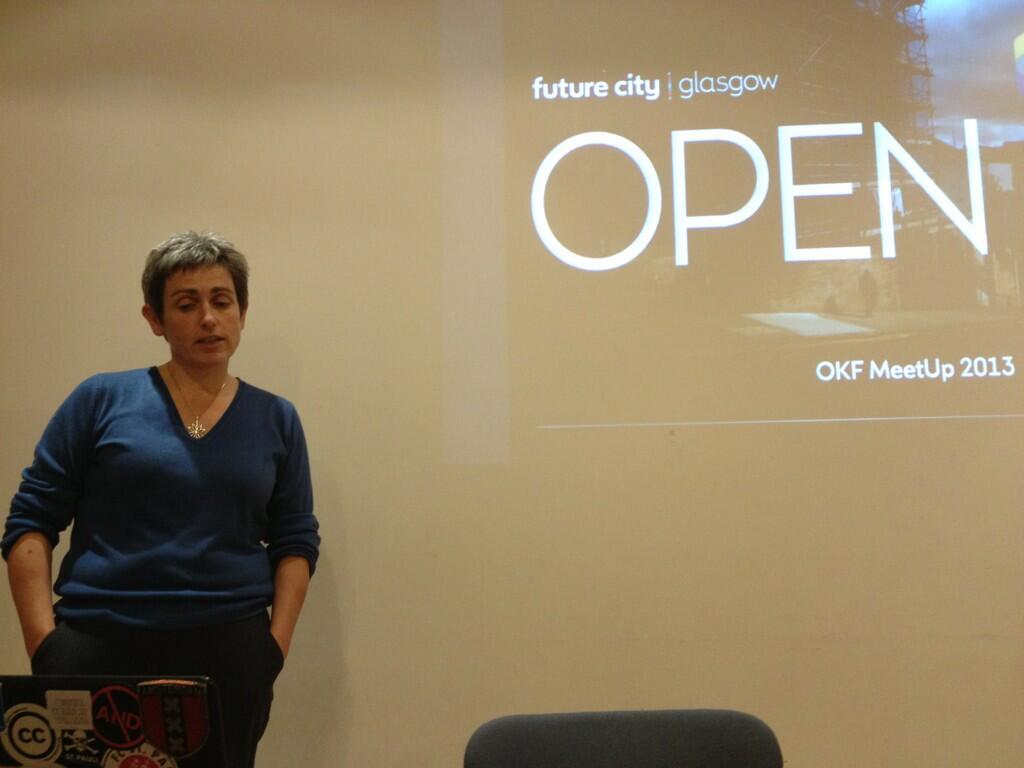 Future Cities Glasgow – Pippa Gardner

Pippa provided an update on the £24 million Glasgow Future Cities Demonstrator project. Last night the project’s Data Portal had 99 data sets, however this morning they tweeted that they had just added their 100th data set from the Celtic Connections Festival. The project used the Open Data Handbook to prioritise themes, however some of their data sets are more open than others, depending on their original licences. Where possible Glasgow will make data open by default. Engagement hubs and links to digital inclusion initiatives are part of the project’s approach and the team will also be running hackathons in the new year.
 Open Architecture – Duncan Bain

Duncan highlighted some very interesting approaches to open architecture including Wikihouse, which aims to democratise the process of construction, Terrafab which allows you to download and print 3D models of Norwegian terrain maps, and Terrainator, a similar UK based on OS open data. Duncan’s talk provoked a fascinating debate on lack of openness in architecture education practice, and why architecture has not embraced openness in a similar way that software development has.
 Open Street Map – Bob Kerr

Presented an impromptu overview of the very cool work of the Open Street Map initiative and pointed us to the LearnOSM step by step guide. Bob highlighted some amazing examples of open street mapping at work, including the humanitarian effort to map Haiti after the earthquake and Map Kibera, a project that mapped the Kenyan shanty town of Kibera revealing the extent of the community and bringing it to life. Bob’s talk generated a really interesting discussion on the political and social importance of maps. Duncan pointed out that traditionally the people who have the power have the maps, however initiatives like Open Street Map is changing that.
This meeting was organised by Graham Steel, Graeme Arnott and Ewan Klein with a little input from Sheila MacNeil and I. The event was streamed by Jennifer Jones.A few thoughts on the launch of OERu
Last week saw the launch of the Open Educational Resource university (OERu), a UNESCO COL project coordinated by the Open Education Resource Foundation and lead by Wayne Mackintosh (PhD) Director of the OER Foundation at Otago Polytechnic.
OERu describes itself as
“an international network with a philanthropic mission to provide first-class, accessible and affordable education to everyone – no matter where they live, or what their background.”
Unlike many commercial MOOC providers, the ethos of OERu is very much on open – open educational resources, open educational practices , open access, open licensing, open source, open philanthropy.

Another distinctive feature of OERu is that the initiative is being promoted as a route to formal academic credit. Depending on the individual subject, OERu courses carry varying degrees of accreditation, with some partner institutions providing optional assessments for formal academic credit. Students have the option of engaging with courses as self directed learners, picking and choosing topics and activities that interest them; alternatively they can receive certificates for active participation, on the basis of completed activities and interactions; or they can submit their work for formal assessment by designated OERu partners on a fee for credit basis.
During the project launch at Thompson Rivers University in British Columbia, Sir John Daniel, former president of the Commonwealth of Learning, stated that
“The OERu will reduce the cost of higher education dramatically. I believe that radical innovations in higher education must be accompanied by particularly robust frameworks of accreditation and credentialing in order to reassure the public. It’s all very well for evangelists to promote do-it-yourself accreditation from the personal safety of CVs replete with reputable qualifications, but ordinary people want the ‘beef’ of proper recognition too.”
The OERu currently has thirty two partners from five continents, though so far there is only one UK partner, Prifysgol De Cymru, the University of South Wales.
While I fully support OERu’s commitment to open principles and practice, I’m less sure about the imperative for formal accreditation. The jury still seems to be out as far as certification is concerned, with some MOOC providers and participants suggesting that accreditation is not the be all and end all of online learning. However it’s also notable that many first generation MOOC participants are already educated to degree level, so perhaps Sir John Daniel is making a valid point about “ordinary people’s” desire for proper recognition. (Though characterising any group of individuals as “ordinary” rather makes me baulk.)
I also couldn’t help noticing that, although there had been quite a lot of publicity about the OERu initiative in the run up to its launch, I haven’t seen a great deal of discussion about it since. While Creative Commons and Times Higher Education published new items about the launch, the reception on the blogosphere has been rather muted, and it barely caused a ripple in my twitter feed. After the hype that surrounded the launch of FutureLearn, and the distinctly hostile reception that Coursera founder Andrew Ng received during his Open Education Conference keynote earlier this week, it’s perhaps unsurprising that ed tech commentators are becoming distinctly jaded about yet another new / innovative / disruptive startup that will revolutionise online education as we know it. If that is the case, then it’s unfortunate for OERu, as I think it’s a very welcome addition to the online learning / MOOC landscape, and if it really does stick to its open principals the it is is certainly to be applauded.
POERUP Policy Advice for Universities
(Cross posted from Open Scotland)
 Policies for OER Uptake (POERUP) is a European Commission funded Life Long Learning Programme project, coordinated by Sero Consulting, which is carrying out research to understand how governments can stimulate the uptake of OER by policy means. The project aims to:
“convince decision-makers that in order to be successful with OER, they will have to formulate evidence-based policies based on looking beyond one’s own country, region or continent, beyond the educational sector they look after.”
POERUP have already undertaken a survey of open education policy along with developments in education, e-learning, internet and copyright in 26 countries and have produced a series of comprehensive reports which can be viewed on the Country Reports wiki.
The project is also tasked with producing OER policy documents for a number of EU nations including Scotland, and the team are keen to work with those who have been involved in Open Scotland. The project are also drafting three EU-wide policy papers for schools, colleges and universities on fostering OER uptake, which will act as aides-mémoire for the national policy documents. A draft of the POERUP EU-wide Policies for Universities is available here.
This document provides an invaluable overview of policy developments relative to open education from EU initiatives (e.g. Bologna, Europe 2020, Opening Up Education), OER projects, lobbyist circles (e.g. Opal, UNESCO/COL) and POERUP working meetings. From this evidence base, the following eighteen Policy Proposal Recommendations have been synthesised. In formulating these proposals care has been taken
“not to over-focus on OER as an end but more of a means towards educational transformation.”
To provide comments or feedback on these recommendations please contact Paul Bacsich of Sero Consulting at paul.bacsich@sero.co.uk.
Recommendations for European Commission and via EU for the Member States
Innovation – new institutions
1. The Commission should set up a competitive innovation fund to develop one new “European” university each year with a commitment to low-cost online education around a core proposition of open content.
Accreditation of institutions – new accrediting bodies and mutual recognition
2. The Commission should foster the development of transnational accrediting agencies and mutual recognition of accreditations across the EU.
3. The Commission should reduce the regulatory barriers against new kinds of HE providers (e.g. for-profit, from outside the country, consortial, etc).
Quality agencies
4. Quality agencies in ENQA49 should: Develop their understanding of new modes of learning (including online, distance, OER and MOOCs) and how they impact quality assurance and recognition;
- Engage in debates on copyright;
- Consider the effects of these new modes on quality assurance and recognition;
- Ensure that there is no implicit non-evidence-based bias against these new modes when accrediting institutions both public and private including for-profit (if relevant), accrediting programmes (if relevant) and assessing/inspecting institutions/programmes.
Bologna-bis: competence-based not time-based assessment
5. The Commission and related authorities developing the European Higher Education Area50 should reduce the regulatory barriers against new non-study-time-based modes of provision: in particular by developing a successor to Bologna based primarily on competences gained not duration of study.
Assessment and accreditation of modules
6. The Commission should recommend to universities that they should work to improve and proceduralise their activity on APL (Accreditation of Prior Learning) including the ability to accredit knowledge and competences developed through online study and informal learning, including but not restricted to OER and MOOCs, with a focus on admitting students with such accredited studies to the universities’ own further courses of study.
7. The Commission should recommend to the larger member states that they should each set up an Open Accreditor to accredit a range of studies which could lead to an undergraduate degree. In the first instance the Accreditor should focus on qualifications in the ISCED 5B area as this is most correlated with high-level skills for business and industry.
Funding mechanisms for institutions and content
8. The Commission should foster work into standardised syllabi EU-wide for undergraduate degrees in certain professions (e.g. medicine, nursing, mathematics, IS/IT) where this is appropriate for EU-wide action, and in the light of a successful outcome to such initiatives, foster the developments of common bases of OER material to support these standards, including relevant open repositories and (ideally jointly with publishers) open textbooks.
9. The Commission should ensure that any public outputs from its programmes (specifically including Erasmus for All and Framework) are made available as open resources under an appropriate license.
10. The Commission should encourage member states to do likewise for their national research and teaching development programmes, including for the public funding component of university teaching.
11. The Commission should encourage member states to increase their scrutiny of the cost basis for university teaching and consider the benefits of output-based funding for qualifications.
IPR issues
12. The Commission should adopt and recommend a standard Creative Commons license for all openly available educational material it is involved in funding. This should currently be Creative Commons 3.0 in unported or relevant national versions, updated from time to time. The Commission should also recommend this license to all member states.
13. The Commission should study the issues in the modern European HE system round the “non commercial” restriction and make appropriate recommendations for its own programmes and for member states.
14. The Commission should support the development of technological methods to provide more and standardised information on IPR to the users of digital educational content.
15. The Commission should mount a campaign both centrally and via the member states to educate university staff on IPR issues.
Training of academics
16. The Commission should support the development of online initial and continuous professional development programmes for teachers, focussing on online learning with specific coverage of distance learning, OER, MOOCs and other forms of open educational practice, and also IPR issues.
17. The Commission should encourage member states to do this also and should recommend the use of incentive schemes for teachers engaged in online professional development of their pedagogic skills including online learning.
Further research
18. The Commission should fund research into the verifiable benefits of OER, with greater efforts to integrate such analyses with its ongoing research on distance learning, on-campus online learning, and pedagogy; and recommend the same to member states.
The six best conference questions: Or, how not to paper-bomb at a conference
Recently Times Higher Education published an article by Allan Johnson about the six questions every academic dreads to hear at conferences, which started an interesting discussion among a group of historians on twitter about the kind of conference questions we really like to hear. Joanne Bailey, Reader in HIstory at Oxford Brookes University, suggested this would make a great topic for an article and took the lead in turning the twitter discussion into something more coherent, and it gives me great pleasure to post the resulting article here.
The six best conference questions: Or, how not to paper-bomb at a conference
By Joanne Bailey, Isaac Land, Lorna M. Campbell and Steven Gray
Giving a conference paper can be a daunting and sometimes even an unpleasant experience, as Allan Johnson reminded us in his article in the Times Higher about the six conference questions every academic hears, and wishes they didn’t. They range from the helpful, to the ambush, to the direct attack. There are the well-intentioned, if condescending offerings: the ‘Courtesy Question’ and ‘The Tell-Us-What-You-Want Question.’ Then there are the conference versions of photo-bombing: ‘Talk-To-Me-Personally Question’ and ‘Wandering Statement’ where the questioner sticks their research in front of the speaker’s. Finally, the argumentative: ‘Obstinate Question’ and ‘Display of Superior Knowledge’.
Well, we’ve all been there, possibly on both sides of the desk. Some of us even avoid giving papers to escape these questions. One of us remembers the joy she felt at a conference when the fire-alarm went off as she finished the paper, which avoided questions altogether. But of course we need other researchers’ questions to make our research efforts worthwhile. Their questions are the life-blood of conferences. That is why we give papers. We want to test our direction, our findings, and our approach. By the way, if you go to a conference in order to monitor the competition rather than to survey the field, we suggest you should save your money as that kind of attitude is unlikely to be helpful to you or anyone else.
So in the ideal world what should conference Q&A sessions be like? A short survey on Twitter asking academics what kind of questions they’d benefited from after delivering conference papers came up with several horror stories but – more importantly – the sort of interaction and enquiries we want and need when we bravely set our work in front of others.
The supportive Question
Okay, sometimes the audience is silent because of its state of exhaustion, hangovers, desire to have lunch, or need to get the train. So for the kindly soul who breaks the ice, we like questions which show that the audience member has actually listened to our presentation, so ask about a specific point that was raised. It can be robust: ask for clarification as that actually gets the speaker to engage and explain; particularly useful for researchers at the start of a project.
The Selfless Question
When you give a conference paper you want the questions to be about your paper or aspects of your research. So the questioner who focuses on your research is more helpful than the one who dwells on their own work. It means the panel member can think about their own research and not get distracted by trying to guess who the speaker is from the clues in the question, or if they already know who the speaker is, trying to (a) avoid offending them, or (b) offend them. For the egotist academics out there, why not see your questions as an opportunity to publicly help others? They’ll be eternally grateful!
Another way to do this is to try to ask questions about more than one paper. This makes the conversation a three-way discussion between the questioner, the speakers and the audience. We can all learn something then.
The Tough-but-Fair Question
This is probably the most rewarding question. Tough makes us explain and clarify. It can turn our research around. One PhD student advocates the kind of questions which ‘point out the holes and inconsistencies in my arguments/proof, or extrapolate off my argument and then poke holes. I find those questions to be really useful, because they show me where I need to do more work, especially at expressing my ideas’. But, the question must be fair. Try something like: ‘You mentioned your (evidence type) which poses problems, can you say a few words about the solution?’ Or how about offering the speaker an exception to their case and ask them to reflect on it?
The Practical Recommendation
Everybody loves this question. We need to know what we have missed in the primary and secondary sources, but phrase it positively please! Don’t demand to know why the speaker has omitted classic work a, b, or c. Try: ‘Have you consulted such and such because it reinforces your argument?’ Or, admit that there isn’t a reason for the speaker to have looked at this, but tell them it is similar.
The Think-Outside-the-Box Prompt
Another popular question is one which gets the speaker to think outside the box in which they have neatly confined their research. Remember this is not an attack, nor should it be about the questioner’s own work. Simply ask the speaker to think about a specific comparative case, or comment that their findings may be reflected in other fields or time periods. Not only does this challenge pre-conceptions in a useful way, it may help speakers to think about expanding their work in new directions. This should be exciting rather than threatening. One medievalist offered a question that had helped them: ‘You were talking about women in England, I know that in Germany at the time this was happening, is that the same?’
The Tell-Me-What-Else-You Know
We all cut loads out of our papers. Very often, speakers comment on this while delivering the paper, partly because we are so desperate to point out that we haven’t missed something obvious, we just haven’t had time to cover it. So ask the speaker about the areas they had to leave out! Useful questions, like: ‘You mentioned that time did not permit you to go into XYZ. Can you elaborate now? Speakers appreciate the chance to flesh out details and demonstrate the depth of their research.
When academics give conference papers we don’t necessarily want everyone to agree with us and praise us, though admittedly that can be nice. What we seek is for our audience to take us seriously, whatever stage of our careers we are at. And that means not dismissing speakers because they are at an early stage of their research and have not yet read the ‘seminal’ work. As one well-established academic observes: ‘Never greet a young scholar’s paper with “that’s not where the field IS,” which is self-evidently incorrect’. Similarly, those of us at the other end of the academic life-course need to be challenged by ‘new’ approaches and techniques. Early-career scholars can offer so much here, even if they might feel vulnerable about questioning more senior academics. Try phrasing questions along the lines of: ‘How do you respond to (specific scholar) when they say (specifically X)’, rather than dismissing them with ‘You are out of touch’.
What emerged from the Twitter survey is that we give papers in order to think things through and to learn. Audience members are at the panel for the same reasons. This puts us on the same team, not on opposing sides, even when we hold alternative views! So questions should be about personal and collective development, not scoring points off the captive speaker. Next time you ask a question in a conference be a giver, not just a taker. Learn, but offer your learning too, so that it is helpful rather than confrontational.
What academic speakers need and want is simple: courtesy, civility, and interest. Rephrase your ‘Obstinate Question’ into a ‘Tough-but-Fair’ question that allows the speaker to think and respond. Turn your ‘Wandering Statement’ into a ‘Practical Recommendation.’ If you are desperate to fill a silence, make the ‘Courtesy’ question a ‘Supportive’ one, or help out constructively with a ‘Tell-Me-What-Else-You-Know’. We all like to talk about our own work, but recognise that you aren’t giving a paper, so make ‘Another Place-or-Time-Prompt’ which introduces your interest but asks a question of the speaker, encouraging them to think beyond their chronological or spatial boundaries. Be brief, be focused, be answerable, and respond to something specific in the actual paper.
There is, perhaps, a seventh type of conference question that deserves consideration here. What to say when the disagreement is genuine and large, so large that downplaying it would be an injustice to your own intelligence and the speaker’s? Consider that civility is more important in this situation than in any other. It may be helpful to frame your comment as a request for clarification (“are you arguing that…” or “perhaps I misunderstood, but…”). Even if you heard the argument correctly, you are offering them an opportunity to introduce nuances or climb down altogether from an untenable position. If you back a speaker into a corner with an accusation, they are likely to respond in a purely defensive spirit.
A good rule for the statement of strong disagreement is to keep it brief. Jane Austen said it best: try ‘… to unite civility and truth in a few short sentences.’ You can register your dissent and the reasoning behind it without taking up so much time (or unleashing such strong emotions) that others in the room cannot go on to engage with the speaker on their own terms in the remainder of the Q&A. If the reasoning behind your point is widely shared in the room, you won’t need to belabour it; if it is not widely shared, a lengthy intervention will not win you many converts. Remember that you can discuss the issues with the speaker after the session.
A practical problem remains unexamined: How should a speaker respond when faced with a question that feels inappropriate or hostile? We should bear in mind that people have different natural styles and levels of social skill, and a bluntly worded question is not necessarily a malicious one. Audience members have little time to prepare their questions. It may be helpful to respond in a tone and style that is slightly friendlier than the questioner’s. In some cases, this is all that is required to smooth the waters and enable dialogue. Avoid the temptation to shrug off the challenge with a minimalist reply, ask for clarification if needed, for instance. Honesty is disarming: ‘that is very interesting, but there really isn’t enough time to expand the scope of my work in that direction.’ Do consider that one source of belligerent audiences and long-winded questions may be past history with speakers who came across as dismissive.
We should also be sensitive to the ways that acerbic questioners may be imitating aspects of their own rough treatment at the hands of (anonymous) peer reviewers or (named) book reviewers. We cannot expect a Rivendell of civility at conferences to last for long if the trolls have taken over elsewhere.
Useful Links
Six conference questions every academic hears by Allan Johnson
How not to ask questions at a conference by Kevin Burke
How to disagree with civility by Lincoln Mullen
The Authors
Joanne Bailey is a Reader in HIstory at Oxford Brookes University where she a historian of early modern, Georgian and Victorian Britain, with particular interests in marriage, marriage breakdown, family relationships, the domestic economy, parenting, masculinities and identities. Joanne blogs at Joanne Bailey Muses on History.
Isaac Land is an Associate Professor in the Department of History at Indiana State University where his teaching and research interests focus on the intersection of national and international histories, and the history of sailors and port cities.
Lorna M Campbell is the Assistant Director of the Centre for Educational Technology, Interoperability and Standards at the University of Bolton. Along with her colleague Heather Noel-Smith, she is also undertaking an independent research project on the the careers of young officers in the Napoleonic navy. Lorna blogs at Open World and Indefatigable1797.
Steven Gray is undertaking a PhD at Warwick University with the working title ‘Imperial Coaling: Steam-power, the Royal Navy and British Imperial Coaling stations circa. 1870-1914’. Steven’s research concerns the expansion of a steam-powered Royal Navy in the second half of the nineteenth century and the wider ramifications across the British empire. Stephen blogs at sjgray.blogspot.co.uk.
Business models, MOOCs and disruptive innovation
One of the most interesting presentation I heard at the recent EADTU Conference in Paris was Variable cost minimisation (VCM) business models in higher education by Yoram Kalman of the Open University Israel. I confess that initially I wasn’t hugely enthused by the title and, if I’m honest, I nearly sneaked out before the presentation began :} I’m very glad I stayed though, as Yoram gave a highly enlightening and engaging talk covering business models, disruption and MOOCs. There’s a lot of talk about business models and disruptive innovation in higher education at the moment so it was very helpful to hear a detailed analyses of what these terms actually mean.
Here are the notes I took of Yoram’s presentation, if I’ve misrepresented or misunderstood anything, my apologies!
Disrupting higher education
Free has been disrupting industries for a long time (e.g. music, journalism, travel). Is HE the next industry to be disrupted?
What is a business model?
It is possible to summarize an organisation’s unique attributes using a small number of components. This model provides useful insight and allows comparison of similarities and differences. Business models are not only applicable to businesses – can be apply to any type of organisation.
The language of business models may be unfamiliar to higher education but can be roughly equated as follows:
Customer, finances, industry = student, resource, sector
Business model interdependence
Business models have three components that are interdependent:
- Customer value proposition – how do we characterise our customers and what are their needs?
- Infrastructure – resources and processes.
- Financial
Business model analysis shows that you cannot change one component without impacting on the others.
Disruptive Innovation
Disruptive innovations are called disruptive because they disrupt the business model. As a result of the disruption, the business model cannot sustain itself. Disruptive innovation is not revolutionary; disruptive innovation disrupts the business model and kills the organisation.
Very few companies have managed to survive a big change in business model. Apple is one of the few that have done it. Smart phones and itunes really changed Apple’s business models.
Variable cost minimization
Disruptive innovation is often made possible due to the constant reduction of ICT costs, e.g. bandwidth, storage, processing. Often the only variable costs that can be minimized are ICT costs.
Free business models
There are many free business models which are explored in detail by Chris Anderson in his book Free (http://www.scribd.com/doc/17135767/free-by-chris-anderson)
- Free as a method to compete with paid competitor products
- Free product creates monetizable activity
- Freemium
- Free as a tool to promote reputation, e.g. OER
At this point Yoram said that he always asked his students who Facebook’s customers are? Facebook’s customers are the advertisers, the users are the product.
The customer value proposition of higher education
The dissemination of knowledge is a social role of universities, this is a key part of the customer value proposition for society.
MOOC business models
There are a range of business models for MOOCs:
- Government funding for developing & running MOOCs
- Payment for complementary services
- Certifiaction etc
The high drop out rates form MOOCs may actually be part of the business model for traditional universities where it is beneficial for online education to be perceived as a pale substitute for “real” education. For further exploration of MOOC business models see Money Models for MOOCs by Chrysanthos Dellarocas, Marshall Van Alstyne (http://cacm.acm.org/magazines/2013/8/166304-money-models-for-moocs/fulltext)
Social implications of MOOCs
Despite the hype, it’s the privileged that benefit from MOOCs not the disadvantaged.
Worrying social implications:
- There is no distinction between quality open distance learning (ODL) and variable cost minimisation (VCM) based ODL. People now equate distance learning with MOOCs and this is worrying for ODL universities.
- There is a delusion that VCM will decrease the costs of education for disadvantaged communities, this is not true as disadvantaged students need all the additional support provided by quality open and distance learning.
- MOOC hype strengthens the naïve public perception that education = lectures + exams.
- MOOCs can result in massive rates of failure and disempowerment, for many, the experience of HE becomes a negative one.
cMOOCs do overcome some of these problems.
Disruptive innovation?
MOOCs are not disruptive to traditional universities, as they do not change the current business model. The disruptor for traditional universities is what is happening to in the market place, the value of the degree and the changing requirements from industry and employers.
Open and Flexible Higher Education Conference
Last week I went to the Open and Flexible Higher Education Conference in Paris where I presented two Cetis papers on the Open Scotland initiative and technology challenges from the Jisc / HEA UKOER Programmes. Both papers were well received and there was considerable interest in Open Scotland from colleagues from Norway. The papers are available to download form Slideshare here:
Technology Challenges from the UKOER Programmes by Phil Barker and Lorna M. Campbell
Open Scotland by Lorna M. Campbell, Phil Barker, Sheila MacNeill and Joe Wilson

EADTU Conference,
Les Cordeliers, Sorbonne
This is the first time I’ve attuned the EADTU Conference, with its focus on distance education provision in the HE sector, it’s a slightly different community from the one Cetis usually engages with. However there were many well known faces there and it was good to see such a large contingent from the Open University UK present. Unfortunately I wasn’t able to arrive in time to hear the opening keynote presentations however the papers I heard in the parallel sessions were excellent and the closing keynotes on the first day were suitably thought provoking. Inevitably MOOCs were a prevalent theme but I was encouraged that there was still a lot of discussion about other forms of open education practice and open education resources. It was also good to see Li and Stephen’s MOOCs and Open Education Cetis whitepaper quoted by one of the delegates from Lisbon. Here’s a few of the highlights.
Variable cost minimisation business models in higher education
– Yoram Kalman, Open University of Israel
This excellent talk presented a coherent analysis of the nature and characteristics of business models and exploded many of the myths surrounding the ability, or not, of MOOCs to disrupt HE business models. Yoram’s presentation raised so many relevant issues that I’ll try and write a blog post summarising his main points.
Sketching the user interface of digital textbooks applied to formal learning environments
– Luis Fernandes, Universidade Nova de Lisboa
Unfortunately Luis himself was unable to be present but his paper was ably presented by his colleague Andreia Teles Vieira who demonstrated Luis etexbook implementation based on HTML5, EPub3 and CSS3. The implementation included book marks, annotation, and discussion groups, the ability to share via social media, rearrange and reorganise book content and compare different versions of books. Cetis have recently been discussing the potential of ePub3 and its ability to interoperate with other specification such as QTI, so I hope we can find out more about Luis work.
Do MOOCs announce a new paradigm for higher education?
– John Daniel and Stamenka Uvalic-Trumbic
Daniel suggested that while MOOCs are not a new paradigm for education, they may usher in other new paradigms and are accelerating three trends in HE:
• Shorter courses
• New types of awards such as open badges.
• Accelerate the move to online learning.
In response to these trends universities must develop new policies, execute online courses well and pay attention to quality. Uvalic-Trumbic developed the theme of quality and suggested that new courses and forms of assessment and accreditation need new forms of quality assurance, adding that open badges don’t take quality into account. I’m not sufficiently up to speed with open badges to know if this is actually true, so I’d be interested to hear other’s thoughts on the matter.
While I agreed with some of the points raised by this presentation I strongly disagreed with Sir John Daniel’s assertion that “Most MOOCs are OER with added assessment.” As I see it, most MOOCs have little to do with openness and even less to do with OER!
Foresights on Open Education 2030
– Yves Punie, Institute or Prospective Technological Studies, Seville
Yves presented the outputs of Imagining Open Education 2030 initiative, which called for vision papers covering three sectors; school education, higher education and lifelong learning. The vision papers and outputs of this exercise can be found here: http://blogs.ec.europa.eu/openeducation2030/
The following key tensions were distilled from vision papers and scenarios.
- At the core of open education 2023 are unbundling, abundance, networking, flexibility and personalised learning
- Learning services will not necessarily be free, under an open licence and accessible to all.
- HE institutions will not disappear but need to redefine their role in the open education landscape – existing funding and quality mechanisms are not sustainable.
Yves also highlighted the SURF Policy paper e-InfraNet: ‘Open’ as the default modus operandi for research and higher education which can be downloaded here: http://www.surf.nl/en/publicaties/Pages/e-InfranetOpenreport.aspx
I haven’t had a chance to look at this paper but it does include this diagram illustrating the range of “opens”.

OpenupEd as a European answer on MOOCs: a student centred approach
– Fred Mulder, OUNL and UNESCO
Fred introduced the EU Opening Up Education initiative, which appears to be gearing up to become a direct competitor to US MOOC providers such as Coursera and Udacity. Opening up education is a subtle change from open education and shows that this is a process; there is no fixed model for education over time, there will always be diversity.
The term open is used widely but is not well defined. OER is one of the few terms that is well defined. The Hewlett Foundation defines OER as:
“OER are teaching, learning, and research resources that reside in the public domain or have been released under an intellectual property license that permits their free use and re-purposing by others. Open educational resources include full courses, course materials, modules, textbooks, streaming videos, tests, software, and any other tools, materials, or techniques used to support access to knowledge.”
But OER is not open education, there are five components of open education:
Supply side components
1. Open educational resources
2. Open learning services
3. Open teaching efforts
Demand side components
4. Open to learners needs
5. Open to employability and capabilities development
Opening Up Education is a globally linked and decentralised model that will provide a distinctive quality brand with high visibility and marketing potential. Participants will be able to engage with partners’ experience and expertise in developing MOOCs and evaluating and monitoring them from an institutional perspective. In addition partners will also have the opportunity to join cross-national projects with external funding. I also got the impression that there is, or will be an Opening Up Education platform, but that’s something I need to look into in more detail.
