PressED Conference 2019 – Better late than never!

This post is now six weeks overdue but I’m adding it here for the sake of completeness if nothing else!  The second PressED Conference, run by the apparently inexhaustible Pat Lockley and Natalie Lafferty, happened way back in April and it was just as fun and inspiring as last year’s event.  The range of presentations was really eclectic and thought provoking and I particularly enjoyed Lorna Jane Richardson’s keynote on the Public Archaeology Twitter Conference, which was the original inspiration for PressED, and Kevin Gannon’s keynote on Letting Students Own Their Learning.  I also learned some Not So Stupid WordPress Tricks from Alan Levine 🙂

This year I was involved in two presentations one, with Ewan McAndrew, on our use of SPLOTS to support digital skills, and one with Frances Bell, Maren Deepwell and Sheila MacNeil reflecting on our experience of facilitating the #femedtech Open Space for OER19.  I’ve posted both presentations in separate blog posts here: 

Weirdly, I still find twitter presentations far more nerve-wracking than speaking in public, I’m not sure why because I’ve used twitter routinely for almost ten years, and it’s a medium I’m usually really comfortable with.  Maybe it’s some kind of odd performance anxiety :}  Here’s a Top Tip I wrote for newcomers to the conference to help with those nerves.

Blogging about Blogging

I’ve been rather neglecting this blog recently, ironically because I’ve been busy blogging about blogging on other blogs :}  The University of Edinburgh launched a new Academic Blogging Service, including a centrally supported WordPress platform, blogs.ed.ac.uk, last year and the service has really taken off.  

In addition to our workshop Blogging to Build your Professional Profile, as part of the roll out of the service, Karen Howie (Digital Learning Applications & Media) and I have been curating a Mini-Series on Academic Blogging over on the Teaching Matters blog. The series features reflections on different uses of academic blogs from staff and students across the university.  Together with Susan Greig (Digital Skills) and Daphne Loads (Institute of Academic Development), I wrote a post on blogging for professional accreditation Blogging: What is it good for? The post reflects on my experience of using my blog to create and evidence my CMALT portfolio, while Susan and Daphne discuss how blogging can be used to support CMALT and HEA accreditation. 

We’ve also recorded two podcasts as part of the series; one on How Blogging can be used as an effective form of assessment, and another on Blogging to enhance professional practice, which is a conversation between Karen Howie, Eli Appleby-Donald (Edinburgh College of Art), James Lamb (Centre for Research in Digital Education) and I.  Though I’ve recorded lots of webinars, this is the first time I’ve recorded a conversational podcast and it was a really fun experience!  Karen made a great “interviewer” and, perhaps surprisingly, Eli, James and I managed not to talk over each other all the time.  Although all of us have quite a difference experience of and approach to blogging we were all very much in agreement that blogging can be a great way to enhance professional and academic practice. 

The week before last I had double blogging; on Wednesday afternoon I gave a talk as part of a panel on “Using Social Media to Engage Research End Users” for colleagues in the College of Arts Humanities and Social Sciences. 

Then later in the evening I joined Girl Geek Scotland to give a talk on professional blogging (slides) as part of and event on “Your Online Self:  How do you make yourself stand out from the crowd?” Girl Geek Scotland are a network and community for those working and studying in creativity, computing, enterprise, and related sectors in Scotland. As most of the participants are working and building careers in the commercial sector it was quite a different audience to the kind I usually experience and it was really interesting for me to reflect on the affordances and tensions between using blogging and social media to develop your personal profile and to market a personal brand.  Unfortunately I couldn’t stay for the whole event so I missed the discussion sessions later in the evening but Anne-Marie said that there was considerable interest in using blogs for personal development, so I’ll take that as a win.  Now all I need to do, is get my own blog back in order!

Opening Online Learning with OER

This is the transcript of a talk I gave last week at the College of Medicine and Veterinary Medicine’s Post Graduate Tutors Away Day at the University of Edinburgh.  Slides are available here: Opening Online Learning with OER. 

Before I go on to talk about open education and OER, I want you to think about Ra’ana Hussein’s inspiring video where she articulates so clearly why participating in the MSc in Paediatric Emergency Medicine has been so empowering for her. 

Ra’ana said that the course helps her to be better at her work, and that she gains knowledge and learning that she can implement practically. It’s enabled her to meet people from diverse backgrounds, and connect with a global community of peers that she can share her practice with.  She finds online learning convenient, and tailored to her needs and she benefits from having immediate access to support, which helps her to balance her work and study commitments.

I’d like you to try and hold Ra’ana’s words in your mind while we go on and take a look at open education, OER and what it’s got to do with why we’re here today.

Continue reading →

Salty and fanCCy – My autobiography according to twitter

Earlier this week Laura Czerniewicz posed an interesting and entertaining question on twitter…

I’ve written on this blog before about the difficulty of explaining what my job as a learning technologist involves, (What do you do? Starting out on CMALT), so I was completely stumped by Laura’s question.  When in doubt, the best course of action is always to ask twitter, and the results, which were clever, enlightening and funny, did not disappoint. Come to think of it, clever, enlightening and funny is also a pretty good description of the learning technology community on twitter 🙂

John’s suggestion refers to the fact that I have the rare honour of being immortalised in the IMS Question And Test Interoperability (QTI) specification.  Somewhere, buried in the voluminous spec documents, is an example of a multiple choice question along the lines of “Lorna is flying home, which airport is closest to her home town?” 

And then there’s Anne-Marie…

OER19 – Stories of Hope

It always takes me a while to write my post OER Conference reflection because I invariably come back brimming with so many thoughts, ideas, emotions and new perspectives that it’s hard to know where to start. When Catherine Cronin introduced the themes of OER19 Recentering Open: Critical and Global Perspectives at the end of OER18 in Bristol she stressed the imperative of moving beyond hero narratives and including marginalised voices, and the conference certainly met that challenge.  Rarely have I had the privilege to be part of such a diverse, inclusive, respectful and supportive community.  It was a humbling and empowering experience. 

Hope, Labour and Care

If I was to pick one overarching theme from the conference it would be hope. Kate Bowles set the tone of the conference with her profoundly moving and thoughtful opening keynote A quilt of stars: time, work and open pedagogy.  Along the way, Kate acknowledged and paid her respects to those who have shaped and supported her learning journey, from the traditional owners of the land on which she works, the Wadi Wadi Nation, though pioneering Irish astronomers, American solar quilters, friends and colleagues.  And Kate also gave us a moment of silence to re-member those who had helped us on our own open journeys and who were not able to be with us in Galway.

Kate spoke about the importance of our labour of care, and how we absorb that labour into our own open practice, but she also highlighted the risk that without a system wide ethic of care, open practice becomes another caring labour.  And we know that such labour usually falls to women and those who lack power and privilege. (This is a something that is very close to my own heart and the heart of the femedtech network.) But it was Kate’s closing note that really resonated with me throughout the conference.  Quoting Henry Giroux “Hope must be tempered by the complex reality of our times” Kate reminded us that although hope must be realistic about the environment we work in, change is possible, and that  

“Hope is not a pipe dream, it is the most important resource we have. It is the heartbeat of our politics.”

Hope was also the theme of the closing address of the conference, with co-chairs Catherine and Laura separately and independently both choosing the same quote from Rebecca Solnit’s Hope In The Dark

“Hope is not a lottery ticket you can sit on the sofa and clutch, feeling lucky. It is an axe you break down doors with in an emergency. Hope should shove you out the door, because it will take everything you have to steer the future away from endless war, from the annihilation of the earth’s treasures and the grinding down of the poor and marginal… To hope is to give yourself to the future – and that commitment to the future is what makes the present inhabitable.”

Telling Tales

It seems fitting somehow that Galway was a place to tell stories. Kate began by quoting Jerome Bruner in her keynote “any story one may tell about anything, is better understood by considering other ways in which it can be told.” I heard many stories told in many different voices. Su-Ming Khoo told the Haida story of The Raven and the First Men and the opening of the world.  Johanna Funk shared her story of Learning on Country in the coastal homelands of Galiwin’ku with Dr Kathy Guthadjaka.  Lori Hargreave told her own deeply personal Tale of Resilience. When the audio technology failed us, Frances Bell stepped in and  gave voice to Suzan Koseoglu’s moving found poem reflecting the voices of Turkish womens’ stories of open and distance learning, which led to a powerful conversation about women’s anger when they are denied the right to education. (Huge appreciation to Tom Farrelly for chairing a technically challenged session with such sensitivity, ensuring that all these women got to tell their stories.)  But perhaps the story that spoke to my own heart was Sara Thomas’ Once Upon an Open, a story about rescuing two Scottish women, Marie Lamont and Lady Catherine Bruce of Clackmannan, from the forest of history, a story of orcs, and trolls and damn rebel bitches, a story of who gets to tell stories.

Values and Pictures

We were also telling stories in our University of Edinburgh workshop, Positioning the values and practices of open education at the core of University business, when Stuart Nicol, Anne-Marie Scott and I challenged participants to share stories of how openness could be centred and have impact in their institutions.  To provide inspiration we shared some of the amazing open licensed images curated by the University’s Centre for Research Collections and the results were as inspiring as they were creative.  We filmed the stories people told and as soon as we’ve got them online, we’ll share them on Open.Ed.

Decolonisation

Decolonisation, dispossession and the need to foreground indigenous knowledge were other themes that ran throughout the conference.  In her challenging and thought provoking keynote, Openings – Bounded (in) equities; entangled lives, Su-Ming Khoo noted that while we would like to think of Higher Education as a zone of freedom, that freedom is bound up in our entanglements with power, capitalism, and the colonial present. She challenged us to unmask the colonial wound and use these open wounds to be the place where healing and suturing can take place, reminding us that there is honour and value in the art of repair, kintsugi.

“We need to address the psychological and emotional legacy of colonialism and the needs of both the oppressor and oppressed in order to overcome and transform.”

Su-Ming’s keynote made me think of my own people and their history of being both oppressed and oppressor; the Gaels who were cleared from their homelands to the ‘New World’ only to re-enact their own dispossession on the people they found there.

femedtech

femedtech had a powerful presence at the conference.  Sharon Flynn gave a huge shoutout to the importance of the community in her welcoming address and we were overwhelmed by the positive response to the femedtech Open Space, femedtech.net, both in terms of the writing that’s been shared and the people who came to our open space session, where it was standing room only.

In their presentation on the open distributed network and shared curation model that is @femedtech on twitter, Frances Bell, Louise Drumm and Lou Mycroft explained that femedtech’s resources are passion, kindness, enthusiasm and volunteer time, all of which were present at OER19 in abundance.  If any one image sums up the femedtech community, it’s this: 

It is such an honour and a privilege to be part of this amazing community.

Regrets

If I have one regret from the conference, it’s that because I took part in so many sessions and was also on chairing duties, I missed dozens of talks that I really wanted to hear.  I had to duck out of Taskeen Adam, Caroline Khun and Judith Pete’s open praxis keynote panel so I’m immensely grateful for the recording of this and other sessions provided by ALT and OER’s amazing media team of Martin Hawksey and Harry Lamb.  Huge thanks to Martin and Harry for making sure these critical and necessary voices can be heard by all.

That Guy(TM)

There’s one last point I want to reflect on before I round off this post…Not once over the course of the four days I spent in Galway, did I find myself stuck listening to That Guy(TM).  You know the one, I’m sure you’ve met him at many conferences, the guy (though they’re not always guys) who hogs the conversation and is tone deaf to the voices of those who lack his privilege.  I heard many, many diverse voices at OER19, but not once did I hear That Guy(TM).  So I’d like to thank Catherine, Laura, Maren, Martin and everyone who made OER19 such an empowering and inclusive conference, and ensuring that marginalised voices were listened to and heard.  It fills me with hope.

Other Voices

This piece was originally posted on femedtech.net

I’m not entirely sure where I’m going with this post, tbh I’m not even sure what it is I’m trying to say, but I have a gut feeling that something needs to be said about the historiography of the open movement. Who is it that writes that history? Whose voices do we choose to amplify? Whose contributions do we remember and celebrate? Whose are forgotten and silenced? How do we acknowledge the contribution of individuals whose personal ethics and politics are often at odds with our open feminist practice? I’m talking about the saints and messiahs, the ideologues and homesteaders, the founding fathers and benevolent dictators. Men who have played an undeniable role in shaping concepts of openness in the domain of technology, but whose personal ethics may be wildly out of tune with many of the values we hold dear in the open education community; equality, diversity, inclusion, social justice.

As a sometime-historian, this is a dilemma, and I realise that even by writing this post I’m perpetuating the narrative that certain individuals are central to any understanding and history of open. I also realise that much more thoughtful writers than me have examined the history of openness and technology through a nuanced and critical lens. Audrey Watters has written extensively about our collective amnesia when it comes to the history of ed tech, and Mar Hicks has published widely about how women suffered the double ignominy of first being discarded by the UK computer industry and then being written out of its history all together.

Of course it’s possible to acknowledge the importance of ideas, while purposefully “forgetting” where they came from, to retain the ideas, but write their authors out of history. But I’m really uneasy about separating the message from the messenger like this, because I think our beliefs are, to a greater or lesser degree, codified in our ideas. Our ideas are shaped by who we are, by our personal ethics and belief systems, by our view of the world around us.   If we purposefully forget where some of the ideas that have shaped our concepts of openness have come from, and how they have been formed, we run the risk of sleep walking into a future where open education is for the few not the many, and where openness simply reinforces real world injustices and inequalities.

Following the lead of writers like Audrey and Mar we need to construct our own diverse and inclusive narrative and historiography of openness. We need to understand how people’s views are reflected in their work and we need to approach them critically and reflectively. We can’t write people out of history, and nor should we attempt to do so, but we can choose whose voices we amplify, whose we listen to, whose we hear. And we also need to learn to listen to the silences, to identify whose voices have been elided and excluded from narratives of open.   We need to be thoughtful and critical and open minded. We need to listen to other voices.


Some comments on this blog post from twitter:

Open Practice and Invisible Labour

This piece was originally posted on femedtech.net.

Something has been niggling at me for ages now. Something about digital labour and open education. I’ve been struggling to figure out how to frame this and what I’m trying to say, but Martin Weller’s thoughtful blog post on gatherer calories and invisible artefacts and Frances Bell’s subsequent comment gave me a starting point.

On the blogging calories front, there have been 6 guest OER19 posts so far, with 11 authors, all women

Catherine Cronin has eloquently reminded us that openness is a continually negotiated space, a constantly negotiated practice. We all experience openness differently, from different perspectives and different positions of privilege and discrimination. For some of us, open education is part of our job, for some it’s our research, our field of study, for some it’s a philosophy, an ethos, a personal commitment, for some it’s political. For many it’s all of the above.

I am privileged to be able to work in the area of open education and I also regard myself as an open education practitioner. My open practice is expressed in different ways; I read, I write, I comment, I blog, I participate in the femedtech network, I contribute to Wikipedia. It’s a practice that extends far beyond the bounds of my job and I have no complaint with that, quite the opposite in fact, I appreciate this blurring of my institutional role with my personal commitment to openness. That’s part of my privileged experience of openness. However the blurring of these boundaries also raises issues of digital labour.

We all have a deep personal commitment to our practice, to equity and openness, we all want to be good citizens of the open community, making a positive contribution to the commons, but when do the hours that we willingly devote to open education start to become unacknowledged, invisible digital labour? And as both Frances and Martin have pointed out, so often those that go the extra mile are those who are marginalised in some way, women, people of colour, early career researchers, those employed on precarious contracts. At what point does personal commitment become unwitting exploitation of labour?

These are problems that exist right across academia of course and open education is far from immune. How much does the open community rely on invisible digital labour? How far does it exclude those who are unable or unwilling to contribute their labour for free? And how do we mitigate this?

This thread from @HEreflections1 caught my attention on twitter last week:

One of the most pernicious aspects of stress, anxiety and burnout in education is that it often starts with individuals who work longer hours through enjoyment and an ethic of care. But at some point the organisation captures this as core work which has to be done.

As a result the enjoyment, the agency is lost and the stress begins to grow, leading eventually to hate and/or exhaustion in some cases. And it creeps up on people so that they blame themselves. This is the failure of the system, and any discussion of well-being or

expert groups focusing on happiness misses the point completely. What starts with dignity and vocation is smashed by performativity, by human as resource, and by an inability to see education as a community.

The point that particularly struck me was this:

What starts with dignity and vocation is smashed by performativity

And this was echoed by Laura Czerniewicz during this week’s OER19 preview webinar when she cautioned that

“Good intentions can undermine themselves with unintended consequences.”

When so much of our open practice is mediated through social networks there is sometimes a pressure to always be “on”, to always be commenting and contributing, to always to be seen to be doing. And it was this that prompted me to ask this question in our femedtech OER19 Open Space

If there a performative aspect to openness, what does it achieve and how?

I don’t have an answer to this question, and I’m not even sure I know where I’m going with this yet, but I do think we do need to be able to balance our agency as open practitioners and citizens of the global open education community with cognisance that it is our digital labour that sustains that community at both the personal and institutional level.

uCreate Studio – Amazing successes and interesting fails

Yesterday Charlie and I paid a visit to uCreate Studio, the University of Edinburgh’s community maker space, to talk about how the OER Service can help to promote some of the amazing creative outputs being produced by the staff and students using the studio.  The team at uCreate, led by Mike Boyd, offer equipment, advice, training, and support to help you make (almost) anything.  Based in the main Library, the studio provides free access to a wide range of tools and equipment including 3D printing and scanning, die cutting, vacuum forming, CNC milling and much more.  Some of the models and projects being created by staff and students using the studio are already being shared in online maker community repositories such as Thingiverse and Sketchfab and we hope we’ll be able to work with Mike and his team to share some of these creative outputs through the OER Service.   It was great to see all the amazing things going on in the studio, I particularly liked the Showcase of Amazing Successes and Interesting Fails and I would love to have a go of the CNC mill :}

You can find out more about uCreate Studio here and and book an induction and equipment here.

Inspiring students, pioneering women and virtual dragons

February and March are always busy months for Open Education and this year was no exception, with the University’s Festival of Creative Learning, Open Education Week and International Women’s Day all coming back to back.

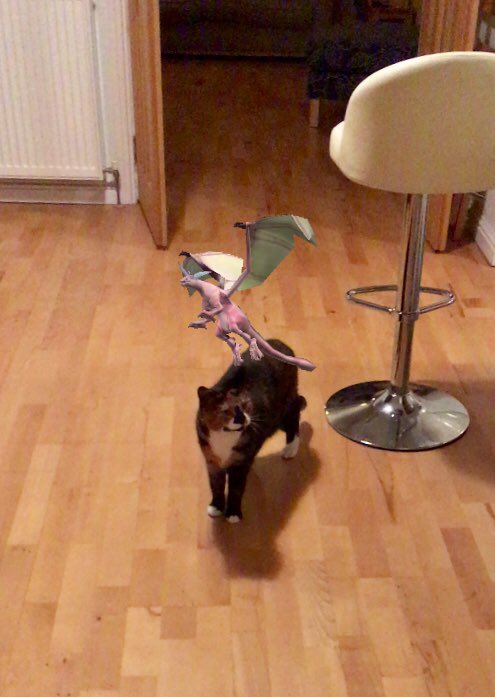
Niko is unimpressed…, CC BY, Lorna M. Campbell

The fun and games kicked off with Festival of Creative Learning in mid February.  My OER Service colleague Charlie ran a really fun and thought provoking 23 Things for Digital Confidence workshop.  The workshop challenged us to explore how we engage with technology in creative ways and we also got to play with some really cool augmented reality toys.  Oh, and there were dragons!  I took them home but I don’t think my cat was very impressed :}

Later in the week I helped to run a Get Blogging! workshop with Karen, Lila and Mark from DLAM, which guided students through the process of setting up a blog on Reclaim Hosting and provided them with some pointers on the benefits of blogging and topics they could write about.  I don’t usually get to work directly with undergraduate students so it was a really rewarding experience.  Their enthusiasm was infectious and it was great to see how proud and excited they were to leave at the end of the day with their very own brand new blog.  The fabulous feedback the students left was just the icing on the cake.  My slides from the day are here: Why Blog?

At the beginning of March we celebrated Open Education Week, I’ve already written a post about the activities we planned over the course of the week, and they all went really well.  We curated eight blog posts from staff, students and graduates on the Open.Ed blog over the course of the week, each bringing a unique perspective on engaging with open education. You can read a round-up of of these posts here.  I particularly like this quote from Martin Tasker, our very first Open Content Curation Intern, who is now building a career as a software engineer.

“In an age where where the world is both more connected and less trusting than ever, the onus is on institutions such as universities to use their reputations and resources to promote open education. As well as benefiting the public, it benefits the institutions themselves – there’s little better in the way of marketing than having potential applicants having already experienced some learning at your institution.” 

I’ve often quoted Martin’s Open Content Curation blog posts when I talk, and I’m sure I’ll be quoting his Open Education Week blog post, Reflecting on the Importance of Open Education, too.  

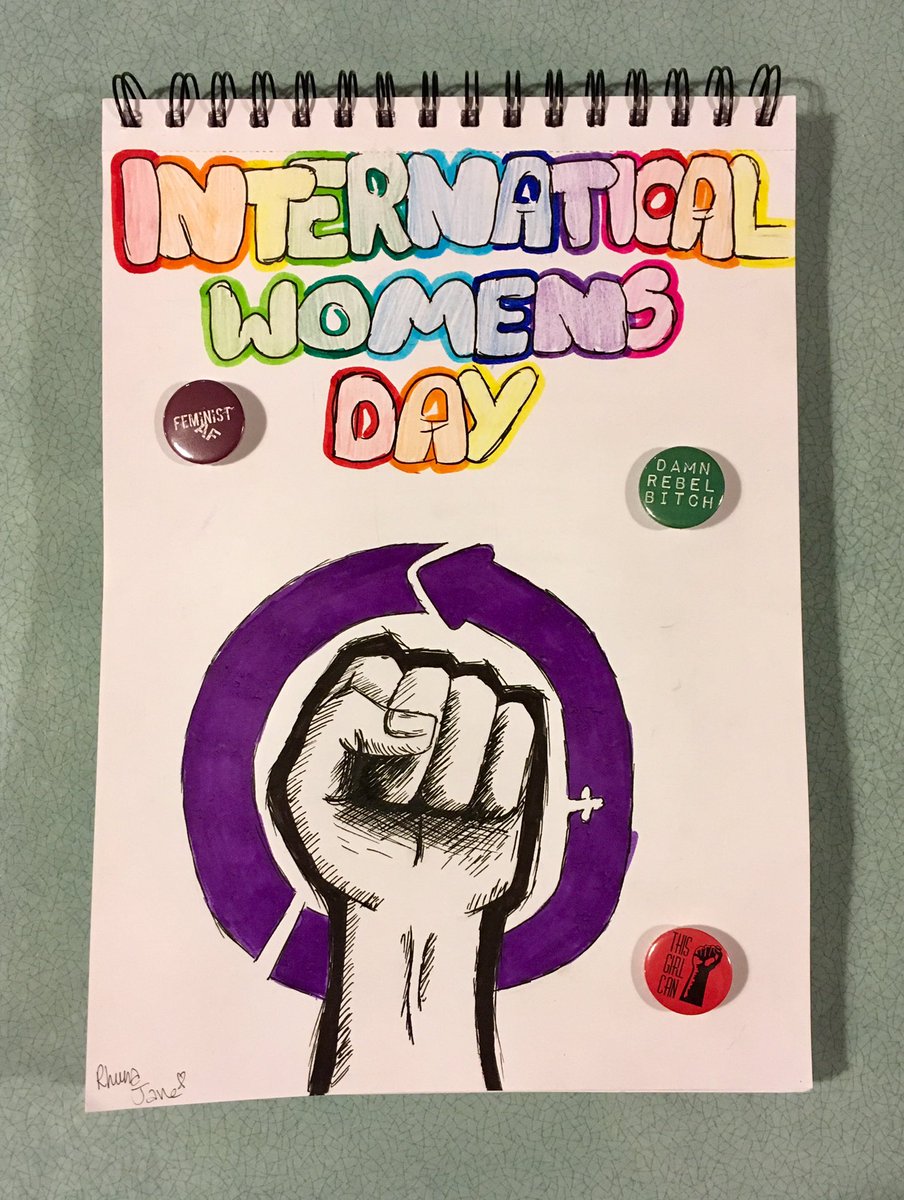
My daughter’s contribution to International Women’s Day, CC BY SA, RJ McCartney

International Women’s Day fell at the end of Open Education Week and Information Services marked the event by hosting a Women of Edinburgh Wikipedia Editathon and naming the Board Room in Argyle House after Brenda Moon, the first woman to head up a research university library in the 1980s, and who played a major role in bringing the University into the digital age. I spent part of the day updating the Wikipedia entry I’d previously written about Mary Susan McIntosh to include information about her work as a Women’s Rights Advocate campaigning for legal and financial rights for married and co-habiting women, defending the right to sexual expression, and arguing against censorship of pornography.  

The following week I was off down to UCL for their Open Education Symposium.  It was a privilege to be invited to share the University of Edinburgh’s strategic approach to Open Education, and it was great to hear about some of ways that openness is supported across UCL.  I particularly enjoyed hearing a group of Arts and Sciences BASc students reflecting on their positive experience of engaging with Wikibooks.  Their comments reflected those of our Edinburgh student who have participated in Wikipedia assignments and editathons. 

Somehow, in amongst all that, there was also several ALTC submissions, the launch of femedtech.net, and my daughter’s 13th birthday.  How the hell did that happen?! 

Introducing the femedtech Open Space

This blog post, by Frances Bell and I, originally appeared on the OER19 Conference website earlier this week and I’m cross-posting it here for International Women’s Day.  Frances and I first started discussing the idea of a femedtech Open Space when OER19 launched their call for proposals, and right from the off we knew we wanted to create a space that was as open and inclusive as possible, one that would allow those who were unable to attend the conference to participate, and one that would live on after it.  I was keen to explore the use of the TRU Writer SPLOT template, having previously had a lot of fun with other SPLOT templates through our work at the University of Edinburgh.  Out of these vague ideals, lots of late night e-mail and twitter conversations, and with the generous help of the people acknowledged below, the femedtech Open Space was born. Find out more about this initiative and please consider contributing your voice to our community. 

One of the real strengths of the OER Conferences is that in recent years they have increasingly facilitated an ongoing critical discourse that seeks to question and renegotiate what openness means to educators, teachers and learners within different contexts and perspectives.  This discourse ripples out from the physical and temporal boundaries of the conferences in the form of blogs posts, twitter conversations, research papers and discussions that enable us to trace the evolution of narratives of open from year to year.  OER17 The Politics of Open explored the challenges current political movements posed for Open Education and how they might further or hinder values of inclusivity, sharing, connectedness, equity, voice, agency, and openness. OER18 Open For All sparked discussions around power and marginality, inclusivity, diversity, identity, decolonisation and respect, and these themes will be explored further during OER19.  When Co-Chair Catherine Cronin introduced the themes of OER19 Recentering Open: Critical and Global Perspectives at the end of OER18 in Bristol she stressed the imperative of moving beyond hero narratives and including marginalised voices.

These themes and values align strongly with those of femedtech, an open, inclusive and voluntary network of education technology practitioners informed by feminist principles.  femedtech is committed to creating inclusive online spaces where marginalised voices can speak and be heard. We acknowledge that this is an ongoing work in progress and a learning experience for all of us.

With this in mind, the femedtech network will be facilitating an inclusive Open Space session around OER19 to explore themes and conversations that have emerged from previous OER conferences around power, marginality, equality, diversity and inclusion.  We’ll be seeking to question dominant narratives of “open”, explore whose voices are included and whose are excluded from our open spaces and open practices, whose voices we choose to amplify and whose are silenced. 

Questions we hope to consider before, during and after the OER19 session include;

  • How do we balance privacy, openness and personal ethics?
  • How do we mediate our place in the open community, aspects of which might conflict with our personal ethics?
  • Is openness an act of conformance and / or defiance? And are there performative aspects to openness?
  • Do we feel pressured to be more open than we are comfortable with, or do our boundaries constrain us?
  • How do we manage sustainable spaces for exploring challenging issues around open?

In order to facilitate these discussions and to ensure the widest participation from the community, we are building an online femedtech Open Space, http://femedtech.net/, to gather stories, thoughts, reflections, responses and reactions, in the form of written content, images, audio, and media.  We welcome reflections on all aspects and experiences of openness from feminist perspectives and we encourage participants to raise their own questions and tell their own stories.  We acknowledge that our understanding of openness is highly personal and contextualised, and appreciate that there is no standard definition of openness to which we must comply.  In order to ensure that engaging with the #femedtech Open Space will be as widely accessible and inclusive as possible, participants are able to contribute to these conversations anonymously if they choose.   

Through the femedtech Open Space, we also aim to explore how we build our communities and practices here and elsewhere in the #femedtech network, and evaluate whether this is a sustainable model for growing the #femedtech community and network. Inspired by Dignazio & Klein (2018), we will develop our inclusive values statement iteratively in conjunction with activities on the Open Space and across the femedtech community. 

During the conference session, we will briefly introduce the Open Space for those who haven’t seen it before, and invite delegates and virtual participants to contribute and discuss their own ideas and reflections. We’ll summarise progress to date, invite feedback from session participants, outline future plans, and encourage participants to engage with others’ contributions after the conference. We also hope to encourage remote participation in the conference session.

We invite you to visit the femedtech Open Space to contribute your thoughts, reflections, comments, stories and ideas: http://femedtech.net/

Acknowledgements

This is an extra-institutional project taking place within the broad venture of the femedtech network. 

Thanks to Maren Deepwell and Sheila MacNeill who have contributed to shaping this initiative and will be helping to facilitate our OER19 conference session. 

The femedtech Open Space is generously hosted by Reclaim Hosting.  Reclaim Hosting provides educators and institutions with an easy way to offer their students domains and web hosting that they own and control.   The site uses the open source TRU Writer SPLOT WordPress theme developed by Alan Levine and available on Github. 

Our Code of Conduct is adapted with permission from  PressED Conference run by Natalie Lafferty and Pat Lockley. It incorporates elements from ukmedchat and FOAMed and is intended to be interpreted according to feminist principles.