Reusing Open Resources: Learning in Open Networks for Work, Life and Education

rorBack in 2003 I contributed a chapter to Allison LIttlejohn’s book Reusing Online Resources: A Sustainable Approach to E-learning and I’m delighted to say that, together with co-authors Sheila MacNeill and Martin Hawksey, I have another paper in the subsequent book in this series Reusing Open Resources: Learning in Open Networks for Work, Life and Education edited by Allison Littlejohn and Chris Pegler.

“Every day, learners use and reuse open, digital resources for learning. Reusing Open Resources offers a vision of the potential of these open, online resources to support learning. The book follows on from Reusing Online Resources: A Sustainable Approach to E-learning. At that time focus was on the creation, release and reuse of digital learning resources modeled on educational materials. Since then the open release of resources and data has become mainstream, rather than specialist, changing societal expectations around resource reuse. Social and professional learning networks are now routine places for the exchange of online knowledge resources that are shared, manipulated and reused in new ways, opening opportunities for new models of business, research and learning.”

~Littlejohn and Pegler

Our paper,  “Analytics for Education”, presents an overview of the development and use of analytics in the context of education through a critical analysis of current developments in the domain of learning analytics, and contrasts the potential value of analytics research and development with real world educational implementation and practice. The paper also focuses on the development of education content analytics, considers the legal and ethical implications of collecting and analysing educational data and highlights new developments including the exploration of data from massive open online courses (MOOCs).

Reusing Open Resources also includes papers on a wide range of current topics including European OER policy, workplace learning in informal networks, collaborate knowledge creation and, of course, MOOCs.

Several papers from this book, including ours, have already been published in a special edition of JIME, the Journal of Interactive Media in Education, Reusing Resources – Open for Learning.

#Cetis14 Open Education: From Open Practice to Open Policy

Last week Li and I ran a session at the Cetis Conference on Open Education: From Open Practice to Open Policy.  My initial plan had been to focus on questions such as:

  • What, if any, is the value of open education policy?
  • Do institutions need open education policies?
  • Should government agencies play a role in the development of open education policy?
  • Are there conflicts between commercial interests and market forces, and open education policy and practice?
  •  How can open education initiatives be nurtured and sustained?
  • And what do we mean by “open education” anyway?!

However after talking to David Kernohan he suggested:

“Why not invent a country and create an open education policy for it? We treat the delegates as the government of said country, and we each present what we have done making recommendations for the policy. At the end we ask the “government” to discuss and reach a conclusion.”

So we invited six speakers to talk about their experience of open education policy and practice and, if they felt up to the challenge, to present their policy recommendations for our fictional country.  Marieke Guy of the Open Knowledge Open Education Working Group attended the session has already written an excellent summary of the presentations and discussions here: Cetis Conference 2014 – Time to unhide open. I’m not going to attempt to duplicate Marieke’s great post, which I can highly recommend, so I’ll just highlight a couple of points raised by speakers over the course of the session.  I’ve also posted a Storify of the twitter discussion and relevant links here.

David Kernohan, Jisc

David Kernohan of Jisc kicked off by discussing what is and is not a policy and asking why we might want policy in any given area.

To provide explicit support for a particular practice or idea…
… but not to enforce either the practice or the idea.

To provide a scaffolding for proposed future work…
… or to reinterpret earlier work in the light of a later idea.

To bring a matter to wider attention…
… with a hoped-for result that more concrete steps are taken.

David went on to present a potted history of Jisc’s involvement in open education (he even unearthed a picture of the dreaded #Cetis08 conference “pudding”) and the experiences of the UK Open Education Resources Programme.  David suggested that the success of UKOER was that it was non prescriptive and that multiple, small projects gave agency for people to “work in the open space”.  UKOER encompassed many policies, many people, many practices but resulted in one community.

David Kernohan, Jisc

David Kernohan, Jisc

David’s slides can be downloaded here – Policy, Practice, Chance and Control

Paul Richardson, Jisc RSC Cymru

Paul discussed different meanings of open, and along they way suggested that “MOOCs are a way of turning OER into an experience.”  He also presented a number of Welsh initiatives in the open education space including OER Wales Cymru, the Wales Open Education Declaration of Intent , Y Porth and the Open and online: Wales, higher education and emerging modes of learning Welsh Government report which Paul himself made an invaluable contribution to and which I’ve already blogged about here and on the Open Scotland blog.

Joe Wilson, Scottish Qualifications Authority

Joe gave a lively and thought provoking talk which focused on the potential benefits of open education practice and open educational resources in the schools and further education sectors.  This is a challenge when many education authorities still actively discourage their teachers from sharing resources.  Tis illustrates the gap between policy structures and teachers practice.  Joe also discussed the issue of skills development and called for greater support in upskilling teaching staff and raising awareness of open education.  Finally Joe concluded by introducing Open Scotland and the Scottish Open Education Declaration.

Joe didn’t use any slides but he was wearing a rather fine Desperate Dan t-shirt which later resulted in this dreadful pun on twitter.

Desperate DanDesperate Dan – an important steak holder in open education?

Desperate Dan © DC Thomson & Co. Ltd.
Desperate Pun © Viv Rolfe

Suzanne Hardy, Newcastle University

Suzanne Hardy, Newcastle University

Suzanne Hardy, Newcastle University

Suzanne told us the story of open education developments at Newcastle University.  Being a Russell Group university, Newcastle is highly risk averse and pushing through new policies takes “forever”.  However despite legal concerns about copyright and licensing, Newcastle has embraced MOOCs and will be running its first Futurelearn MOOC shortly, Hadrian’s Wall: Life on the Roman frontier.  Suzanne noted wryly that MOOCs are seen as a good marketing opportunity, and that “marketing trumps the lawyers”. In conclusion, Suzanne warned of the danger of policy becoming a tick box exercise that stifles innovation before reminding us that “it’s people that sustain open education, not policy, not practice”.

Suzanne’s presentation is available here.

Paul Booth, North West OER and Manchester Metropolitan University

Paul presented his own experiences of engaging in open education practice and, like previous speakers, highlighted the gap between open policy and practice.  On the one hand he was praised and rewarded for his open pedagogy, but at the same time he was also threatened with disciplinary action by his own institution. Paul also discussed the challenges of developing regional OER policy and warned that awareness of openness is still low and more needs to be done to promote open education.  Finally Paul rose to David Kernohan’s challenge and announced that he had established a new breakaway open education territory “kind of like Pitcairn” called it Granadaland with it’s own national anthem, sporting heroes and religion.

Granadaland's official sporting team

Granadaland’s official sporting team

cetis14_pb1

Grandaland’s official religion

Tore Hoel, Nordic OER and Oslo and Akershus University College of Applied Sciences.

Tore began by comparing the success of the Open Access movement to that of the open education movement adding “Why did open access succeed? It’s simple, there was a clear enemy.”  Tore suggested that much still needs to be done to raise awareness  and understanding of open education but added that OER can give organisations an opportunity to redesign their educational and financial models. Tore discussed the importance of multilingualism in developing open educational resources and also highlighted the Norwegian Government’s report on MOOCs.  In conclusion, Tore reminded us that “it’s not what you share it’s how you create it”.

Tore Hoel, Nordic OER

Tore Hoel, Nordic OER

Tore’s presentation can be downloaded here: CETIS14_OER.

OCWC Global Twitter Highlights

I’ve made a storify of a few of my twitter highlights from the recent OCWC Global Conference in Lubljana here: OCWC Global Conference Storify.

ocwcglobal_storify

Without a doubt my twitter highlight of the entire event has to be from Peter Bryant….

Welsh Government Report on Open and Online

(Cross posted from Open Scotland blog)

Last week the Welsh Government’s Online Digital Learning Working Group published their report  Open and Online: Wales, higher education and emerging modes of learning. The group was established in February 2013 by Leighton Andrews AM, the Welsh Government’s Minister for Education and Skills at the time,

“to examine the potential for online digital learning and how the Welsh Government can support the higher education sector in this growing field.”
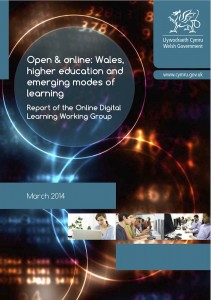
Wales O&OPaul Richardson of Jisc RSC Wales acted as professional advisor to the group and undertook the consultation exercise.  The report includes an invaluable background paper produced by Paul on Open and online resources: implications for practice in higher education institutions in Wales, which provides an invaluable overview of recent open education developments including OER and MOOCs, and quotes from a number of Cetis blogs and publications.  Although Paul’s paper focuses on the implications of open education for Welsh HEIs I can also highly recommend is as an excellent general summary of recent developments open education policy, practice and technology.

The report itself includes the following of seven recommendations addressed to the Minister for Education and Skills and higher education institutions.

To the Minister for Education and Skills

1. Widening access to higher education to those with low participation backgrounds.

Fund the development of O&O resources for use in schools and colleges, with the aim of raising aspirations of learners from low participation backgrounds. This scheme should be co-ordinated through collaboration between HEIs and schools and colleges in their region, via existing Reaching Wider Partnership networks.

Investigate the use of Hwb as a host for the O&O resources developed, with the intention of establishing a central repository where all schools and colleges may access these resources.

Extend the work of the Open University OpenLearn Champions project to cover the whole of Wales via the Reaching Wider Partnerships.

Liaise with NIACE Dysgu Cymru, Agored Cymru, and others to align O&O resource production with the needs of adult learners pursuing agreed progression routes, including CQFW.

2. Developing skills for the workplace and the Welsh economy

Develop a strategy, working with other agencies, to raise awareness of the potential for online learning to support economic development.

Use the Welsh Government’s sector panels to foster dialogue between stakeholders (including educational providers and employers) in order to identify opportunities to develop skills using online resources.

Examine how online learning should be integrated into the approach for programmes funded through the European Social Fund.

3.  Developing Welsh language skills for employment

Develop a Welsh language skills MOOC at higher education level so that students and work-based learners can develop their professional Welsh language skills and potentially seek certification for those skills.

To the higher education institutions

4. Reviewing institutional policies, monitoring developments and exploiting opportunities

Agree what the institution’s overall approach to open and online resources should be, monitor external O&O developments, and exploit opportunities to produce and use resources.

5.  Strengthening institutional reputation and brand

Exploit open and online resources in appropriate circumstances to showcase the quality of learning opportunities.

To the Minister and the higher education institutions

6.  Improving the skills of higher education staff

Institutions should provide academic staff with the skills and support they need to make most effective use of open and online approaches to learning.

HEFCW should continue to contribute to the costs of Jisc’s programme on open and online resources and take advantage of Jisc’s expertise.

HEFCW and the Higher Education Academy should take a lead on this agenda.

7. Licensing and sharing open educational resources

The Welsh Government should encourage the systematic adoption of open licensing for open educational resources produced by HEIs in Wales

Where possible staff and institutions should release open educational resources using an appropriate Creative Commons licence

Institutions should make open educational resources widely available, including via the Jorum repository.

Taken together with Welsh HEIs recent statement of intent to work towards the principals of open education, the publication of this report represents another important step forward for open education in Wales and provides inspiration for Open Scotland to continue raising awareness of open education policy and practice at senior management and government level.

The Open and Online report can be downloaded here and Andrew Green, chair of the Online Digital Resources Working Group has written an introductory blog post here MOOCs and other animals: ‘open & online’ report published

Open Scotland at Jisc DigiFest

 – this time with festival pic!

I missed a trick at Jisc DigiFest yesterday.  All the other presenters at David Kernohan’s splendid “Whatever happened to the MOOC?” session kicked off with a festival anecdote. David and Viv Rolfe, even had pictures of themselves playing at festivals! How cool is that?! I, however, launched straight into open education policy and practice :} Afterwards, James Clay rightly complained about my lack of festival-going anecdote.  So here, as promised and by way of recompense, is a picture of me at Glastonbury in 1992. And once you’ve all stopped laughing, there’s a copy of my presentation below.

Glastonbury 1992

Glastonbury 1992

Open Scotland

“We’ve heard about some really inspiring open education developments, many of which have their roots in the UKOER programmes. We know that it’s notoriously difficult to measure the impact of short term innovation funding, but two years after the end of UKOER, it’s interesting to look back and see that the programme does seem to have had a hugely positive impact right across English higher education. One of the aims of UKOER was to embed open education practice across the sector and it’s actually starting to look as if has done just that.

The situation is rather different north of the border.  Scottish institutions were not eligible to participate in the UKOER and, arguably, this has resulted in lower awareness of the potential benefits of open education, and open education practice is less well embedded across the sector.

Although there have been no comparable large scale funding initiatives, we have seen a number of innovative open education developments within Scottish education, particularly in the area of open badges and MOOCs, and groups like the Open Knowledge Foundation and Wikimedia UK have also made real efforts to engage with the education community.

In an attempt to join up these initiatives and disseminate open education practice more widely, Cetis, SQA, Jisc RSC Scotland and ALT Scotland, launched Open Scotland, a voluntary cross sector initiative that aims to raise awareness of open education, encourage the sharing of OER, and promote the development of open policy and practice.

Open Scotland partially takes its inspiration from Nordic OER “a network of stakeholders to support uptake, adoption and collaboration around OER in the Nordic countries” and we’ve also been inspired by Higher Education institutions in Wales who came together to agree a statement of intent to adopt open educational principles.  We see this statement as a positive development and are interested to see what impact it will have in practice.

Open Scotland has undertaken a number of awareness raising activities including the Open Scotland Summit, which brought together senior managers, policy makers and key thinkers to explore the development of open education policy and practice in Scotland. The Open Scotland blog was launched to disseminate news relating to all aspects of openness in education and to act as a focal point for discussion and debate.  We have also just this week released the first draft of a Scottish Open Education Declaration.  This is based on the UNESCO Paris OER Declaration, but extends its scope to focus on open education in general, rather than OER in particular. We invite all those with an interest in open education to contribute to shaping this draft declaration so we can reach a consensus on open education principles that will benefit all sectors of Scottish education.

There have also been some significant developments at Government level.  In a speech earlier this year, the Cabinet Secretary for Education outlined the Scottish Government’s vision of higher education and acknowledged the potential of MOOCs to form new pathways to learning, to widen participation and promote a culture of collaborative development and reuse. While it is hugely encouraging that the Scottish Government has started to acknowledge the potential of open education, there is some concern that the scope of this vision is insufficiently broad and may fail to encompass the wider benefits of open education to the Scottish sector as a whole. We all know that MOOCs are just one component of the wider open education landscape.

Open education policies and practice have the potential to benefit teachers and learners right across the sector, in schools, colleges and universities, in formal and informal learning scenarios, and to support life long learning right across the board. Open Scotland will continue engaging with these communities to highlight the benefits of all aspects of open education, to encourage the development of open education policy for Scotland.”

Jisc DigiFest and “What I Know Is”

It’s been a little quiet on this blog recently, I haven’t been sitting around twiddling my thumbs though, far from it! I’ve been busy on the Open Scotland front and with another exciting project that Phil Barker and I will be announcing very shortly.

I also seem to have got myself roped into an awful lot of conferences and events over the next three or four months. I’ve got ten presentations coming up between now and the end of June, on topics ranging from open education policy and Open Scotland, to the Learning Resource Metadata Initiative, to the crew of an 18th century naval frigate (yes really!)  If you want to find out where to catch me, I’ve updated my list of Presentations & Events.

The first couple of events I”m looking forward to are the Jisc DigiFest in Birmingham on the 12th of March and “What I Know Is” – a research symposium on online collaborative knowledge building in Stirling on the 19th of March.

Jisc DigiFest

digifest-side-bar

©Jisc and Matt Lincoln
www.mattlincolnphoto.co.uk
CC BY-SA

David Kernohan has invited me to Jisc DigiFest to participate in the panel session he’s running called Whatever happened to the MOOC?  The session will be:

“A discussion between UK and international speakers concerning current activity around open education and open courses. Find out how cutting edge academics and institutions are taking control of their own open education offerings, and adding value to traditional courses and outreach activities.

The “MOOC” (Massive Open Online Course) dominated discussions about online education in 2013. But as the bubble of media interest begins to fade, we will look at some of the interesting open education experiments and practices that could define the next wave of open education.

David has ambitious plans to run the panel as a single seamless narrative with seven speakers.  We’ve each been given a starting point and an end point in the narrative and have five minutes to cover our topic in between.  There will be no breaks between presenters and David has threatened to be ruthless if we deviate from our allotted five minutes. It’s going to be an interesting challenge!  The panel will also feature video contributions from the incomparable triumvirate of Jim Groom, David Wiley and Audrey Watters.  David has promised us it will be

“Insane? Possibly. Risky? Certainly. Fun? Totally.”

Wish me luck!

“What I Know Is”

260px-Wikimedia_UK_logo“What I Know Is” is a research symposium hosted by the Division of Communications, Media and Culture at the University of Stirling, which focuses on Wikipedia and other wikis and “inquires as to its status as a platform for collaborative online knowledge-building.”  The symposium aims to

“…bring together speakers from a range of disciplines, with a range of interests, from within the School of Arts and Humanities, and from across the UK, to share their work addressing different dimensions of  knowledge-building activities. It is hoped that in engaging with and sharing the various philosophical and interdisciplinary strands of research included in the symposium’s speaker-respondent structure, we will gain some insights into the true value of these online collaborations.”

I’m really pleased to have been invited to contribute to this event as I’ve been hugely impressed with Wikimedia UK’s recent efforts to diversify and engage with the education community throughout the UK over the last year.  I’m particularly looking forward to this event as, due to other commitments, I haven’t had a chance to participate in any of the fascinating events run by Wikimedia UK.  (I was particularly gutted to miss the recent Anybody but Burns editathon hosted by the Scottish Poetry Library.)  I’ll be speaking about Open Scotland and the Open Knowledge Foundation in a session on “Networked Communities, Commons and Open Learning.”

For a comprehensive overview of Wikimedia UK activities in SCotland see this great post by Graeme Arnott on the Open Scotland blog: Wikimedia in Scotland 2014.

College Development Network Librarians Open Developments in Scotland

[Cross-posted from the Open Scotland blog]

Earlier this week I travelled up to the Stirling where I had the pleasure of presenting the keynote at the College Development Network Librarians Open Developments in Scotland event. It was an interesting and lively event and it’s great to see college librarians really engaging with the open education debate. Open education has the potential to be of enormous benefit to the FE sector, and librarians have a critical role to play in raising awareness of open education and advising their staff on the development and use of open educational content and licences.

My slides are available here and I’ve posted a Storify of the event here: Librarians Development Network: Open Developments in Scotland.

My presentation was followed by a fascinating talk by Suzanne Scott about Borders College‘s adoption of Mozilla Badges.  There’s been a lot of talk about the potential of open badges recently, so it’s really interesting to see them being used in a real world scenario.   Borders College aren’t just using badges to motivate students and acknowledge their achievement, they are also using them to engage with staff and have replaced all staff CPD paper certificates with Open Badges.  Adopting badges has also had significant reputational benefit and has raised the profile of the college;  Borders College are 4th on Mozilla’s list of international Open Badge Issuers. 

Following Suzanne, Mike Glancey of the National Museums of Scotland gave a talk about SCURL‘s Walk in Access initiative.  Now I have to confess, I had never heard of Walk in Access before, but it sounds like a really valuable initiative.  Walk in Access provides members of the public with on-site access to digital content such as journals and databases, where licensing terms and conditions permit.  Walk in Access highlights libraries commitment to opening access and also helps to widen engagement and provide access to distance learning students. The SCURL Walk in Access report is available here.

In the afternoon we were lucky to have a presentation from the always inspiring Christine Sinclair about the University of Edinburgh’s Coursera MOOCs and her team’s experiences of running the ELearning and Digital Cultures MOOC (). Christine explained that Edinburgh initially got in involved with MOOCs for five reasons: reputation, exploration, outreach, shared experience and, most importantly, fun!  The Edinburgh MOOCs have the support of the principal and the senior management, and the university has invested a considerable amount of funding in the initiative, however a lot the courses still run on “staff goodwill, evenings and weekends.”   It’s too early to say if this is a sustainable approach, Edinburgh are still exploring this.  Although the  team didn’t want to produce “star tutor talking heads” videos they discovered that students still wanted to “see” their lecturers and to form a connection with them. Some students struggled with the  approach, asking “Why aren’t you teaching us? Where are our learning outcomes?”  but others really engaged and came back to act as Community Teaching Assistants the following year.

Christine was followed by Gary Cameron of the College Development Network who gave an inspirational talk calling for his colleagues across the college sector to “Share, Share, Share!” To facilitate this sharing the Re:Source repository has been established for the Scottish college sector as a place to share open educational resources.  CDN are also planning to issue small grants for staff to openly licence resources in key topic areas. Gary ended his talk by reminding us that:

“OER is no longer an option, it’s an imperative, but still need to win battle for hearts and minds.”

The final presentation of the day was from Susanne Boyle, who has recently taken over from Jackie Carter as Director of Jorum and Senior Manager, Learning and Teaching at Mimas.  Susanne is not the only new member of staff to join the Jorum team, within a couple of months, 50% of the  team will be new appointments!  Jorum will be supporting the Jisc funded FE and Skills Programme, and will be creating tools to make it easier for FE practitioners to connect with Jisc and Jorum content.  The team will also be focusing on Health Practice resources and collections, and will be working closely with the North-West OER Network.  I have been involved with Jorum since it was just a wee glimmer of a project proposal, and I have sat on its Steering Group through every phase of its development so it will be very interesting to see what this new lease of life brings!

Questioning assumptions about openness

Like many of my colleagues on twitter this week, I spent most of Tuesday following the #MOOCs2 back channel from the Leadership Foundation for Higher Education’s MOOCs: What we have learned, emerging themes and what next event.  Inevitably the issue of degrees of openness arose with many participants questioning and discussing the variable openness of MOOCs and their relationship to OER.   Anyone who follows this blog will know that this is a bit of a hobby horse of mine so I followed the discussion with interest.

Quite coincidentally, half way through the afternoon OERs4OpenShools (@OERs4OS) tweeted

https://twitter.com/OERs4OS/status/428191570836209665

Hoping to find a nice example of an open OER based course I klicked the link and was met with the following

oer4schools

Now I know I could simple have logged in, but I can’t help finding it slightly off-putting when a site that purports to be open immediately confronts me with a log in screen.  In a fit of impatience I tweeted:

To which Javiera Atenas (@jatenas) replied:

As so often happens, I didn’t have the time to dig any deeper so it was left to Pat Lockley to point out that this site appears to be a ning community which most likely has no restrictions on joining.  Still unconvinced I replied:

At that point Pat pointed out that OER-Discuss, the Open Education Resources Jiscmail list of which I am a moderator, also requires users to sign up, which I had to concede is a very fair point.  The whole discussion certainly led me to examine my own assumptions and preconceptions regarding openness and to turn my original question “How open is open?” back on myself.  Is a simple log in screen really a barrier to openness?  Does it discourage people from engaging?  And on a more personal level, have I got unrealistic ideals of what constitutes openness?

 PS. For the record, I’ve now tried registering for OER4OpenSchools and it appears to have a three step registration process.
1. Enter name, e-mail and dob, answer question, fill in captcha.
2. Receive e-mail and click authentication link.
3. Enter full name, country of residence, job description and reasons for wanting to joining the community.
I confess I gave up at step 3. although the site owners are very apologetic about the authorisation and authentication process:

“We have to approve every new member to protect the community from “spammers.” We apologize for any delay this causes. Please tell us why you are joining this network.”

Scottish Government Support for Open Education?

(Cross posted from Open Scotland.)

“We broadly support open licences and OER and need a serious public debate on this issue.”

~Michael Russell, MSP

This was the Minister for Education’s response to a question I put to him earlier today regarding Scottish Government support for open education policy and open licences for publicly funded educational resources in order to benefit learners, not just within Scotland, but internationally.  The Minister was speaking at the Future of Higher Education In Scotland and the UK event in Edinburgh, organised by the ESRC Fellowship Project: Higher Education, the Devolution Settlement and the Referendum on Independence.

In a wide-ranging speech outlining the Scottish Government’s vision of higher education in an independent Scotland, Russell stated that we need an education sector that can meet the challenge of new technological advancement and institutions that can fully explore the potential of new technologies for learning. MOOCs and OER have great potential to form new pathways to learning, to widen participation and promote a culture of collaborative development and reuse. Consequently a core group supported by SFC has been established to look at the benefits of OER and promote online learning resources produced by Scottish universities.  This group is composed of the Open University and the Universities of Edinburgh, Glasgow and Strathclyde; UHI may also have a role to play.

While it’s hugely encouraging to hear the Minister for Education acknowledging the importance, not just of the inevitable MOOCs, but of OER and open education more generally, I have some concerns that with such a narrow group of stakeholders involved in the core group, the scope of the debate might fail to encompass the wider benefits of open education to the Scottish sector as a whole.  Open education policies and practice have the potential to benefit teachers and learner right across the sector, in schools, colleges and universities, in formal and informal learning scenarios, and to support life long learning right across the board.

As yet, no further details have been released regarding the nature of the core group activities and the level of SFC investment, so we will continue to watch these developments with interest.

I hope to able to blog a fuller summary of this event shortly, but in the meantime, Martin Hawksey has made a twitter archive of the event hashtag available here: #HEScot

A good start to 2014? MOOCs, OER and open courses

Just a fortnight in to 2014 and it’s already been an encouraging year on the open education front.   I’ve had a lightning talk on Open Scotland accepted for OER14 in Newcastle and Phil Barker and I have also had a paper on LRMI accepted for the OCWC Conference in Llubljana.

I was also very encouraged by Andy Beggan’s announcement on OER_Discuss that the University of Nottingham will be running a FutureLearn MOOC, Sustainability, Society and You, which, in Andy’s own words:

“tries to adhere closely to the aims and objectives of OERs as much as possible, and is 8 weeks long with hundreds of OERs of various types from external sources. We have also made the entire course itself available under a Creative Commons licence.”

I’ve written several posts recently about the restrictive licenses used by some commercial MOOC platform providers and their thorny relationship with OER, so it’s really encouraging to see more MOOC developers making a real commitment to openness.  There have been other examples of MOOCs based on open content and principals ofcourse, most notably the University of London’s Coursera MOOC English Common Law: Structure and Principals, which Pat Lockley has been involved in.  Other courses highlighted by list members include the University of Southampton’s Web Science: How the web is changing the world, which plans to share all it’s resources through EdShare, and Delft University of Technology’s courses on edEx which carry a CC-BY-SA-NC licence.

Andy’s announcement also sparked an interesting discussion about the Terms and Conditions adopted by FutureLearn and other MOOC platform providers and whether they supported or discouraged the use of open education resources and open education practice.  The overwhelming response from list members whose institutions have signed partnership agreements with FutureLearn is that they have been very supportive of partners who want to develop courses based on OERs and that they are keen to offer more courses using open licences, which is very good news indeed!

For the record, FutureLearn’s Terms and Conditions state:

“Certain Partner Institutions may, at their own discretion, make available certain Online Content and Courses under a Creative Commons licence (non-Commercial). Should Partner Institutions choose to do this, it will be clearly identified on the appropriate Online Content and Courses page of the Website and we acknowledge that the Creative Commons licence will override certain of these terms and conditions as appropriate. A full copy of the relevant Creative Commons licence will be available from a link at that point.”

So any decision to use  or develop openly licensed content or courses lies with the partner institutions, rather than FutureLearn itself.

There was also some discussion about the Non Commercial clause; Steve Stapleton explained that the Nottingham team contacted the rights holders of all third party content they planned to use in their MOOC and, of all those that responded, none objected to their content being used.  Pat Lockley added that the University of London had also contacted third party rights holders and that only one had refused permission for their content to be used in the Common Law MOOC.

You can follow the full thread of this discussion which includes some fascinating points about FutureLearn and Coursera’s terms and conditions (honestly, it’s much more interesting than it sounds!) and their increasingly positive approach to open education courses and content.  That has to be a good way to start the year doesn’t it?!