A Culture of Sharing: Strategic Support for OER at the University of Edinburgh

Many thanks to P-8 Digital Skills Project “Strengthening Digital Skills in Teaching”, ETH Zürich and ZHAW for inviting me to speak at their OER Conference 21. Slides and transcript of my talk, which highlights the work of Wikimedian in Residence, Ewan McAndrew, GeoScience Outreach students and Open Content Curation Interns, are available here.

Before we get started I just want to quickly recap what we mean when we talk about open education and OER.

The principles of open education were outlined in the 2008 Cape Town Declaration, one of the first initiatives to lay the foundations of the “emerging open education movement”. The Declaration advocates that everyone should have the freedom to use, customize, and redistribute educational resources without constraint, in order to nourish the kind of participatory culture of learning, sharing and cooperation that rapidly changing knowledge societies need.  The Cape Town Declaration is still an influential document that was updated on its 10th anniversary as Capetown +10, and I can highly recommend having a look at this if you want a broad overview of the principles of open education.

There are numerous definitions and interpretations of Open Education, some of which you can explore here.

One description of the open education movement that I particularly like is from the not for profit organization  OER Commons…

“The worldwide OER movement is rooted in the human right to access high-quality education. The Open Education Movement is not just about cost savings and easy access to openly licensed content; it’s about participation and co-creation.”

Continue reading →

Fundamentals of Music Theory – Adventures in open textbooks

Fundamentals of Music Theory open textbook coverLast week I was delighted to see a project that I’ve been working on since the beginning of the year come to fruition with the publication of the Fundamentals of Music Theory open textbook on the University of Edinburgh Library’s new ebook platform Edinburgh Diamond.  The open textbook was created by the the Open e-Textbooks for Access to Music Education project, which was funded by a University of Edinburgh Student Experience Grant. Led by Dr Nikki Moran and I, the project was a collaboration between the University’s OER Service, and staff and student interns, Kari Ding, Ifeanyichukwu Ezinmadu and Ana Reina Garcia, from the Reid School of Music.

The aim of the project was to explore the creation of an open etextbook using existing content from the Reid School of Music’s Fundamentals of Music Theory course. This course covers the fundamentals of Western music theory, from absolute basics to more advanced concepts, and provides learners with the skills needed to read and write Western music notation, and to understand, analyse, and listen informedly. The course uses content originally created for a successful Coursera MOOC, in addition to new materials developed more recently for an on campus blended learning course, addressing global decolonisation issues around music theory and music education. These high-quality resources were ideally suited to further repurposing to create an open textbook, increasing the use of this tried-and-tested content, and making it available to teachers and learners in an accessible format ideally suited to hybrid and online learning.   

The project provided us with an opportunity to evaluate a range of open textbook platforms and to gain valuable hands-on experience of the process and practicalities of creating an open textbook.  This experience is particularly valuable at a time when universities are increasingly moving from print to digital textbooks and are facing rapidly rising textbook licensing costs. Open textbooks have the potential to benefit the University by reducing textbook costs, benefit staff by providing access to easily customisable open textbooks, and benefit students by providing free, high quality digital learning materials. 

The project also enabled our student interns to develop valuable digital and copyright literacy skills including an understanding of open educational resources, open licenses and open etextbooks, familiarity with current etextbook applications, and experience of working with existing digital content and educational resources across a range of platforms. 

One of the first tasks undertaken by the project was to evaluate a range of different hosting options for our ebook; Manifold, PressBooks, GitHub and the University Library’s new ebook platform, Edinburgh Diamond, based on Open Monograph Press.  Balancing the pros and cons of each platform and considering the constraints of time and funding, we decided to publish our open textbook on Edinburgh Diamond. Open Access Publishing Officer Rebecca Wojturska, provided us with invaluable support in getting our textbook onto the platform and providing ISBN and DOIs. 

The project wasn’t without it’s challenges; the whole project had to be undertaken online due to COVID-19 restrictions, some of our student interns were working in different time zones, and I had no prior experience of producing the ePub formats required by the ebook platform, so it was a steep learning curve on my part!  I also had to dust off my rusty html and css skills which I haven’t used for years.  Despite the challenges, the project successfully demonstrated that it is possible to take existing MOOC and on-campus course content and repurpose it into an open textbook.

All in all, this was a hugely rewarding project, not least because of the enthusiasm and dedication of the team at the Reid School of Music.  It was a real joy to work with Nikki, Ana, Ifeanyichukwu and Kari.  One of the high points of the project was listening to our student interns presenting about their work at the OERxDomains Conference –  The Scale of Open: Re-purposing open resources for music education.  Our talk was really well received, with lots of delegates commenting on how important it was to hear students’ voices.  We learned a great deal from this small project and I hope that Fundamentals of Music Theory will be the first of many open textbooks published by staff and students across the University. 

Fundamentals of Music Theory is shared under a Creative Commons Non-Commercial ShareAlike (CC BY-NC-SA 4.0) licence and can be downloaded from Edinburgh Diamond in the following formats: Word, PDF, EPub (reflowable), ePub (fixed layout).  An HTML version will be available shortly. In order to make the open textbook as accessible and reusable as possible, users can download the book in its entirety, or topic by topic.

ISBN: 978-1-912669-22-6
DOI: https://doi.org/10.2218/ED.9781912669226

Header and cover image adapted from a free to use image by Geralt on Pixabay.

A new OER Policy for the University of Edinburgh

This post originally featured on the University of Edinburgh’s Teaching Matters blog. 

In September 2021, the University of Edinburgh’s Education Committee approved a new Open Education Resources (OER) Policy, which revises and updates our previous 2016 policy. Supported by the central OER Service, the policy encourages staff and students to use, create and publish OERs to enhance the quality of the student experience, expand provision of learning opportunities, and enrich our shared knowledge commons. Investing in OER and open licensing helps to improve the sustainability and longevity of our educational resources, while encouraging colleagues to reuse and repurpose existing open materials expands the pool of teaching and learning resources and helps to diversity the curriculum. As one of the few universities in the UK to have an OER policy, the new policy strengthens the University of Edinburgh’s position as a world leader in open education and reiterates our strategic commitment to openness and achieving the 2030 Agenda for Sustainable Development.

Five years of OER at the University of Edinburgh

“Staff and students at The University of Edinburgh produce huge amounts of teaching and learning materials every year. The OER policy helps us to help you make them available for sharing with teachers and students all around the world.”

Dr Melissa Highton, Assistant Principal and Director of Learning, Teaching and Web Services (LTW)

In the five years since the first OER Policy was approved, the quantity and quality of open educational resources produced by staff and students across the University has increased enormously. We now have a collection of thousands of media assets, hundreds of OERs, and dozens of massive open online courses that can be used, re-used, adapted and re-shared in sustainable ways. This includes almost 5000 open licensed videos on Media Hopper Create, 243 open resources and collections shared through the Open.Ed OER Showcase, 84 free short online courses, and 67 student-created OERs for school teachers on TES Resources, which have been downloaded over 60,000 times.  The OER Service has run over 230 digital skills workshops, employed ten student interns, won three awards, and our How To Guides have been accessed 109,502 times.

Policy Review

The OER Policy review and revision was undertaken by Neil McCormick, Education Technology Policy Officer, and Lorna M. Campbell, OER Service Manager, both based in Learning Teaching and Web Services in ISG. In reviewing this policy, we considered developments at several other UK and European universities with existing OER practice.

Some institutions mandate the use of a single central OER repository to curate, quality control and monitor the impact of the resources their faculty create. Here at the University we trust colleagues to quality control their own teaching and learning resources, and we do not have a central OER repository because they are often unsustainable, and it can be difficult to encourage engagement. Instead, the Policy continues to encourage colleagues to share their open licensed teaching and learning materials in an appropriate repository or public-access website so that they can be discovered and re-used by others. The OER Service provides access to many channels for this purpose, including the OER Showcase, the Open Media Bank on Media Hopper Create, the Open.Ed Shop on TES Resources, and various channels on Flickr, YouTube, and Sketchfab.  We also have an @OpenEdEdinburgh twitter account that we use to share news, highlight OERs created by staff and students across the University, and connect with the global open education community.

Some universities mandate that any resource considered for internal teaching awards must be open licensed. While we encourage all colleagues to share their resources under open licence, and the sponsors of awards to consider OERs in their award criteria, we didn’t enshrine this in policy.

A third approach adopted by some institutions is that any resource produced in cooperation with the central learning technology service must be open by default. This is often the case in practice here at the University of Edinburgh; the majority of the teaching and learning resources created with support from the Online Course Production Service for our free short online courses are open licensed and are available on Media Hopper Create. In addition, the OER Service’s digital skills programme helps to increase understanding of the benefits of using and creating OERs, encouraging open practice, and improving copyright literacy among both staff and students.

Policy Updates

Following current global practice, the policy has adopted a new definition of OER from the UNESCO Recommendation on Open Education Resources.

“Open Educational Resources (OERs) are learning, teaching and research materials in any format and medium that reside in the public domain or are under copyright that have been released under an open license, that permit no-cost access, re-use, re-purpose, adaptation and redistribution by others.”

The update also brings the OER Policy in line with our Lecture Recording Policy and Virtual Classroom Policy. With the increase in media being recorded, knowledge of data protection has become essential when creating and sharing open content. The policy clarifies what personally identifiable information colleagues should be aware of when creating open resources, including names, images, voices and personal opinions of individuals.

Policy Licence

As with our previous policy, the new OER Policy has been released under a Creative Commons Attribution-NonCommercial-ShareAlike 4.0 International (CC BY-NC-SA 4.0) to enable it to be shared, reused and repurposed by others.

Visit the University’s OER Service at Open.Ed to find out more about the new OER Policy and what it means for you.

Making Hybrid Meetings Work

Last weekend I joined Wikimedia UK colleagues for our first in-person Board meeting and away day since 2019. I say joined, but I actually dialled in remotely, while the rest of the Board met in person in London.  Much as I would have loved to see everyone, the Board away day is always a really stimulating and inspiring event, I didn’t feel comfortable risking the 7 hour train journey from Glasgow to London. Thankfully Wikimedia UK CEO Lucy Crompton-Reid was more than happy to accommodate remote participation and to run both the Board meeting and the away day as hybrid events.  This wasn’t entirely straight forward because as interim Chair of Board, I was chairing the Board meeting on Friday evening, and we had lots of group working and breakout sessions planned for the away day on Saturday.  With a little patience and consideration from everyone involved we managed to make it work though.  

Since we’re all currently trying to get to grips with hybrid working, I thought it might be useful to share some thoughts and observations on how to make sure everyone can participate in hybrid meetings.   

Good Practice is Good Practice

We’ve all got used to online meetings but hybrid meetings require a little additional planning.  The good news is that, in keeping with the principles of universal design, a lot of the things that really make a difference in running successful hybrid meetings are good practice for any kind of meeting.  Specifically:

Remind everyone to speak slowly and clearly.  This is helpful not just for remote participants, but also for anyone whose hearing is impaired.

Don’t let people speak over each other.  It’s very hard to follow the conversation if multiple people are speaking at once, and this can also discourage people from participating.

Make sure everyone has a chance to speak. If you’re chairing the meeting, make sure you give all participants an opportunity to contribute.  Don’t forget remote participants!

Technology

You don’t need a room with built in conferencing technology to run a hybrid meeting, though it can help. We made it work perfectly adequately with a laptop and Zoom. 

If you’re going down the laptop route, make sure you have a backup machine or two, as audio and connection quality might vary.

Allow extra time to get set up.  It will always take longer than you think!

If remote participants are joining via a dedicated laptop, make sure someone is watching it to catch chat messages or in case the connection drops out.

Audio and Video

Audio quality is much more important than video, if you’ve got low bandwidth or the connection is spotty, turn off cameras.  You might want to turn cameras on for introductions and then turn them off again afterwards.  You can also turn cameras on at periodic points, perhaps during breaks, so people can see each other without disrupting the meeting.

Use an external microphone where possible.  Laptop mics tend to be directional so only pick up those sitting directly in front of the mic.

If you have a screen you can project remote participants onto it, but again, it’s not necessary to run a successful hybrid meeting. 

Background noise has a big impact on audio quality and can make it very hard for remote participants to hear in room discussions. Minimising background noise is particularly challenging as a result of the ongoing COVID pandemic which requires rooms to be well ventilated. Opening windows or turning on air conditioning can introduce so much background noise that remote participants may struggle to participate.  However, the safety of the people in the room has to be paramount, so if possible, try to find a room that you can ventilate safely, without having too much impact on audio quality.  

Facilitating Hybrid Meetings

It’s useful for the meeting facilitator or chair to use a separate laptop from the one remote participants are dialling in to, so they can project minutes, documents, etc., if necessary.  This also means that someone other than the facilitator can reinstate the connection if it drops out.

If you want to capture group discussions, use a shared document projected on to a screen, rather than a flipchart. This enables remote participants to contribute and to read points captured from others.

Photographing card sort activities, flip charts and notes, and sharing the pictures with remote participants works perfectly well if you don’t have shared docs, Padlets etc set up.

Don’t forget to include remote participants!

And if you’re participating remotely…

Test your set up before hand if necessary.

Don’t be afraid to ask colleagues to speak up or to speak more clearly if you can’t hear them.

You may have to interrupt people in order to contribute to group discussions, as participants in the room won’t have the visual cues that you want to speak.

It’s much easier to participate remotely if you’re not the only one dialling in.  If you have multiple people participating remotely you can work together in breakout groups and use shared documents to capture discussions.

Hybrid meetings can really tiring if you’re joining remotely, as you may have to listen really closely to follow discussions in the room.

It might sound like a lot to think about, but with a little preparation, care and consideration it’s not difficult to run successful hybrid meetings were everyone has a chance to participate.

ALTC 2021 – Ethics, joy and no gobackery

This year’s annual ALT Conference was a bit of a different experience for me as it’s the first time in years that I wasn’t speaking or doing social media coverage, I was “just” a delegate among over 300 others, and honestly it was a welcome experience just to be part of that community and to listen to and learn from colleagues across the UK and beyond.  This was the first ALT Annual Conference to take place entirely online, and although I was only able to dip in and out over the course of the three days, I got a real sense of the buzz around the event.  It really did feel like a broad and diverse community coming together. 

With the launch of the ALT Framework for Ethical Learning Technology, ethics was a central theme that ran throughout the conference.  The Framework is an important and timely initiative co-created by members of the community and led by ALT Trustees Bella Abrams, Sharon Flynn and Natalie Lafferty. The aim of the Framework is to provide scaffolding to help learning technologists, institutions, and industry to make decisions around technology in an informed and ethical manner. This work is very much a starting point and over the next year, ALT will be gathering case studies and example policies from across the sector.  At Edinburgh, we’ve already submitted our open licensed Lecture Recording Policy as an example.  Speaking in a panel as part of the launch, Javiera Atenas suggested that we use the Framework as a starting point and urged us to go further than the principle of Do No Harm when it comes to gathering and using data.

Sonia Livingstone’s keynote also focused on the ethics of data use and the quantification and instrumentalisation of learning.  We operate in a system where learning is rendered invisible if it cannot be quantified, and increasingly we’re moving from the quantification of learning to the datafication of everything.   Sonia asked a lot of hard questions, including what does “good” look like when it comes to children’s data rights, and how do we ensure children’s agency and participation in the collection and use of their data?

Chris Rowell and Matthew Acevedo presented an excellent session on academic integrity and critical digital pedagogy from the forthcoming book Critical Digital Pedagogy – Broadening Horizons, Bridging Theory and Practice edited by Suzan Koseoglu, George Veletsianos, Chris Rowell. Matthew’s talk explored virtual proctoring, the Panoptic gaze, and the discourse of academic integrity. It was another thought-provoking session and I’ll look forward to reading the book once it’s published. 

Mutale Nkonde’s keynote explored the intersection of ethics and technology in her revealing dissection of the racist nature of the TikTok algorithm and the impact this can have on real lived experience.  We know that algorithms and technologies reproduce racial biases that exist in society, but we lack the literacy to be able to view and talk honestly about ourselves as victims and perpetrators of white supremacy. Mutale introduced the Framework for Racial Literacy in Technology which provides us with the means to talk about racism and algorithmic bias through cognitive, emotional and active lenses.  Mutale challenged us to ask ourselves, when we are creating algorithms, how can we optimise them for fairness and justice?  How can we make the lives of marginalised peoples better rather than promoting those who are already privileged?

As the parent of a teen who is a frequent TikTok user, Mutale’s talk left me with a lot to think about and discuss with my daughter.  At 15 she is well aware that TikTok is a massively racist platform and she knows that the way the algorithm pushes content to users can be extremely harmful.  In particular she highlighted the prevalence of content relating to self-harm and trauma dumping.  On the one hand I’m glad that she has sufficient digital literacy to recognise that the content she views is being manipulated by the platform, but at the same time it’s deeply concerning that harmful content is being pushed to users at such a young age.

Lou Mycroft’s keynote was one of the highlights of the conference for me.  I’ve been familiar with Lou’s work for a long time and have often seen the #JoyFE hashtag passing on my timeline, but this is the first time I’ve heard her talking about the philosophies and ethics that underpin this amazing collective.  In an inspiring and expansive talk, Lou explored an ethics of joy as characterised by Spinoza’s concept of potentia; by practising joy, we enact our power in the form of potentia.  Lou challenged us to use our potentia to drive change, and resist the fatal pull of “gobackery”, the gravitational pull of the old.  While Lou acknowledged that the ethics of accountability and KPIs will not be changing any time soon, she argued that we can have parallel values based on an ethics of joy, and urged us to put our core values into strategic planning, asking; What might assessment look like as a process of hope? What might induction look like as a practice of compassion? Or timetabling as a practice of equity?

One of the points Lou made in her talk, which stopped me in my tracks, was that right now Higher Education carries a burden of pain.  It’s true, we all know that, we all feel that pain every day, but to hear it stated so plainly was transformative.  However there is still a place for hope and joy.  In a sector that currently appears to be exercising all its considerable power to pull us back to old entrenched ways living, working, being, learning, we need to use our own hope and joy to keep driving change forwards.  To do that we need educator lead communities with explicit shared values and affirmative ethics.  I believe ALT is one of those communities, with its shared values of openness, independence, participation and collaboration.

As is inevitable with such a packed programme, and juggling the conference around existing work commitments, I missed so many sessions that looked really interesting, including several by colleagues here at the University of Edinburgh and one on Using OER to empower communities of undergraduate scholars by Carlos Goller.   I’ll look forward to catching up with the recordings of these sessions in the coming weeks. 

Right at the beginning of the conference, co-chairs Farzana Latif, Roger Emery, and Mat Lingard asked us when we first attended an ALT Conference or whether we were new to the event.  My first ALT Conference was in Manchester in 2000, where I presented a paper with Allison Littlejohn and Charles Duncan called Share and share alike: encouraging the reuse of academic resources through the Scottish electronic Staff Development Library.  It’s amazing to see how the ALT community has grown and developed over the last 20 years.  I look forward to seeing where the next 20 will lead us.

Enormous thanks once again to everyone who made this year’s ALT Conference such an inspiring and joy-full event, particularly the co-chairs, the keynotes, and of course Maren Deepwell and all the ALT team. 

ALT Annual Conference by Gloria Corra, winner of the #altc student competition at London College of Communication


M&M Podcast on Knowledge Equity

Earlier this week I had the very great pleasure of joining my colleagues Myles Blaney and Michael Gallagher for their fabulous M&M Podcast to talk about knowledge equity.  I’m a big fan of the M&M Podcast and knowledge equity is a topic that is very close to my heart so I really enjoyed the experience.

In a packed, half-hour conversation we covered everything from what knowledge equity means, improving knowledge equity through open education and co-creation, gatekeeping in open spaces, the impact of algorithmic bias, power, privilege and unconscious bias, learning from other cultures and knowledge structures, and what practical steps institutions can take to improve knowledge equity and inclusion. 

We also went off at a few tangents to talk about COVID vaccines, the historical repression of knowledge equity, how history is constructed and taught, acknowledging the legacy of Scotland’s colonial past, and confusing the twitter algorithm. 

You can listen to the podcast here – M&M Podcast 24: The one where we talk with Lorna Campbell, and like all good things, it’s open licensed of course! 

Knowledge Activism: Representing the History of HIV and AIDS activism on Wikipedia

This is a transcript of a talk I gave for the University of Liverpool School of the Arts “Making a difference in the real world” series. 

My name is Lorna Campbell, I’m a learning technology service manager at the University of Edinburgh and I’m also a Trustee of Wikimedia UK, and today I’m going to be talking about Wikipedia as a site of knowledge activism, the representation of queer and marginalised histories on the encyclopedia, and particularly the history of HIV and AIDS activism.  And I’ll also be introducing some of the people who have inspired me on my own journey to becoming a knowledge activist.Slides are available here: Knowledge Activism

First of all I’d like to start with a few acknowledgements.  I know acknowledgements usually come at the end, but as I’m going to be talking about the work of colleagues whose knowledge activism has been deeply inspirational to me, I want to speak their names up front.  So I’d like to thank

  • Áine Kavanagh, Reproductive BioMedicine graduate, University of Edinburgh.
  • Prof Allison Littlejohn, Director, UCL Knowledge Lab & Dr Nina Hood, University of Aukland.
  • Ewan McAndrew, Wikimedian in Residence, University of Edinburgh.
  • Tara Robertson, Tara Robertson Consulting.
  • Tomas Sanders, History graduate, University of Edinburgh.
  • Sara Thomas, Scotland Projects Coordinator, Wikimedia UK.

Wikimedia UK is the UK chapter of the Wikimedia Foundation, the international not-for-profit organisation that supports the Wikimedia projects, of which Wikipedia is the best known.  Wikimedia’s vision is to imagine a world in which every human being can freely share in the sum of all knowledge.  This is not just a statement it’s a promise of inclusivity.

Wikipedia itself needs little introduction, the free encyclopaedia is the fifth most visited site on the internet, with over 6 billion monthly visitors.  English Wikipedia alone has over 6 million articles and there are an estimated 52 million articles in 309 languages supported by the site as a whole. 

Wikipedia is not just a repository of knowledge in its own right, it’s also a source of information for others services such as Google, whose 92 billion visits per month dwarfs Wikipedia’s paltry 6 billion. Amazon Alexa also draws much of its information from Wikipedia. Whenever you ask Alexa a question, there’s a good chance that the answer will come from Wikipedia.

In the global knowledge economy, knowledge is power, and Wikipedia is the largest repository of free, open and transparent information in the world.  Consequently, it’s perhaps no surprise that Wikipedia is censored to various degrees by numerous countries and regimes throughout the world, and outright banned by several including Myanmar, China, and Turkey. 

Having access to a platform where we can all access reliable, high quality information for free has never been more important in this age of disinformation, fake news, and government sanctioned culture wars.  How information is created and consumed matters like never before, and understanding how knowledge is created on Wikipedia can help people to understand how they consume and reproduce information.

Continue reading →

OERxDomains21 – All Change

OER21 BadgeThe OER Conference is always one of the highlights of the year for me. I’ve been privileged to attend every single one since conference launched in 2010 and it’s been interesting to see how the event has changed as open education has evolved over the last 11 years. My keynote at the 2018 conference focused on this evolution and explored how themes and trends around open education had developed, and the OER conferences had responded by become more diverse, inclusive, and international. This year the OER conference entered a new phase of its evolution with a new partnership and a new technology platform. OER21 was run in conjunction with the Domains Conference as OERxDomains21 and, instead of Blackboard Collaborate, the event used Streamyard, YouTube and Discord. The event was brilliantly co-chaired by Joe Wilson, Louise Drumm, Lou Mycroft, Jim Goom and Lauren Hanks.
I have to confess I didn’t know quite what to expect as the conference approached, for the first time in years, I wasn’t able to join the conference committee owing to other work commitments. Streamyard was completely new to me, and although I’m very familiar with Discord I was a bit conflicted about using it for work purposes, as it’s one of my main non-work channels; basically, it’s where I hang out with my friends on group chat.  In the event, the technology worked brilliantly, with unflappable support from ALT and the Reclaim Hosting team.   Proving the adage that a change is as good as a rest, the new platform encouraged all kinds of opportunities for discussion and interaction and lots of participants commented that the event had much more of a social feel than other online conferences. Discord really did have the feel of a physical conference space, where everyone came together to chat, share and hang out, and the live Youtube comment facility that accompanied the presentations and keynotes really helped to encourage discussion.  My only small regret is that with so much of the engagement happening across multiple conference platforms, there was less activity on the hashtags on twitter, which makes it a little harder to look back over all the discussions that took place.

It’s not the technology that makes the OER Conference such a special experience though, it’s the community, and this year was no exception.  I was really delighted to be attending with three student interns, Ana Reina Garcia, Ifeanyichukwu Ezinmadu and Kari Ding, to present a paper on our Open Textbooks for Access to Music Education project.  Our presentation got a really positive response and it was great to see how enthusiastically everyone responded to the students’ involvement in both the project and the conference.  You can find a transcript and slides, as well as more information about the project, on our blog here The Scale of Open: Re-purposing open resources for music education.

I also helped to facilitate an Open Space session with Jane Secker, Chris Morrison, Greg Walters and Sarah Barkala exploring the relationship between open practices, copyright literacy and the shift to online teaching. The Open Space sessions ran in dedicated Discord channels, and although the platform is ideal for group chat, participants were a little shy about taking the mic, and without an in-channel chat facility, it meant that there was less discussion than we’d hoped.  However we did collate some useful resources on a padlet around four key questions related to copyright law, literacy and open practice.

I had to dip in and out of the conference owing to a bit of a crazy workload and a lot of meetings, sadly that’s not something that even the best conference organisation can solve, however the new platform did make it very easy for me to catch up with sessions that I’d missed, which I really appreciated.  I made a point of catching as many of the keynotes as possible, and came away truly inspired. Three themes that emerged strongly across the conference were playfulness and creativity, equity and care, and acknowledging the labour of openness.

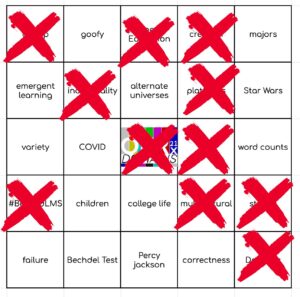
OER21 bingo cardCreativity and playfulness was very much to the fore in Laura Gibbs keynote #BeyondLMS: Open Creativity, Randomized which focused on the transformative power of encouraging creative writing on the open web.  Not only did Laura randomise her keynote slides she also let participants create randomised bingo cards so we could play along during her keynote.  Believe it or not, I was the first to get bingo! Though of course it’s the taking part that counts, not the winning 😉

Another of the creative highlights of the conference was Eamon Costello and Prajakta Grime’s mind expanding University V is alive! Now open to the closed, the cruel and the dead.  More of an incantation than a presentation, this incredible multimedia experience left participants challenged and bewildered. I missed the live performance but there was such a buzz about it on Discord that I dropped everything to jump over to youtube to watch the recording. 

A powerful ethic of care has been nurtured by the OER conferences year on year and it’s been humbling and inspiring to see seeds planted at previous conferences take root and grow.  Jasmine Robert’s keynote asked Open for Whom?: Revisiting the Global Commitments of Open Education and posed three key questions:

Jasmine reminded us that open is not always culturally appropriate in different cultural contexts and questioned the ease with which we assign authority to white men, while urging us to acknowledge and protect vulnerable scholars and people of colour who are doing the hard work of open scholarship. She closed her keynote by quoting bell hooks

“All the great social movements for freedom & justice in our society have promoted a love ethic. The testimony of love is the practice of freedom.”

And asking for “open education that is focused on a love ethic to move towards a path of global healing.”

In the Q&A session afterwards I asked Jasmine how we can work to ensure that the labour of care and social justice labour is fully acknowledged and more equally distributed?  She replied that we must begin by acknowledging how much we *all* benefit from social justice labour and care.

In the closing keynote, Rajiv Jhangiani also focused on the Curious Contradictions and Open-ended Questions of what it means to be open, who gets to decide what is open enough, and whether openness is always a good thing.  Rajiv cited an example highlighted by tara robertson of an instance where openness raised troubling ethical issues.  When the lesbian porn magazine On Our Backs was digitised and released under CC BY licence, women who had modelled for the magazine felt that work they had created for their own community had been appropriated for uses they had never intended and did not consent to. 

As someone who is passionate about knowledge activism and the representation of queer history in open culture, this really gave me pause for thought, particularly as I recently created a Wikipedia entry for another lesbian porn magazine Quim, which was co-created by a former On Our Backs photo editor.

Rajiv reminded us that:

“Openness can be leveraged for justice, but it can also do harm. Closed practices can also do harm, but there are times when closed is the empowered choice. Choice is key. We must serve justice, rather than merely being open.”

Another point Rajiv made that raised interesting questions for me was that “the OER Community is one where people are more comfortable to be vulnerable.”  This is certainly true, and I speak from experience, though of course we all have different relationships with that community and I wonder if we don’t always appreciate just how deeply uncomfortable vulnerability can make us feel, even within such a supportive community.  This had struck me during an earlier conference session where participants were asked so share, as part of a series of small groups discussions, stories of instances where care or equity had been lacking, and record them on slides to be shared with the larger group.  While sharing stories of this nature in a small group can be cathartic and empowering, it can be difficult and potentially risky for some to share examples from personal practice in public.  The exercise raised some interesting issues of power and inequity, points that the presenters acknowledged.  

For me, as is so often the case, it was Catherine Cronin who really captured the ethic of care that resonated at the heart of the conference by reminding us that

“Care without equity exacerbates inequality”.

To close I want to say a huge thank you to the teams at ALT and Reclaim hosting, the conference co-chairs and committee, and all the participants who made OER21 such a fun, engaging, thought provoking and empowering event.  And special thanks, as always, to Maren Deepwell who really embodies ALT’s commitment to community, care, equity and openness ♡

Those who fought: Representing HIV/AIDS activism on Wikipedia

LGBT History month is almost over but before the month draws to a close I want to highlight the brilliant work of the HIV Scotland Wikpedia editathon that took place at the end of January.  The event was supported by the University’s indefatigable Wikimedian in Residence, Ewan McAndrew, and organised by the University’s Disabled Staff Network and Staff Pride Network, who were keen to run another editathon following the success of their previous Pride editathon on LGBT+ Books in Scotland and Beyond.  (I’m proud to have created a page for the controversial lesbian magazine Quim as part of that event.)  I suggested HIV / AIDS activism in Scotland as a potential topic as I’d noticed previously that this important history was almost entirely missing from the encyclopaedia.  Scottish AIDS Monitor and PHACE West had no articles at all, and although an article already existed for Derek Ogg, it only touched on his legal career and made no mention of his prominent AIDS activism.  This omission was all the more glaring in light of the belated public conversation about the impact of the AIDS pandemic sparked by the broadcast of Russell T Davis’ series It’s a Sin.  The Network were keen to address this omission and HIV Scotland also came on board to support the event, and I’m pleased to say that six new articles were created and several others improved. You can find out more about the articles created on the event dashboard here: HIV Scotland Editathon.

As part of the event, I wrote an article about Scottish AIDS Monitor, an organisation I first came into contact with in 1992 at an event at the Tramway which coincided with their seminal exhibition Read My Lips: New York AIDS Polemics.  That event and exhibition, which featured works by Gran Fury, Keith Haring, David Wojnarowicz, Felix Gonzalez-Torress and others, left a huge impression on me.  I was aware of the AIDS pandemic, growing up in the 1980s it was impossible to ignore, even in the Outer Hebrides. Who could forget the stigmatising horror of the Don’t Die of Ignorance campaign?  But it was Read My Lips that really brought home to me the deeply personal impact of all those lost lives, the fight for justice and recognition, and the importance of organisations like SAM in raising awareness, providing support and promoting safe sex.

Read My Lips: New York AIDS Polemics

Returning to It’s a Sin, the second article I wrote this month was a biography of Jill Nalder, the actress and activist who inspired the character of Jill Baxter and who played her mother in the series. I know that there has been some criticism of the series for stereotyping women as carers, and for centering the experiences of a woman whose own sexuality and relationships are elided from the show.  While there’s a discussion to be had there, I think it’s important to acknowledge the many many “ordinary” women who played an important role in awareness raising, fund raising, befriending and yes, caring for, people living with AIDS from the earliest years of the pandemic. 

I still have a copy of the Read My Lips exhibition catalogue, which includes a transcript of Vito Russo‘s seminal speech, Why We Fight, from a 1988 ACT UP demonstration.  These lines really resonated with me. 

“AIDS is really a test of us, as a people. When future generations ask what we did in this crisis, we’re going to have to tell them that we were out here today. And we have to leave the legacy to those generations of people who will come after us.

Someday, the AIDS crisis will be over. Remember that. And when that day comes — when that day has come and gone, there’ll be people alive on this earth — gay people and straight people, men and women, black and white, who will hear the story that once there was a terrible disease in this country and all over the world, and that a brave group of people stood up and fought and, in some cases, gave their lives, so that other people might live and be free.”

Wikipedia is the fifth most visited website in the world, with aspirations to provide “free access to the sum of all human knowledge”.   For this reason more than any other it’s critically important that the history of HIV and AIDS activism is represented on the encyclopaedia.  So that those generations that come after will be able understand the legacy and the courage of those who stood up and fought. 

Open for Good – Open education and knowledge equity for all

This is a transcript of a keynote I gave at the Open University H818 The Networked Practitioner conference. 

The principles of open education were outlined in the 2008 Cape Town Declaration, one of the first initiatives to lay the foundations of what it referred to as the “emerging open education movement”. The Declaration advocates that everyone should have the freedom to use, customize, and redistribute educational resources without constraint, in order to nourish the kind of participatory culture of learning, sharing and cooperation that rapidly changing knowledge societies need.  One of the many contributors to the Cape Town Declaration was Wikimedia founder, Jimmy Wales.  Who commented in a press release to mark the launch of the Declaration:

“Open education allows every person on earth to access and contribute to the vast pool of knowledge on the web. Everyone has something to teach and everyone has something to learn.”

The Cape Town Declaration is still an influential document and it was updated on its 10th anniversary as Capetown +10, and I can highly recommend having a look at this if you want a broad overview of the principles of open education.

As conceived by the CapeTown Declaration, open education is a broad umbrella term, there’s is no one hard and fast definition.  In the words of open education scholar Catherine Cronin, open education is complex, personal, contextual and continually negotiated.

One conceptualisation of open education that I like is from the not-for-profit organization OER Commons which states that

“The worldwide OER movement is rooted in the human right to access high-quality education. The Open Education Movement is not just about cost savings and easy access to openly licensed content; it’s about participation and co-creation.”

And what I particularly like about this interpretation is the focus on empowerment, equity and co-creation, which to my mind are the most important aspects of open education and open knowledge.

Open Educational Resources (OER)

Owing to its contextual nature, open education encompasses many different aspects however open educational resources, or OER, are of course central to any understanding of this domain. Although there are multiple definitions of the term OER, the one I tend to default to is the UNESCO definition.

“OER are learning, teaching and research materials in any format and medium that reside in the public domain or are under copyright that have been released under an open license, that permit no-cost access, re-use, re-purpose, adaptation and redistribution by others.”

UNESCO OER Recommendation

The reason this definition is significant is that in November 2019 UNESCO made a formal commitment to actively support the global adoption of OER, when it approved its Recommendation on Open Educational Resources.

Central to the new Recommendation, is the acknowledgement of the role that OER can play in achieving United Nations Sustainable Development Goal 4: to ensure inclusive and equitable quality education and promote lifelong learning opportunities for all

 The Recommendation recognises that

“in building inclusive Knowledge Societies, Open Educational Resources (OER) can support quality education that is equitable, inclusive, open and participatory as well as enhancing academic freedom and professional autonomy of teachers by widening the scope of materials available for teaching and learning.”

And it outlines five areas of action

  • Building capacity of stakeholders to create, access, re-use, adapt and redistribute OER
  • Developing supportive policy
  • Encouraging effective, inclusive and equitable access to quality OER
  • Nurturing the creation of sustainability models for OER
  • Promoting and reinforcing international cooperation

Equality and diversity is centred throughout the Recommendation with the acknowledgement that

“In all instances, gender equality should be ensured, and particular attention paid to equity and inclusion for learners who are especially disadvantaged due to multiple and intersecting forms of discrimination.”

Wikimedia Movement Strategy

Elsewhere in the open knowledge domain, and running in parallel with the development of the UNESCO Recommendation, the Wikimedia Foundation has been undertaking its own Movement Strategy exercise to shape the strategic direction of the movement. The movement strategy, comprises 10 recommendations for change, and 10 guiding principles, many of which echo of principals of the UNESCO OER Recommendation. 

Enshrined in the Wikimedia Movement Strategy, are the key concepts of Knowledge as a Service and Knowledge Equity.

Knowledge as a service, is the idea that, Wikimedia will become a platform that serves open knowledge to the world across interfaces and communities.

And knowledge equity, is the commitment to focus on knowledge and communities that have been left out by structures of power and privilege, and to break down the social, political, and technical barriers preventing people from accessing and contributing to free knowledge.

Structural Inequality in the Open Knowledge Landscape

And to my mind it is this commitment to knowledge equity that is key to the open education and open knowledge movements, because as I’m sure we are all aware, the open knowledge landscape is not without its hierarchies, its norms, its gatekeepers and its power structures. We all need to be aware of the fact that open does not necessarily mean accessible. Far too often our open spaces replicate the power structures and inequalities that permeate our society.

For example Wikimedia’s problems with gender imbalance,  structural inequalities and systemic bias are well known and much discussed. On English language Wikipedia just over 18% of biographical articles are about women, and the number of female editors is somewhere between 15 and 20%. Some language Wikipedias, such as the Welsh Wicipedia, fare better, others are much worse. Despite Wikipedia’s gender imbalance being an acknowledged problem, that projects such as Wiki Women In Red have sought to address, too often those who attempt to challenge these structural inequalities and rectify the systemic bias, have been subject of targeted hostility and harassment.   

In an attempt to tackle these problems Wikipedia recently launched a new Universal Code of Conduct intended to make Wikimedia projects more welcoming to new users, especially underrepresented groups who have too often faced harassment and discrimination.   It’s too early yet to know how much impact this Code of Conduct will have but it’s certainly a much-needed step in the right direction.

Wikimedia is not the only open space that suffers from issues of systemic bias and structural inequality.  In a chapter on Open Initiatives for Decolonising the Curriculum, in Decolonising the University edited by Gurminder K Bhrambra, open source software developer Pat Lockley notes that UK universities with the highest percentages of black, Asian and minority ethnic staff are those which spend the least, and in many cases nothing, on open access article processing charges. And he goes on to ask whether Open Access really is broadening and diversifying academia, or merely reinforcing the existing system.

Similarly, in a 2017 survey on open source software development practices and communities, Github, another important open online space, reported huge gaps in representation and concluded that the gender imbalance in open source remains profound. From a random sample of 5,500 respondents 95% were men; just 3% were women and 1% are non-binary.

And there are many other examples of similar structural inequalities in open spaces and communities.

In a 2018 article titled “The Dangers of Being Open” Amira Dhalla, who at the time led Mozilla’s Women and Web Literacy programs, wrote:

“What happens when only certain people are able to contribute to open projects and what happens when only certain people are able to access open resources? This means that the movement is not actually open to everyone and only obtainable by those who can practice and access it.

Open is great. Open can be the future. If, and only when, we prioritize structuring it as a movement where anyone can participate and protecting those who do.”

This lack of equity in the open knowledge landscape is significant, because if knowledge and education are to be truly open, then they must be open to all regardless of race, gender, or ability, because openness is not just about definitions, recommendations and strategies, openness is about creativity, access, equity, and social inclusion and enabling learners to become fully engaged digital citizens.

OER and the COVID-19 pandemic

With the advent of the COVID-19 pandemic the role of OER in helping to provide access to inclusive and equitable education for all has become ever more critical.

In April last year, at the first peak of the global COVID-19 pandemic, UNESCO estimated that 1.57 billion learners in 191 countries worldwide had had their education disrupted.  In response to this unprecedented crisis, the organisation issued a Call for Joint Action to support learning and knowledge sharing through Open Educational Resources (OER).  The call highlights the important role that OER can play in supporting the continuation of learning in both formal and informal settings, meeting the needs of individual learners, including people with disabilities and individuals from marginalized or disadvantaged groups, with a view to building more inclusive, sustainable and resilient Knowledge Societies. 

OER at the University of Edinburgh

At the University of Edinburgh we believe that both open education and open knowledge are strongly in keeping with our institutional vision and values; to discover knowledge and make the world a better place, and to ensure our teaching and research is accessible, inclusive, and relevant to society. In line with the UNESCO OER Recommendation, we also believe that OER and open knowledge can contribute to achieving the aims of the United Nations Sustainable Development Goals, which the University is committed to through the SDG Accord. 

The University’s vision for OER has three strands, building on our excellent education and research collections, traditions of the Scottish Enlightenment, and the university’s civic mission.

This vision is backed up by an OER Policy, approved by our Learning and Teaching Committee, which encourages staff and students to use, create and publish OERs to enhance the quality of the student experience, expand provision of learning opportunities, and enrich our shared knowledge commons.

The University’s vision for OER is the brainchild of Melissa Highton, Assistant Principal Online Learning, and the student union were also instrumental in encouraging the University to adopt an OER policy, and we continue to see student engagement and co-creation as being fundamental aspects of open education and open knowledge.

To support this policy we also have an OER Service that provides staff and students with advice and guidance on creating and using OER, engaging with open education and developing information and copyright literacy skills. The OER Service places openness at the heart of the university’s strategic initiatives in order to build sustainability and minimise the risk of what my senior colleague Melissa Highton has referred to as copyright debt. The service also maintains a one stop shop that provides access to open educational resources created by staff and students across the university.

This strategic support for OER and open knowledge enabled the University to respond rapidly to the uniquely complex challenges presented by the global COVID-19 pandemic and what I want to do now is highlight some of those responses.

Critical Care MOOC

With support from the Online Learning and OER Service, and from our partners at FutureLearn, the University’s MSc Critical Care team was able to rapidly launch a COVID-19 Critical Care online learning resource for frontline clinical staff supporting critical care patients.  It took a little over a fortnight of working day and night to collate the resources and get them onto the FutureLearn platform, and they went live on the 5th of April 2020, just as many European countries were first going into lockdown.  Over 5,000 learners enrolled on the first day of the course and by the end of the first 6 week run, over 40,000 learners from 189 countries had accessed the learning materials.  The University’s strategic support for OER and open knowledge, and FutureLearn’s willingness to prioritise the project, helped enable us to develop this resource at speed.  The team comprised staff from the University, FutureLearn, NHS Lothian, the Royal College of Physicians of Edinburgh and NHS Education Scotland, who came together to make something positive happen at a difficult and stressful time for many, motivated by the knowledge of how valuable this educational resource would be to staff on the frontline of critical care.

Free Short Online Courses

Providing open access to high quality online learning opportunities and widening access to our scholarship has always been an important cornerstone of the University’s commitment to open knowledge exchange and community outreach and we  provide a wide range of online courses including masters degrees, MOOCs and MicroMasters programmes.  Ensuring continued access to course materials for online learners, has always been a priority, and now more so than ever when many learners may find it challenging to meet fixed deadlines as a result of other personal commitments and stresses in their lives. To address this issue, we ensure that the majority of online learning content created for these courses can be released under open licence, this includes over 500 high quality MOOCs videos which can be accessed and downloaded from our Open Media Bank channel. The Open Media Bank hosts legacy content covering a wide range of topics, including some that directly address the challenges of the pandemic, such as videos from our former MOOC Critical Thinking in Global Challenges  which explores important global challenges including epidemics and the spread of serious infectious, and the challenges of human health and wellbeing in the modern world. 

Free Teaching and Learning Resources for Home Schooling

Our commitment to knowledge exchange and community outreach also extends to the school sector.   Through TES Resources the OER Service shares a growing collection of interdisciplinary teaching and learning materials, aimed at primary and secondary school level, covering topics as diverse as climate change, food production, biodiversity, and LGBTQ+ issues.    These fun and creative resources are designed to be easily customisable for different learning scenarios.  When schools are closed as a result of lockdown and parents have to take on homeschooling, the OER Service uses its social media channels to disseminate this ready-made collection of free teaching resources to all who might need them.  One of the really nice things about this collection of open educational resources is that they have all been co-created by undergraduates and student interns in collaboration with colleagues from the School of GeoSciences and the OER Service. So this is a lovely example of the benefits of open education and co-creation in action.

Wikimedian in Residence

At the University of Edinburgh we believe that contributing to the global pool of Open Knowledge through Wikimedia is squarely in line with our institutional mission and that Wikipedia is a valuable learning tool to develop a wide range of digital and information literacy skills at all levels across the curriculum. Our Wikimedian in Residence, Ewan McAndrew, works to embed open knowledge in the curriculum, through skills training sessions, editathons, Wikipedia in the classroom initiatives and Wikidata projects, in order to increase the quantity and quality of open knowledge and enhance digital literacy.  Creating Wikipedia entries enables students to demonstrate the relevance of their field of study and share their scholarship in a real-world context, while contributing to the global pool of open knowledge.  And if you want to find out more about Wikimedia in the Curriculum we’ve recently published this book of case studies which you can download here.

Knowledge Equity

Finally I want to return to the theme of knowledge equity; many of our open education and Wikimedia activities have a strong focus on redressing gender imbalance, centering marginalised voices, diversifying and decolonising the curriculum, and uncovering hidden histories. Some inspiring examples include our regular Wiki Women in Red editathons; Women in STEM editathons for Ada Lovelace Day and International Women’s Day; LGBT+ resources for medical education; open educational resources on LGBT+ Issues for Secondary Schools; UncoverED, a student led collaborative decolonial project uncovering the global history of the university; Diverse Collections, showcasing stories of equality and diversity within our archives; and the award winning Survey of Scottish Witchcraft Wikidata project.

Projects such as these provide our staff and students with opportunities to engage with the creation of open knowledge and to improve knowledge equity, and we often find that this inspires our staff and students to further knowledge activism. 

Conclusion

All these projects are examples of knowledge equity in action; the dismantling of obstacles that prevent people from accessing and participating in education and knowledge creation. Ultimately, this is what knowledge equity is about; counteracting structural inequalities and systemic barriers to ensure just representation of knowledge and equitable participation in the creation of a shared public commons.

Before I finish, I want to return to the UNESCO Call for Joint Action to support learning and knowledge sharing through OER, and this quote which reminds us why engaging with open education and OER is of critical importance to us all.

“Today we are at a pivotal moment in history. The COVID-19 crisis has resulted in a paradigm shift on how learners of all ages, worldwide, can access learning. It is therefore more than ever essential that the global community comes together now to foster universal access to information and knowledge through OER.”