Earlier this month the annual ALT Conference returned as an in-person event for the first time since the pandemic. Around 400 participants joined the hybrid conference at the University of Manchester, for both an in-person and online programme. For many delegates it was their first in-person conference since the Before Times and I think it’s fair to say that everyone appreciated the opportunity to reconnect with friends and colleagues from across the sector.
I had the pleasure of being one of the co-chairs of the conference, as to mark its in-person return, the event was was chaired collaboratively by the Trustees of ALT. My term on the ALT Board came to an end at the AGM, so I’m proud to say that opening ALTC 2022 with a short reflection, alongside Natalie Lafferty and Puiyin Wong, was one of my last actions as an ALT Trustee.
Attempted to tweet this this afternoon but failed… here is a late is always better than never group selfie with the amazing ladies @LornaMCampbell & @nlafferty after our reflections of what’s gone well and looking forward at the #altc22 opening plenary! @A_L_T #altc pic.twitter.com/tbX1Lz5sZa
— Puiyin Wong 💙🇪🇺🇭🇰 (@Puiyin) September 6, 2022
Natalie emphasised the need for learning technologists to become a collective voice that shapes the narrative and the future of learning and teaching. Asking how we can consolidate the relationships we’ve developed with academics during the pandemic, Natalie urged us to be confident in our own role working at the intersection of academic and professional services.
Puiyin reflected on her own journey as a learning technologist over the last few years. As a result of the pandemic, colleagues finally know who learning technologists are and what we do. We’re not just the people who fix Moodle, we understand pedagogy, we understand learning, we understand how to use technology in education, and how to make learning engaging, accessible and fun. Puiyin also urged us to welcome more TEL researchers into the community to share our knowledge and expertise.
I touched on the ebook crisis and the increase in institutions establishing open textbook presses in response. I hope that our libraries and open presses will draw on the OER expertise that already exists in the learning technology community to build on our knowledge of openness in education. I also emphasised the necessity of ethically informed approaches to how we implement and interact with learning technology and the importance of pedagogies of care, which are increasingly necessary during these uncertain times.
"There is no back to normal" @LornaMCampbell #altc22 re significance of pedagogy of care. ALT Ethical Framework as a reference point https://t.co/YBVQZXEqcj
— Matt Cornock (@mattcornock) September 6, 2022
Although openness wasn’t one of the specific themes of the conference, it remains one of ALT’s core values, and openness underpinned many of the sessions. The Global OER Graduate Network presented an overview of their community values and research activities, and I also really appreciated Fereshte Goshtasbpour and Beck Pitt sharing their experience of re-purposing an existing open course for reuse in a different global context. Reuse and repurposing of existing OERs is something that we’re really interested in at Edinburgh, so it was useful to hear this case study.
Ethics and care were two themes that also ran throughout the conference. Rob Farrow’s keynote presented a short overview of ethics in Western philosophy and highlighted the need for ethical frameworks for technology, such as the ALT Ethical Framework, and the space they offer for reflective collaborative thinking Rob also picked up on the theme of ethics of care, which was explored by Chris Rowell in his talk on critical digital pedagogy. Chris outlined six principles for critical digital pedagogy, all of which really spoke to me:
- Knowledge should be co-created between teachers and students.
- Digital education should challenge oppression.
- Digital education is a human process.
- Education and technology is inherently political.
- Knowledge should relate to and develop from the lived experience of teachers and students.
- Digital education is built on trust and belonging and should cultivate hope and optimism.
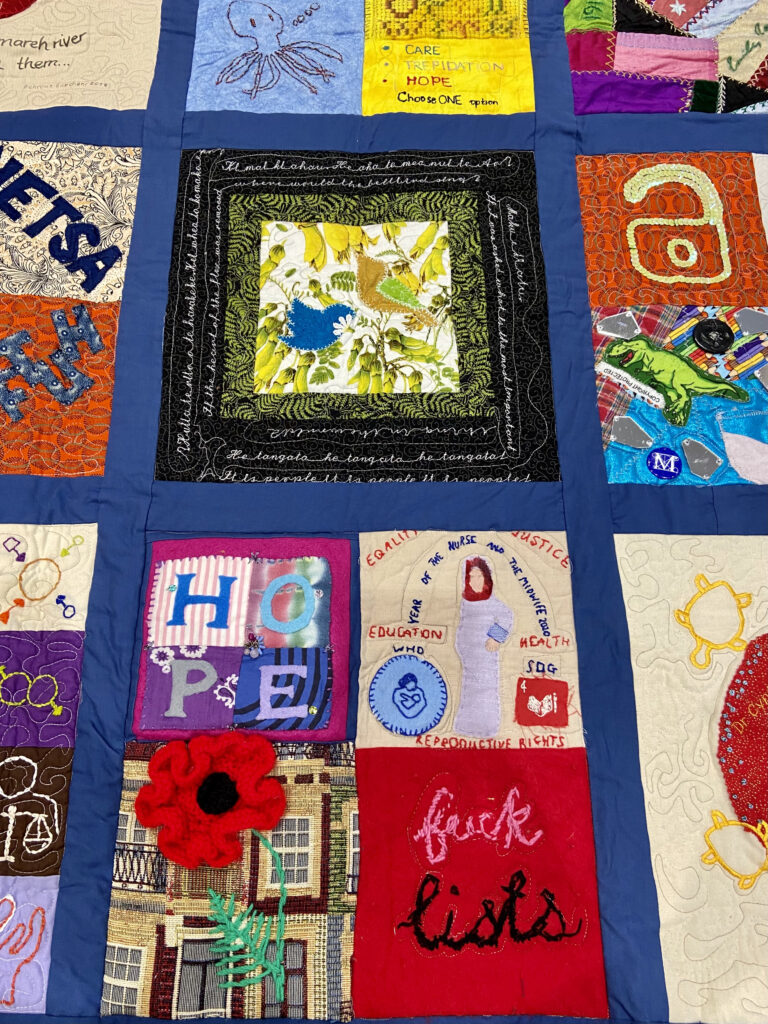
One beautiful manifestation of all these principles is the Femedtech Quilt of Care and Justice in Open Education, a craft activism project led by Frances Bell in collaboration with members of the FemEdTech network in 2019/2020. You can read the story of the quilt on femedtech.net and also engage with the digital quilt at quilt.femedtech.net The quilt was originally intended to be displayed at the OER20 conference, but as a result of the pandemic this is the first opportunity we have had to showcase the quilt in all its material glory
I spent most of the second day of the conference quilt sitting along with Frances Bell, Catherine Cronin and Sheila MacNeill. It was a really moving experience seeing people interacting with the quilt. It was especially lovely to see people finding and reconnecting with squares they had created, pointing out this or that square – “That’s my daughter’s dress!” “That’s my mother’s earing!” So many women, mothers, daughters, grandmothers, so many personal connections are sewn into the quilt. There was also an opportunity for people to contribute to the quilt by sewing on a button or a few stitches of embroidery and it was wonderful seeing people taking a quiet moment out of the busy conference schedule and becoming absorbed in the shared task of making.
So lovely to see people interacting with the #femedtechquilt at #altc22 pic.twitter.com/h8QKTRHHzY
— Lorna M. Campbell (@LornaMCampbell) September 7, 2022
Sheila has already written a lovely reflection on the quilt here: Transcending the digital and physical at #altc22 – the #femedtechquilt. I particularly love this observation:
In quite a magical way, the presence of the quilt provided a way to bind many of us together by providing a safe, open, space to have long overdue catch ups, to share experiences and allow time for reflection and just “being”.
At the end of the day, those of us who had contributed to the quilt came together to suspend it over the balcony outside the main auditorium so it could be viewed by delegates. It was an emotional (and slightly nerve wracking!) experience holding all that shared hope and creativity in our hands.
At the end of today’s #altc22 sessions, a committed #femedtech crew gathered the #FemEdTechQuilt & held it over a balcony to display it in its full glory. Haven’t seen those photos yet, but here’s what it looked like behind the scenes 🙂 pic.twitter.com/tadlky5j9O
— FemEdTech – shared account for FemEdTech network (@femedtech) September 7, 2022
Look at all these amazing ladies with the #FemEdTechQuilt @femedtech @A_L_T #altc22 #altc! pic.twitter.com/tHCI6vpVFY
— Puiyin Wong 💙🇪🇺🇭🇰 (@Puiyin) September 7, 2022
We’re still living in desperately uncertain and insecure times, and our new normal is a world away from our old normal, however reconnecting with the learning technology community at ALTC 2022 gives me hope that if we can work together, to share our experiences and share the load, we can support and care for both our community and our learners.