What is schema.org? Technical Briefing Paper

Last week my colleague Phil Barker and I published a new technical briefing paper What is schema.org?

schema_briefingThis briefing has been produced as part of our work with the Learning Resource Metadata Initiative (LRMI). LRMI expands schema.org so that it can be used to describe educationally significant characteristics of resources. At a technical level, the first step to understanding LRMI is to understand schema.org.

What is schema.org? describes the schema.org specification for a technical audience. It is aimed at people who may want to use schema.org markup in websites or other tools, and who wish to know more about the technical approach behind schema.org and how to implement it. As such, it has relevance beyond the description of educational resources, and we hope it will be of interest to anyone describing resources on the web. Additional briefings providing an in-depth technical overview of LRMI will follow.

What is schema.org? Can be downloaded from the Cetis Publications website here http://publications.cetis.ac.uk/2014/960

About LRMI

The Learning Resource Metadata Initiative is funded by the Bill & Melinda Gates Foundation, and jointly lead by Creative Commons and the Association of Educational Publishers—now the 501(c)(3) arm of the Association of American Publishers—with the aim of making it easier to publish, discover and deliver high quality educational resources on the web. With input from a wide range of organisations, from both the open and commercial spheres, involved in publishing, creating and using educational resources, LRMI successfully proposed additions to schema.org (an initiative of Google, Yahoo and Bing) allowing the description of educationally important properties of resources to be marked-up in web pages in a manner that is easily understood by search engines. This enables users to create custom search engines that support the filtering of search results based on criteria such as their match to a specific part of a curriculum, the age of the students, or other relevant characteristics.

Open Scotland at CILIP Scotland Conference

Earlier this week I was invited to present about Open Scotland at the CILIP Scotland Conference in Dundee. This is the first time I’ve attended the CILIPS conference and it was a really lively and engaging event with over 300 participants and an inspiring keynote on “Challenges, Choices and Opportunities” from Martyn Evans, Chief Executive of the Carnegie Trust.  My Open Scotland presentations seemed to be well received and I was very encouraged to have a couple of questions about the potential role of public libraries in opening access to educational resources, particularly for the school sector.  When we held the first Open Scotland Summit in Edinburgh in 2013 it occurred to me that the education sector potentially has much to learn from the public library sector in terms of open practice.  My presentation session was ably chaired by Heather Marshall, Senior Librarian at Glasgow Caledonian University Library and in conversation with her afterwards I was struck yet again by GCU Library’s commitment to promoting open educational resources and encouraging open educational practice among their staff.

cilips14

Open Education, Open Scotland Event

The Association for Learning Technology (ALT) Scotland Special Interest Group (SIG), in collaboration with Jisc RSC Scotland, SQA and Cetis will host Open Education, Open Scotland at the Informatics Forum at the University of Edinburgh on Tuesday, 3rd June 2014.

This free one-day event will provide an opportunity for ALT Scotland SIG members and the wider community to come together and share ideas and experiences of adopting and promoting open educational practices across all sectors of Scottish education.

“Open education can promote knowledge transfer while at the same time enhancing quality and sustainability, supporting social inclusion, and creating a culture of inter-institutional collaboration and sharing. In addition, open education can expand access to education, widen participation, create new opportunities for the next generation of teachers and learners and prepare them to become fully engaged digital citizens.”

– Scottish Open Education Declaration

Early last year, these four supporting institutions launched Open Scotland, a voluntary, cross-sector initiative that aims to raise awareness of open education, encourage the sharing of open educational resources, and promote the development of open policy and practice. A number of awareness raising activities have taken place including:

  • The Open Scotland Summit, which brought together senior managers, policy makers and key thinkers to explore the development of open education policy and practice in Scotland.
  • The Open Scotland blog was launched to disseminate news relating to all aspects of openness in education and to act as a focal point for discussion and debate.
  • The first draft of the Scottish Open Education Declaration was released. This open draft is based on the UNESCO Paris OER Declaration, but extends its scope to focus on open education in general, rather than OER in particular.

Invited Speakers and Topics:

  • Maren Deepwell, ALT: Update from ALT
  • Colin Cook, Scottish Government: Scottish Government perspectives
  • David Beards, SFC: SFC Update
  • Ronald MacIntyre, Open University: OU Scotland’s Open Education Project
  • Suzanne Scott, Borders College: Open Badges, Open Borders
  • Jonathan Worth, Coventry University: Open Courses
  • Natalie Lafferty, University of Dundee: Students as consumers and producers of open educational resources
  • Ian Stewart and John Johnstone, GLOW
  • Lorna M Campbell, Cetis: Scottish Open Education Declaration

There are still a few places available for this free event.  Registration and further information is available here: https://www.alt.ac.uk/civicrm/event/info?reset=1&id=106

Open Practice and Open Policy at the Cetis Conference

The theme of this years annual Cetis Conference at the University of Bolton is Building the Digital Institution, and once again there is a strong focus on openness.  In addition to Audrey Watters keynote,  and parallel sessions on open knowledge (Open Knowledge: Wikipedia and Beyond) and open source (Web Services or Cloud, Open Source or outsourced?),  there are two open education sessions:

Open Education: a New World Order? facilitated by Li Yuan and Stephen Powell
Open Education: From Open Practice to Open Policy by Lorna M.Campbell and Li Yuan.

Open Education: From Open Practice to Open Policy is very much a natural progression from open education parallels we’ve run at previous Cetis Conferences.  The first open education session we ran at the Cetis Conference was the UK OER Scoping Session way back in 2008 and since then we’ve progressed through the OER Technical Roundtable, Building Collections of OERs, to Open Practice and OER Sustainability, so it seemed natural that this year’s session should focus on moving from open practice to open policy.

In addition to looking at the emergence of open policy and practice across the UK and further afield, we’ll be exploring questions relating to the potential benefits of these developments. What, if any, is the value of open education policy? Do countries, regions and institutions really need open education policies? Should government agencies play a role in the development of open education policy? Are there conflicts between commercial interests and market forces, and open education policy and practice? How can open education initiatives be nurtured and sustained?

We’ve also decided to throw a little theoretical exercise in to the mix, we’re challenging session participants to develop (or not) open education policy for a hypothetical country (we’ll come up with a name later!).  We’ve lined up an eclectic range of speakers who will be presenting their experience of open education practice and policy and arguing for a particular way forward for our new country.  Session participants will be able to discuss and debate the merits (or not) of the proposed approaches and decide on a way forward.  Participants are free to appoint themselves as government ministers, lobbyists, militants, military dictators, etc and speakers may be encouraged to wear national dress.  Li and I will be assuming the roles of Kirsty Wark and Jeremy Paxman 😉

Speakers include:

Paul Booth, North-West OER Network and Manchester Metropolitan University
Suzanne Hardy, Newcastle University
Tore Hoel, Nordic OER and Oslo and Akershus University College of Applied Sciences
David Kernohan, Jisc
Paul Richardson, Jisc RSC Cymru
Joe Wilson, ALT Scotland SIG and SQA

You can register for the Cetis Conference here and I hope we can look forward to seeing you in Bolton in June!

OER14

I’m just back from OER14 in Newcastle and it was another fabulous conference. I know that many people sadly predicted the demise of the OER conference after the Jisc / HEA UKOER Programmes ended in 2012, but two years after the end of UKOER the conference really is going from strength to strength. The quality of the papers this year was excellent, and if I have one criticism of the event, it’s that there were so many great presentations that I only got to hear a fraction of the ones I was really interested in! The venue worked well, the conference organisers did a splendid job, there was a really positive feeling of community, it was great to see people from all over the world and, last but not least, it was a lot of fun!

During the conference dinner we were all given little packets of Lego and asked to build something that represented what open education means to us.  The results were as imaginative, eclectic (and occasionally rude) as you might imagine.  Here’s mine, it’s supposed to be Open Scotland and Creative Commons :}  Many thanks Darya Tarasowa for letting me borrow her skirt!

cc_openscot

Huge thanks to all those involved in organising OER14 and in particular to conference chairs Simon Thomson and Megan Quentin-Baxter.

OCWC Global Twitter Highlights

I’ve made a storify of a few of my twitter highlights from the recent OCWC Global Conference in Lubljana here: OCWC Global Conference Storify.

ocwcglobal_storify

Without a doubt my twitter highlight of the entire event has to be from Peter Bryant….

Inspiration from OpeningUpSlovenia

OpeningUpSlovenia at OCWC Global

OpeningUpSlovenia at OCWC Global

I’ve spent most of this week in Ljubljana, Slovenia for the Open Course Ware Consortium Global Conference where I was interested to hear about a project that has much to inspire Open Scotland. Ljubljana was chosen to host the conference to highlight an ambitious new national initiative, OpeningUpSlovenia.  The initiative was launched at the conference by Jernej Pikalo, Slovenian Minister for Education, and Mitja Jermol, Head of Center for Knowledge Transfer at the Jožef Stefan Institute.

OpeningUpSlovenia takes its inspiration from the European Commission’s 2013 Opening Up Education communication.  OpeningUpSlovenia is a collaborative cross sector initiative involving all Slovenian universities, compulsory and vocational education institutions together with technical, research and industry partners.  The aim of this ambitious initiative is to:

“create an open educational system parallel to the formal one to exploit all aspects of open education, allowing rigorous, transparent, and replicable testing of open learning environments, open education theories, new business models, open organisational forms, open education computational tools, and new and emerging technologies for the educational technologies market place.”

During the fist stage of the initiative, three sub-projects will be launched focusing on different educational sectors;

1. Compulsory pre-school, primary and secondary education,
2. OER in higher education,
3. Vocational education, on-the-job training and life-long learning.

These projects will create advanced technologies, open learning environments and open educational resources and will foster open connectivity and innovation. Supporting multilingualism in open education is also a corner stone of the OpeningUpSlovenia.

Through this initiative, Slovenia aims to become a role model for open education in a knowledge based Europe.  In response to the question ‘Why Slovenia?’ Mitja Jermol responded, ‘Because Slovenia is a “little big country”’.  Due to its size and scale, Slovenia is in an ideal position to support the EU’s aim of opening up education across Europe and globally.  In order to do this, Slovenian Minister for Education Jernej Pikalo stressed unequivocally the need for legislative measures and explicit government policies to support innovation in open education.

It will be very interesting to see how the OpeningUpSlovenia initiative progresses and what Scotland, as another “little big country”, can learn from their experiences.  In drawing the launch of OpeningUpSlovenia to a close, Fred Mulder, UNESCO Chair in Open Educational Resources called for more countries to follow Slovenia’s example and open up education.  Wouldn’t it be nice if Scotland was next?

You can find out more about OpeningUpSlovenia here: http://www.k4all.org/openingupslovenia/

OKF Open Education Working Group Advisory Board

Earlier this month I was delighted to be invited to join the Advisory Board of the Open Knowledge Foundation’s Open Education Working Group. The aim of the group, which is led by Marieke Guy, is “to initiate global cross-sector and cross-domain activity that encompasses the various facets of open education.”  Marieke has invited all Board members to write an introductory blog post for the group so here’s mine. It was published over at Open Education Working Group site last week.

okf_edu3

OKF Open Education Working Group

It’s hard to say when my own involvement in open education began. The start of the Jisc / HEA UKOER Programmes in 2009 is an obvious point of reference but many of the programmes and projects I was involved in long before that were concerned with sharing educational resources. Open licences were unheard of when I began working in education technology in 1997 so early projects I was involved with, such as Clyde Virtual University (SHEFC Use of the MANs Initiative) and the Scottish electronic Staff Development Library (SHEFC ScotCIT Programme), took a walled garden approach to sharing. Different methods of sharing, managing and disseminating educational resources were explored and developed over the next decade by a wide range of Jisc development programmes. Some of the ones I was directly involved in include Exchange for Learning (X4L), Digital Libraries in the Classroom, ReProduce, and the Digital Repositories and Preservation Programmes.

It was only with the launch of the Jisc / HEA UKOER Programme that I really got involved with open education as we might recognise it today though. On the surface, the primary aim of the HEFCE funded UKOER Programme was to get openly licenced educational content out there into the public domain, (the metaphor we frequently used was turning on the tap), however the underlying aim to the programme was to raise awareness of OER and embed open education practice within English higher education institutions. In keeping with the experimental and innovative nature of UKOER, Cetis recommended a novel approach to steering the programmes’ technical direction. Rather than identifying specific applications, standards, application profiles and vocabularies, we recommended that the UKOER programmes should adopt an open approach to the use of technology and standards. No descriptive standards, exchange mechanisms or specific technologies were mandated, thus allowing projects the freedom to choose the tools or technologies that best suited their requirements. The only provisos were that all projects should use the programme tag ‘ukoer’ and represent the resources they released in the Jorum national repository.

IntoWildCoverThis open approach to technology and standards enabled us to learn from real world practice and to surface technical issues and problem areas. As a result, Cetis role in the UKOER Programmes was more conversational than directional. We monitored projects’ progress with the adoption and use of a wide range of technologies, applications and resource description approaches and helped to identify common technical issues. At the end of UKOER we synthesised the technical outputs of the programmes and produced an open ebook called Into the Wild: Technology for open educational resources. Even this book was a result of open practice! The book was the result of booksprint using the open source Booktype platform and an open draft was shared with the community for input and comment.

Working with the UKOER Programmes was a hugely rewarding experience and I think its fair to say that we all learned a lot, not just about open education technology, but also about the culture and practice of sharing. Measuring the impact of short-term innovation funding programmes is notoriously difficult, but looking back now, two years after the end of UKOER, it really does look like the programme made a real difference in raising awareness of OER and embedding open educational practice in the English higher education sector.

Since the end of the UKOER Programmes in 2012 I’ve continued to engage with a wide range of open education developments, including the US Learning Registry initiative, Creative Commons, the Learning Resource Metadata Initiative, Wikimedia UK and the Open Knowledge Foundation.

More recently I’ve been involved with the Open Scotland initiative. Open Scotland is a voluntary cross sector initiative, led by Cetis, the Scottish Qualifications Authority, Jisc Regional Support Centre Scotland and the Association for Learning Technology’s Scotland Special Interest Group. The aim of Open Scotland is to raise awareness of open education, encourage the sharing of open educational resources, and explore the potential of open education policy and practice to benefit all sectors of Scottish education. To further these aims, we have recently launched the draft Scottish Open Education Declaration. This declaration builds on the UNESCO 2012 Paris OER Declaration but the scope has been widened to focus on open education more generally, rather than OER specifically.

http://declaration.openscot.net/

http://declaration.openscot.net/

The cornerstone of the Open Scotland initiative is our belief that open education can promote knowledge transfer while at the same time enhancing quality and sustainability, supporting social inclusion, and creating a culture of inter-institutional collaboration and sharing. I believe that open education can expand access to education, widen participation, create new opportunities for the next generation of teachers and learners and prepare them to become fully engaged digital citizens. I know that these are goals and beliefs that the OKF Open Education Working Group shares and I am privileged to have an opportunity to contribute to this group.

Welsh Government Report on Open and Online

(Cross posted from Open Scotland blog)

Last week the Welsh Government’s Online Digital Learning Working Group published their report  Open and Online: Wales, higher education and emerging modes of learning. The group was established in February 2013 by Leighton Andrews AM, the Welsh Government’s Minister for Education and Skills at the time,

“to examine the potential for online digital learning and how the Welsh Government can support the higher education sector in this growing field.”
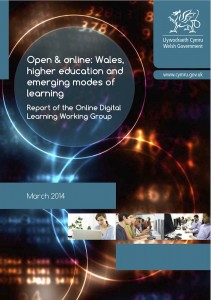
Wales O&OPaul Richardson of Jisc RSC Wales acted as professional advisor to the group and undertook the consultation exercise.  The report includes an invaluable background paper produced by Paul on Open and online resources: implications for practice in higher education institutions in Wales, which provides an invaluable overview of recent open education developments including OER and MOOCs, and quotes from a number of Cetis blogs and publications.  Although Paul’s paper focuses on the implications of open education for Welsh HEIs I can also highly recommend is as an excellent general summary of recent developments open education policy, practice and technology.

The report itself includes the following of seven recommendations addressed to the Minister for Education and Skills and higher education institutions.

To the Minister for Education and Skills

1. Widening access to higher education to those with low participation backgrounds.

Fund the development of O&O resources for use in schools and colleges, with the aim of raising aspirations of learners from low participation backgrounds. This scheme should be co-ordinated through collaboration between HEIs and schools and colleges in their region, via existing Reaching Wider Partnership networks.

Investigate the use of Hwb as a host for the O&O resources developed, with the intention of establishing a central repository where all schools and colleges may access these resources.

Extend the work of the Open University OpenLearn Champions project to cover the whole of Wales via the Reaching Wider Partnerships.

Liaise with NIACE Dysgu Cymru, Agored Cymru, and others to align O&O resource production with the needs of adult learners pursuing agreed progression routes, including CQFW.

2. Developing skills for the workplace and the Welsh economy

Develop a strategy, working with other agencies, to raise awareness of the potential for online learning to support economic development.

Use the Welsh Government’s sector panels to foster dialogue between stakeholders (including educational providers and employers) in order to identify opportunities to develop skills using online resources.

Examine how online learning should be integrated into the approach for programmes funded through the European Social Fund.

3.  Developing Welsh language skills for employment

Develop a Welsh language skills MOOC at higher education level so that students and work-based learners can develop their professional Welsh language skills and potentially seek certification for those skills.

To the higher education institutions

4. Reviewing institutional policies, monitoring developments and exploiting opportunities

Agree what the institution’s overall approach to open and online resources should be, monitor external O&O developments, and exploit opportunities to produce and use resources.

5.  Strengthening institutional reputation and brand

Exploit open and online resources in appropriate circumstances to showcase the quality of learning opportunities.

To the Minister and the higher education institutions

6.  Improving the skills of higher education staff

Institutions should provide academic staff with the skills and support they need to make most effective use of open and online approaches to learning.

HEFCW should continue to contribute to the costs of Jisc’s programme on open and online resources and take advantage of Jisc’s expertise.

HEFCW and the Higher Education Academy should take a lead on this agenda.

7. Licensing and sharing open educational resources

The Welsh Government should encourage the systematic adoption of open licensing for open educational resources produced by HEIs in Wales

Where possible staff and institutions should release open educational resources using an appropriate Creative Commons licence

Institutions should make open educational resources widely available, including via the Jorum repository.

Taken together with Welsh HEIs recent statement of intent to work towards the principals of open education, the publication of this report represents another important step forward for open education in Wales and provides inspiration for Open Scotland to continue raising awareness of open education policy and practice at senior management and government level.

The Open and Online report can be downloaded here and Andrew Green, chair of the Online Digital Resources Working Group has written an introductory blog post here MOOCs and other animals: ‘open & online’ report published

Open Scotland Webinar

Last week Joe Wilson of SQA and I presented a short webinar on the Open Scotland initiative and the Scottish Open Education Declaration.  The webinar, which was hosted by Celeste McLaughlin of Jisc RSC Scotland, generated some interesting discussion and debate around open education in Scotland.  A recording of the webinar is available here, and our slides are embedded below.

The Scottish Open Education Declaration was introduced in the context of other open education developments including the UNESCO / COL Paris OER Declaration, the Open Educational Resources in Europe project, and Welsh HEIs statement of intent to work to open education principals. The Open Scotland initiative welcomes participation from individuals and institutions and we encourage all those with and interest in open education to comment on and endorse the Scottish Open Education Declaration.  Joe encouraged participants to get involved as individuals and also to take the Declaration back to their academic boards to raise awareness of the initiative and to get their institutions to sign up.  At this stage, the main aim of the Declaration is to raise awareness of the potential benefits of open education policy and practice, a valuable next step would be to start gathering exemplars that illustrate each statement of the declaration in action.

Joe and I both highlighted examples of open education practice in Scotland and further afield and participants also suggested other examples of communities sharing educational resources including the Computing at School Scotland initiative which aims to promote the teaching of computer science at school, and the fabulously named Magic Physics Pixies and their Scottish Physics Teaching Resources network.  This discussion prompted Tavis Reddick, of Fife College, to ask:

“Are there any illustrative exemplars of, say, OER, which Open Scotland would recommend to show how sharing and remix could work in practice?”

Although Open Scotland hasn’t got as far as recommending specific resources, the UKOER Programmes produced a wide range of resources including the OER Infokit,  and the ALT Open Education SIG recently gathered a series of case studies for Open Education Week.  The University of Leeds have also produced guidelines on developing and using OER for staff and students which have been adopted and repurposed by Glasgow Caledonian University: Library Guidance on open educational resources.

There is also considerable interest in the potential of Open Badges across the sector. Joe flagged up SQA’s commitment to Open Badges  and Celeste highlighted the work of the Open Badges in Scottish Education Group and Borders College’s use of Open Badges to replace paper based certification for continuing professional development activities.

There was some discussion of the Re:Source repository of open education resources for the Scottish college sector, with questions being asked about how extensively it is currently being used and whether a sustainable funding model could be developed. One suggestion was that, in the longer term, recurrent funding for Re:source could potentially come from the things it might replace, such as teaching materials acquisition budgets. One participant noted that their college did not yet have a policy that allowed them to publish OERs to Re:Source, but added that they hoped their board would take an interest soon.

One very valid question raised towards the end of the webinar was “how will we know if we are getting any better at this?” There are currently no benchmarking guidelines or KPIs for open education in Scotland but it would certainly be very interesting to undertake a landscape study of current open education practice across all sectors of Scottish education.  This would act as a baseline against which we could measure progress, but a survey of this nature would require dedicated funding and resources.    We’re already aware of lots of interesting examples of open education practice in Scotland but I’m sure that are many, many more out there, so if you know of any, or if you’re involved in any open education initiatives at your own institution, please do get in touch!