The Cost of Freedom – What is Open?

Another gem from The Cost of Freedom project, this time by Richard Goodman (@bulgenen), my partner in crime from the ALTC-2016 social media team.  I was chuffed to bits when Rich decided to write something for the project.  You can read his poem What is Open? here.

As part of disquiet Junto Project 0202 Text-to-Speech-to-Free Rich’s poem has also been recorded by Michel Banabila who created this amazingly atmospheric remix.

Links

The Cost of Freedom – The Open World

Based on an original painting by Omar Ibrahim, designed by Julien Taquet.

Based on an original painting by Omar Ibrahim, designed by Julien Taquet.

Towards the end of last year, following an invitation from Adam Hyde of booksprints.net, I wrote a contribution for a free and open online book called The Cost of Freedom.  The book is dedicated to Syrian internet volunteer and open knowledge advocate Bassel Khartabil, باسل خرطبيل‎, who has been detained in Syria since March 2012. On the 3rd October 2015 Bassel’s name was deleted from the Adra Prison’s register where he was detained and no further information has been obtained about his whereabouts.

The Cost of Freedom is not a statement about freedom and culture — it is a primal scream — the sum of our questions and desires. It is the raw expression of our lives. It talks about what is ultimately made through the dream of free culture: us.

~ The Cost of Freedom

The book was written in Pourrières in France during a five day book sprint in early November 2015, with additional contributions being submitted by writers from all over the world. Here’s my contribution, a personal reflection on what openness means to me.
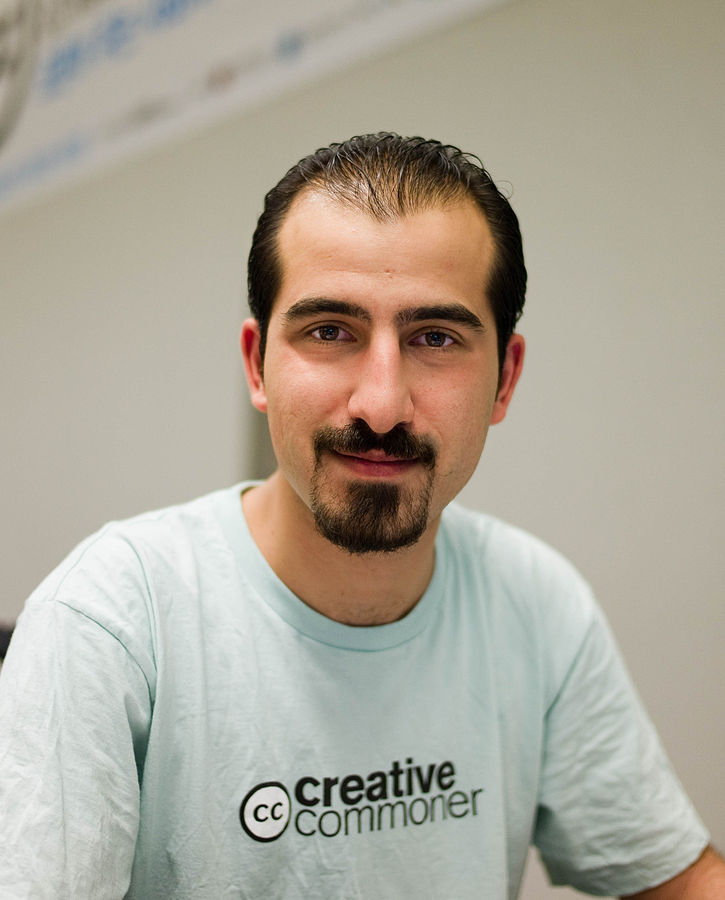
"Bassel Khartabil (Safadi)" by Joi Ito - http://www.flickr.com/photos/joi/4670781482CC BY 2.0

“Bassel Khartabil (Safadi)” by Joi Ito – http://www.flickr.com/photos/joi/4670781482 CC BY 2.0

The Open World

In Open is not a License Adam Hyde has described openness as

‘a set of values by which you live…a way of life, or perhaps a way of growing, an often painful path where we challenge our own value system against itself.’

To my mind, openness is also contradictory. I don’t mean contradictory in terms of the polar dichotomy of open vs. closed, or the endless debates that seek to define the semantics of open. I mean contradictory on a more personal level; openness raises contradictions within ourselves. Openness can lead us to question our position in the world; our position in relation to real and perceived boundaries imposed from without and carefully constructed from within.

In one way or another I have worked in the open education space for a decade now. I have contributed to open standards, created open educational resources, developed open policy, written open books, participated in open knowledge initiatives, facilitated open events, I endeavour to be an ‘open practitioner’, I run a blog called Open World. However, I am not by nature a very open person; my inclination is always to remain closed. I have had to learn openness and I’m not sure I’m very good at it yet. It’s a continual learning experience. Openness is a process that requires practice and perseverance. (Though sometimes circumstances leave us with little choice, sometimes it’s open or nothing.)

And of course, there is a cost; openness requires a little courage. When we step, or are pushed, outside our boundaries and institutions, it’s easy to feel disoriented and insecure. The open world can be a challenging and unsettling place and it’s easy to understand the impulse to withdraw, to seek the security of the familiar.

When large scale open education funding programmes first started to appear, (what an impossible luxury that seems like now), they were met with more than a little scepticism. When a major OER funding initiative was launched in the UK in 2009 (UKOER), the initial response was incredulity (OER Programme Myths). Surely projects weren’t expected to share their resource with everyone? Surely UK Higher Education resources should only be shared with other UK Higher Education institutions? It took patience and persistence to convince colleagues that yes, open really did mean open, open for everyone everywhere, not just open for a select few. One perceptive colleague at the time described this attitude as ‘the agoraphobia of openness’(1).

Although open licences and open educational resources are more familiar concepts now, there is still a degree of reticence. An undercurrent of anxiety persists that discourages us from sharing our educational resources, and reusing resources shared by others. There is a fear that by opening up our resources and our practice, we will also open ourselves up to criticism, that we will be judged and found wanting. Imposter syndrome is a real thing; even experienced teachers may fail to recognise their own work as being genuinely innovative and creative. At the same time, openness can invoke a fear of loss; loss of control, loss of agency, and in some cases even loss of livelihood. Viewed through this lens, the distinction between openness and exposure blurs.

But despite these costs and contradictions, I do believe there is inherently personal and public value in openness. I believe there is huge creative potential in openness and I believe we have a moral and ethical responsibility to open access to publicly funded educational resources. Yes, there are costs, but they are far outweighed by the benefits of open. Open education practice and open educational resources have the potential to expand access to education, widen participation, and create new opportunities while at the same time supporting social inclusion, and creating a culture of collaboration and sharing. There are other more intangible, though no less important, benefits of open. Focusing on simple cost-benefit analysis models neglects the creative, fun and serendipitous aspects of openness and, ultimately, this is what keeps us learning.

In the domain of knowledge representation, the Open World Assumption ‘codifies the informal notion that in general no single agent or observer has complete knowledge’. It’s a useful assumption to bear in mind; our knowledge will never be complete, what better motivation to keep learning? But the Open World of my blog title doesn’t come from the domain of knowledge representation; it comes from the Scottish poet Kenneth White (2), Chair of 20th Century Poetics at Paris-Sorbonne, 1983-1996, and a writer for whom openness is an enduring and inspiring theme. White is also the founder of the International Institute of Geopoetics, which is ‘concerned, fundamentally, with a relationship to the earth and with the opening of a world’ (3). In the words of White:

no art can touch it; the mind can only

try to become attuned to it

to become quiet, and space itself out, to

become open and still, unworlded (4)

disquiet ambient/electronica have recorded a number of the contributions to the book, including mine, which you can listen to here.

References

  1. I cannot remember who said this, but the comment has always stayed with me.
  2. White, K., (2003), Open World. The Collected Poems, 1960 – 2000, Polygon.
  3. White, K., (2004), Geopoetics: place, culture, world, Alba.
  4. White, K., (2004), ‘A High Blue Day on Scalpay’ in Open World. The Collected Poems, 1960 – 2000, Polygon.

Links

How to be a Brilliant Conference Chair

The recent Guardian article that Joanne Begiato, Steven Gray, Isaac Land I I wrote on The Six Best Conference Questions turned out to be so popular that we decided to write another one! This time about conference chairing. An edited version of this article appeared in the Guardian Higher Education Network on the 2nd December, but here’s the full director’s cut.

conference_chair

How to be everyone’s favourite Conference Chair

By Joanne Begiato, Steven Gray, Lorna M. Campbell and Isaac Land

We’ve all got an anecdote about the worst conference chair we have ever experienced. The chair who forgot or mispronounced the speakers’ names, or (horrors!) forgot to turn up altogether, leaving the bewildered speakers to introduce themselves. The chairs who let questions ramble on through self-interested thickets or didn’t notice the shy hand raisers, only seeing the professor of gesticulation. Or how about the occasional chair who takes the chance to tell the audience about his/her fascinating research and superior knowledge? And don’t we all dread the chair who can’t tell the time, appears not to care that the audience is gasping for a drink, or lets that awkward silence drag on once all the questions have dried up. The painfully self-aware among us know in our heart of hearts that we have all been that chair at one conference or another (possibly after a late night at the conference dinner, not entirely unrelated events). Although such chairing debacles are something of a scholarly rite of passage, which help us to hone our chairing and facilitation skills, our aim here is to help you avoid these pitfalls and offer a six-point check-list so you can become everyone’s favourite conference chair.

Be Prepared and Organised

Make sure contact your speakers in advance, either at the conference or via email, to ask for a short biography or check if they’re happy for you to use their biography and title from the conference programme (quite often people change the focus of their paper by the time they come to present). Then, find your speakers at coffee before the session so you can introduce yourself, find out how they prefer to be addressed and check how to pronounce their names writing them down phonetically if necessary. If needs be, ask whether presenters will be using the conference PC or their own laptop, and make sure you know where to find the tech support to get them connected. In order to assure seamless transitions, ensure that presentations are preloaded, and check that your speakers know how to find and open their own presentations. And if the tech gods let you down, know how to contact the IT support.

Be Fair and Inclusive

When introducing the speakers do not give one of them more prominence than the others, whoever they might be, and highlight each speaker’s key publications and achievements equally. Be prepared for the eventuality that when you open the floor for questions you are met with stony silence, by preparing your own question for each speaker. Nonetheless, if there is a flurry of hands, don’t hog the questions or abuse the chair’s prerogative. Prevent questioners from dominating, bullying, or patronising speakers by courteously reminding them to come to the point and you scan the audience to ensure early career researchers and more reticent colleagues have an opportunity to address the panel. Where possible, try to make sure that all the speakers get and least one comment or question so that none of them leave vowing never to give another paper again.

Be Impartial and Selfless

Keep anecdotes about your own research to coffee time and let the speakers take the spotlight. If you have found links with your own work, or know of references that might help inform speakers’ research, talk to them or email them later and focus on their own findings during the session. Be sensitive and helpful and encourage early career researchers and new speakers and boost their confidence by thanking them for their presentation and showing an interest in their work. Know when to save your own questions for another time because the audience has a lot to ask.

Be Visibly Attentive

You are the chair, on full view and managing the panel, so listen attentively to the speakers, and take notes on relevant points that might be used for questions later. Save your knitting, crocheting, nail filing, and yawning for your evenings in front of the TV. Sit on the podium without fidgeting, or in the front row where you can maintain eye contact with your speakers. When its time for questions, stand to the side of the podium scanning the audience for questions, leaving centre stage for your speakers. If multiple audience members raise their hands, make eye contact with each and nod discretely so they know you have seen them and you return to them to invite them to ask their questions when the opportunity arises.

Be Polite but Firm

Always begin promptly and make sure you time each speakers’ slot individually, so that each has his/her fair share of the session. However, awkward, you must keep people to time because the alternative is unfair. Be prepared to tackle a speaker even if s/he is higher up the academic ranks, self-important, or simply stubborn enough to ignore you. To achieve this difficult task, agree with your speakers in advance what sign you will use to alert them that they must begin drawing their talk to a close, such as a note or finger gesture (no, not that one). If necessary, know when to stop believing the speaker’s promises that they are about to conclude and stand up and inform them firmly that you will have to stop them there in order to introduce the next presenter. By the way, for all speakers reading this, let’s make the chair’s life more comfortable by ending when asked!

You Know When to Finish

When you get to question time, it is your responsibility to lead the discussion by encouraging dialogue between audience and speakers. Questions at the end of a paper can be the most rewarding part of the session; otherwise speakers may as well have stayed at home and read their paper to the cat. Do this simply by ensuring that everyone who wants to speak has the opportunity to do so, and try to read faces and feel the silences. This way you know when the questions have dried up and it’s time to thank the speakers and the audience, and say how great the session has been. Even if there are more questions, when the time for the panel to end arrives, tie things up neatly, thereby allowing everyone to happily head for tea and biscuits or, better still, the pub (where they won’t talk about you, because you did your job well).

Oh, and we were very pleased that this article was the editor’s top pick in last week’s Higher Education Network Newsletter 🙂

conference chair editors pick

Erinma Ochu: Crowd Sourcing for Community Development

Earlier this week I went along to an event at the National Museum of Scotland run by the University of Edinburgh’s  Citizen Science and Crowdsourcing group.  There were some fascinating projects and initiatives on display but the highlight of the event was undoubtedly Erinma Ochu‘s engaging and thought provoking public lecture on Crowd Sourcing for Community Development.

Erinma Ochu

Erinma outlined the benefits that amateurs can bring to scientific research; they can help to validate data, fill in gaps in data collected by scientists, bring interesting new perspectives and, if they are not overly trained, they may be better able to spot patterns in data that scientists might miss. However Erinma also reminded us of the reciprocal aspects of citizen science. Citizen science should involve scientists serving the community, not just volunteers collecting data for research. It’s important to balance social and scientific value; the community building process is as important as the data product.  We have a responsibility to make spaces in which social inclusion and engagement can happen. I particularly liked Erinma’s focus on citizen science as a learning opportunity;  projects should give something back to the people who contribute the data and help them to learn.  Along the way Erinma introduced some fascinating and inspiring projects including Turing’s Sunflowers, Farm Hack and Manchester City of Science Robot Orchestra.

For a more comprehensive overview of Erinma’s talk I’ve created a storify of tweets here: Crowd Sourcing for Community Development Storify and Erinma’s slides area available on Slideshare here.

Return of the Six Best Conference Questions

Way back in 2013 Joanne Begiato, Steven Gray, Isaac Land and I wrote a blog post called The six best conference questions: Or, how not to paper-bomb at a conference. The piece was intended to be an encouraging response to a rather entertaining article written by Allan Johnson in Time Higher Education about the six questions every academic dreads to hear at conferences. That post turned out to be by far and away the most popular post ever to appear on this blog and it’s now found a new lease of life in The Guardian.  Earlier today The Guardian Higher Education Network re-published our piece under the title Don’t be a conference troll: a guide to asking good questions. We’ve had an overwhelming response to the article on twitter so it seems like this piece is still striking a chord with colleagues across the sector.

conf_troll_1

I’m also delighted to report that by the end of the day we were more popular than Jo Jonson’s University reforms 😉

conf_troll_2

Many thanks to Steven for suggesting we submit this to The Guardian!

Is there a Library shaped black hole in the web? Event summary.

Is there a Library shaped black hole in the web? was the question posed by an OCLC event at the Royal College of Surgeons last week that focused on exploring the potential benefits of using linked data to make library data available to users through the web. For a comprehensive overview of the event, I’ve put together a Storify of tweets here: https://storify.com/LornaMCampbell/oclc-linked-data

Following a truly dreadful pun from Laura J Wilkinson…

…Owen Stephens kicked off the event with an overview of linked data and its potential to be  a lingua franca for publishing library data.  Some of the benefits that linked data can afford to libraries including improving search, discovery and display of library catalogue record information, improved data quality and data correction, and the ability to work with experts across the globe to harness their expertise.  Owen also introduced the Open World Assumption which, despite the coincidental title of this blog, was a new concept to me.  The Open World Assumption states that

“there may exist additional data, somewhere in the world to complement the data one has at hand”.

This contrasts with the Closed World Assumption which assumes that

“data sources are well-known and tightly controlled, as in a closed, stand-alone data silo.”

Learning Linked Data
http://lld.ischool.uw.edu/wp/glossary/

Traditional library catalogues worked on the basis of the closed world assumption, whereas linked data takes an open world approach and recognises that other people will know things you don’t.  Owen quoted Karen Coyle “the catalogue should be an information source, not just an inventory” and noted that while data on the web is messy, linked data provides the option to select sources we can trust.

Cathy Dolbear of Oxford University Press, gave a very interesting talk from the perspective of a publisher providing data to libraries and other search and discovery services. OUP provides data to library discovery services, search engines, wiki data, and other publishers.  Most OUP products tend to be discovered by search engines, only a small number of referrals, 0.7%, come from library discovery services.  OUP have two OAI-PMH APIs but they are not widely used and they are very keen to learn why.  The publisher’s requirements are primarily driven by search engines, but they would like to hear more from library discovery services.

Neil Jeffries of the Bodleian Digital Library was not able to be present on the day, but he overcame the inevitable technical hitches to present remotely.  He began by arguing that digital libraries should not be seen as archives or museums; digital libraries create knowledge and artefacts of intellectual discourse rather than just holding information. In order to enable this knowledge creation, libraries need to collaborate, connect and break down barriers between disciplines.  Neil went on to highlight a wide range of projects and initiatives, including VIVO, LD4L, CAMELOT, that use linked data and the semantic web to facilitate these connections. He concluded by encouraging libraries to be proactive and to understand the potential of both data and linked data in their own domain.

Ken Chad posed a question that often comes up in discussions about linked data and the semantic web; why bother?  What’s the value proposition for linked data?  Gartner currently places linked data in the trough of disillusionment, so how do we cross the chasm to reach the plateau of productivity?  This prompted my colleague Phil Barker to comment:

Ken recommended using the Jobs-to-be-Done framework to cross the chasm. Concentrate on users, but rather than just asking them what they want focus on, asking them what they are trying to do and identify their motivating factors – e.g. how will linked data help to boost my research profile?

For those willing to take the leap of faith across the chasm, Gill Hamilton of the National Library of Scotland presented a fantastic series of Top Tips! for linked data adoption which can be summarised as follows:

  • Strings to things aka people smart, machines stupid – library databases are full of things, people are really smart at reading things, unfortunately machines are really stupid. Turn things into strings with URIs so machines can read them.
  • Never, ever, ever dumb down your data.
  • Open up your metadata – license your metadata CC0 and put a representation of it into the Open Metadata Registry.  Open metadata is an advert for your collections and enables others to work with you.
  • Concentrate on what is unique in your collections – one of the unique items from the National Library of Scotland that Gill highlighted was the order for the Massacre of Glencoe.  Ahem. Moving swiftly on…
  • Use open vocabularies.

Simples! Linked Data is still risky though; services go down, URIs get deleted and there’s still more playing around than actual doing, however it’s still worth the risk to help us link up all our knowledge.

Richard J Wallis brought the day to a close by asking how can libraries exploit the web of data to liberate their data?  The web of data is becoming a web of related entities and it’s the relationships that add value.  Google recognised this early on when they based their search algorithm on the links between resources.  The web now deals with entities and relationships, not static records.

One way to encode these entities and relationships is using Schema.org. Schema.org aims to help search engines to interpret information on web pages so that it can be used to improve the display of search results.  Schema.org has two components; an ontology for naming the types and characteristics of resources, their relationships with each other, and constraints on how to describe these characteristics and relationships, and the expression of this information in machine readable formats such as microdata, RDFa Lite and JSON-LD. Richard noted that Schema.org is a form or linked data, but “it doesn’t advertise the fact” and added that libraries need to “give the web what it wants, and what it wants is Schema.org.”

If you’re interested in finding out more about Schema.org, Phil Barker and I wrote a short Cetis Briefing Paper on the specification which is available here: What is Schema.org?  Richard Wallis will also be presenting a Dublin Core Metadata Initiative webinar on the Schema.org and its applicability to the bibliographic domain on the 18th of November, registration here http://dublincore.org/resources/training/#2015wallis.

ETA  Phil Barker has also written a comprehensive summary of this even over at his own blog , Sharing and Learning, here: A library shaped black hole in the web?

Ada Lovelace Day at the University of Edinburgh

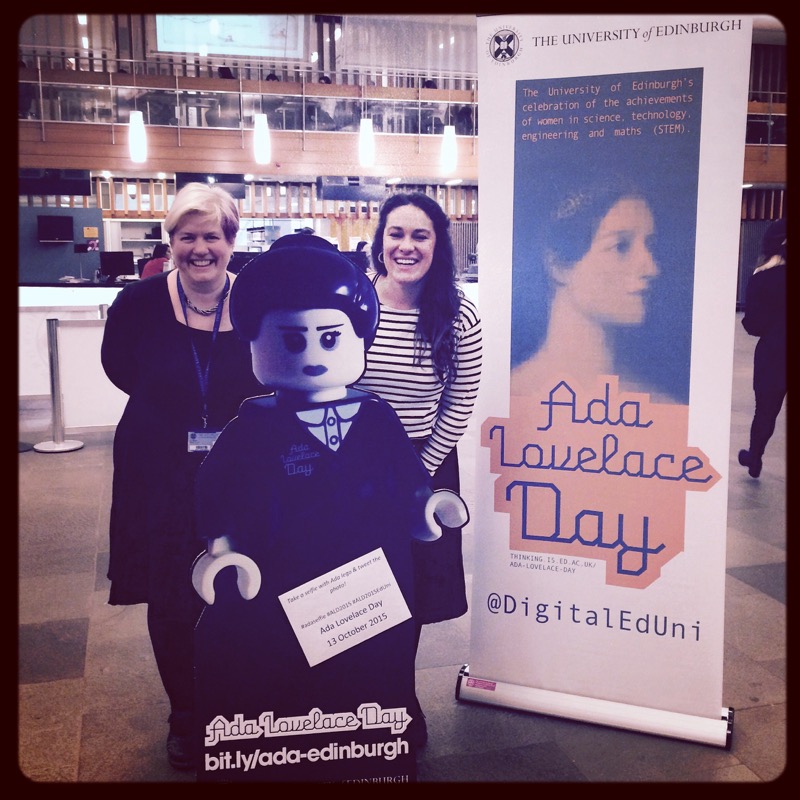
Yesterday I was lucky enough to participate in the first Ada Lovelace Day event at the University of Edinburgh.  The event, which was attended by a wide range of staff and students from across the University, featured an eclectic mix of talks and creative activities.

Melissa Highton introduced Ada herself and highlighted the importance of her relationship with her mentor, the Scottish science writer Mary Somerville; Jo Spiller spoke about the Edinburgh Seven, the first women to matriculate as undergraduates at a university in the UK, who were the subject of a Wikimedia editathon at the University and who have been commemorated with a plaque that was recently unveiled at the Anatomical Museum; Katya Krasnopeeva from the Pilizota Lab gave an amazing demonstration of how Lego is being used in the lab; and Stewart Cromar introduced us to his, frankly wonderful, Lego Lovelace & Babbage.  Stewart has submitted Lovelace & Babbage to the Lego Ideas challenge, where they are steadily gathering votes.  If you haven’t already done so, please go to http://bit.ly/vote-ada and add your vote to make Lego Lovelace a reality.  You can also follow Lego Lovelace on twitter and facebook.

Among the activities, participants had the opportunity to try their hand at building Lego Raspberry Pi enclosures, to compose music with algorithms, and compete in metadata games, which turned out to be horribly addictive and ridiculously competitive :}

In the afternoon Sara Thomas, Wikimedian in Residence at Museums and Galleries Scotland gave us a crash course on Wikipedia editing and led an editathon on the University of Edinburgh’s women in Computer Science.  (I created my very first Wikipedia page, which made me immensely proud 🙂

As if that wasn’t enough there was Lego Lovelace gingerbread made by my lovely colleague Nicola Osbourne and a beautiful colour-in Ada by Jackie Aim.

Best of all, all the deliverables and handbooks created for the day have been released as OERs which you can download here http://thinking.is.ed.ac.uk/ada-lovelace-day/oers/

Anne-Marie Scott and Eugenia Twomey, two of the organisers of #ALD15EdUni

Anne-Marie Scott and Eugenia Twomey, two of the organisers of #ALD15EdUni

Me and two inspiring women!

Me and two inspiring women!

Lego Ada takes a walk in George Square Gardens

Lego Ada takes a walk in George Square Gardens

Jackie Aim's beautiful colour-in Ada, picture by Marshall Dozier

Jackie Aim’s beautiful colour-in Ada, picture by Marshall Dozier

The Challenge of OER Sustainability

Sustaining the outputs of projects and programmes beyond their initial phase of funding is a weel kent problem but it is one that we still struggle to solve. Back in 2009 when Cetis were working with Jisc to scope the technical guidelines for the forthcoming UKOER Programme we attempted to address this issue by recommending that projects deliver their content through multiple platforms. One of the few actual requirements among the programme guidelines was that projects must also deposit their content in JorumOpen, in order to act as a safeguard against resources being lost:

Delivery Platforms

Projects are free to use any system or application as long as it is capable of delivering content freely on the open web. However all projects must also deposit their content in JorumOpen. In addition projects should use platforms that are capable of generating RSS/Atom feeds, particularly for collections of resources e.g. YouTube channels. Although this programme is not about technical development projects are encouraged to make the most of the functionality provided by their chosen delivery platforms.

OER Programme Technical Requirements

Six years down the line and attrition is taking the inevitable toll. Several of the sites and repositories that hosted UKOER content have disappeared and the sustainability of the content hosted by the national Jorum repository remains uncertain following Jisc’s announcement in June that it intended to retire Jorum and “refresh its open educational resources offer”.

These problems were brought into sharp focus by Viv Rolfe (@VivienRolfe) of the University of West England this week when she tweeted

Viv’s tweet sparked a lengthy discussion on twitter that drew in several of the community’s most incisive critical thinkers on open education including Simon Thomson (@digisim), Pat Lockley (@Solvonauts, @patlockley), David Kernohan (@dkernohan), Leo Havemann (@leohavemann) and Theresa MacKinnon (@WarwickLanguage).  

The wide ranging discussion touched on a number of thorny issues relating to OER preservation and sustainability.  I’ve created a Storify of the entire discussion here: The Challenge of OER Sustainability

Self-hosting was seen as one alternative to using institutional or national repositories to host OER, with WordPress being a popular platform in some quarters.  David Kernohan took this one step further, asking if individuals who want to self-host OER should run their own repositories. While this is an interesting idea it was regarded as a rather heavy weight solution to the problem and Pat argued that repositories are the wrong tool for the job as they sit outside standard academic digital literacies.

The discussion then turned to cross-publishing. The LOCKSS (Lots of Copies Keep Stuff Safe) approach to digital preservation was regarded as one good way to ensure that content does not disappear.  However if content is deposited in multiple places and scattered across the web then other issues arise relating to how to find and curate content. Pat commented that multiple deposit may solve “lost hosting” but complicates “find”. Aggregators and the dark arts of search engine optimisation clearly play a role here, however search engines’ ability to accurately interpret licence information is still problematic.

The Solvonauts aggregator and OER search engine represents a good example of one sustainable approach to locating OER content.  Solvonauts has aggregated 141867 OERs, it costs around $50 a year to run and the code and database are shared on Github. If Pat falls under a bus tomorrow, it’s business as usual for Solvonauts. (Pat’s phrase, not mine.  Please don’t fall under a bus Pat!)  Of course Solvonauts can only find content that it is there; it can not solve the problem of how to sustain content if servers are switched off or repositories shut down with little or no warning, which brings us right back to the issue of repository sustainability.

Leo Havemann commented that the main problem is lack of funding rather than the failure of repositories per se and Simon Thomson suggested MERLOT as a good example of a sustainable OER repository.  This resulted in a rather heated discussion about whether MERLOT can be regarded as an OER repository as not all the content is CC licensed and there is a cost associated with deposit.  Simon has already blogged an excellent summary of this discussion and the points he made regarding MERLOT which you can find here: The challenges of maintaining OER repositories, but why we must never stop trying.

Ultimately there is no simple answer to the question posed by David.

 Where should I put my OER so people can find and use it?

Pat’s answer may suggest a way forward in the short term.

I would place content into any platform which supported some licensing, or was free hosting, caveated with a bulk download option should the platform close.

Even if there is no easy answer, sustainability of OER is a pressing issue that requires immediate attention and a collective response from the community.  Digital curation and sustainability of OERs may represent a challenge, but as Simon pointed out in his own blog post, we must never stop trying.

Wikimedia opportunities and events at the University of Edinburgh

[Cross posted from Open Scotland]

edinburghThe University of Edinburgh recently became the first Higher Education institution in Scotland to advertise for a Wikimedian in Residence.  The post will be based within Information Services where the successful candidate will work alongside learning technologists, archivists, librarians and information literacy teams to help establish a network of Wikimedians on campus and to embed digital skills and open knowledge activities in learning and teaching across the University.  Applications for the post, which is part-time and fixed term, are open until the 29th October 2015.

The University of Edinburgh already has a strong tradition of engaging with the Wikimedia Foundation through Wikimedians in Residence at the National Library of Scotland and National Museums Scotland.  A number of editathons have already taken place at the University focused on raising the profile of women in science and Scottish history.  The hugely successful Edinburgh Seven editathon, focused on the first women to be admitted on a degree programme at any British university. The achievements of the Edinburgh Seven were also recognised when a commemorative plaque was unveiled by Fiona Hyslop, Cabinet Secretary for Culture, Europe and External Affairs, at a ceremony in the University of Edinburgh’s Anatomical Museum in September.

ADA_Blog

Another Women, Science and Scottish History editathon will be taking place at the University on Tuesday 13th October to coincide with Ada Lovelace Day, the international celebration of the achievements of women in science, technology, engineering and maths (STEM).  In addition to the editathon, the event will feature speakers on Lovelace, research using LEGO, programming and games, and sessions on composing music with algorithms, and building Raspberry Pi enclosures with LEGO.

Links

OER16 Submissions Open

oer16_logoI’m delighted to announce that OER16 Open Culture is now accepting submissions for the conference which will take place at the University of Edinburgh on the 19th and 20th April 2016. The call for proposals was launched at the ALT Conference in Manchester at the beginning of September and the submissions site is now open.

Submissions are invited for presentations, lightning talks, posters, and panels and workshops on the themes of:

  • The strategic advantage of open, creating a culture of openness, and the reputational challenges of openwashing.
  • Converging and competing cultures of open knowledge, open source, open content, open practice, open data and open access.
  • Hacking, making and sharing.
  • Openness and public engagement.
  • Innovative approaches to opening up cultural heritage collections for education.

If you have any queries about the conference themes feel free to contact me at lorna.m.campbell@ed.ac.uk / lorna.m.campbell@icloud.com or on twitter @lornamcampbell. Any queries regarding the submission process should be directed to Anna Davidge at ALT, anna.davidge@alt.ac.uk.

Further information about the conference is available here oer16.oerconf.org and you can follow @oerconf and #oer16 on twitter. Look forward to seeing you in Edinburgh in the Spring!