PressED Conference 2019 – Better late than never!

This post is now six weeks overdue but I’m adding it here for the sake of completeness if nothing else!  The second PressED Conference, run by the apparently inexhaustible Pat Lockley and Natalie Lafferty, happened way back in April and it was just as fun and inspiring as last year’s event.  The range of presentations was really eclectic and thought provoking and I particularly enjoyed Lorna Jane Richardson’s keynote on the Public Archaeology Twitter Conference, which was the original inspiration for PressED, and Kevin Gannon’s keynote on Letting Students Own Their Learning.  I also learned some Not So Stupid WordPress Tricks from Alan Levine 🙂

This year I was involved in two presentations one, with Ewan McAndrew, on our use of SPLOTS to support digital skills, and one with Frances Bell, Maren Deepwell and Sheila MacNeil reflecting on our experience of facilitating the #femedtech Open Space for OER19.  I’ve posted both presentations in separate blog posts here: 

Weirdly, I still find twitter presentations far more nerve-wracking than speaking in public, I’m not sure why because I’ve used twitter routinely for almost ten years, and it’s a medium I’m usually really comfortable with.  Maybe it’s some kind of odd performance anxiety :}  Here’s a Top Tip I wrote for newcomers to the conference to help with those nerves.

Blogging about Blogging

I’ve been rather neglecting this blog recently, ironically because I’ve been busy blogging about blogging on other blogs :}  The University of Edinburgh launched a new Academic Blogging Service, including a centrally supported WordPress platform, blogs.ed.ac.uk, last year and the service has really taken off.  

In addition to our workshop Blogging to Build your Professional Profile, as part of the roll out of the service, Karen Howie (Digital Learning Applications & Media) and I have been curating a Mini-Series on Academic Blogging over on the Teaching Matters blog. The series features reflections on different uses of academic blogs from staff and students across the university.  Together with Susan Greig (Digital Skills) and Daphne Loads (Institute of Academic Development), I wrote a post on blogging for professional accreditation Blogging: What is it good for? The post reflects on my experience of using my blog to create and evidence my CMALT portfolio, while Susan and Daphne discuss how blogging can be used to support CMALT and HEA accreditation. 

We’ve also recorded two podcasts as part of the series; one on How Blogging can be used as an effective form of assessment, and another on Blogging to enhance professional practice, which is a conversation between Karen Howie, Eli Appleby-Donald (Edinburgh College of Art), James Lamb (Centre for Research in Digital Education) and I.  Though I’ve recorded lots of webinars, this is the first time I’ve recorded a conversational podcast and it was a really fun experience!  Karen made a great “interviewer” and, perhaps surprisingly, Eli, James and I managed not to talk over each other all the time.  Although all of us have quite a difference experience of and approach to blogging we were all very much in agreement that blogging can be a great way to enhance professional and academic practice. 

The week before last I had double blogging; on Wednesday afternoon I gave a talk as part of a panel on “Using Social Media to Engage Research End Users” for colleagues in the College of Arts Humanities and Social Sciences. 

Then later in the evening I joined Girl Geek Scotland to give a talk on professional blogging (slides) as part of and event on “Your Online Self:  How do you make yourself stand out from the crowd?” Girl Geek Scotland are a network and community for those working and studying in creativity, computing, enterprise, and related sectors in Scotland. As most of the participants are working and building careers in the commercial sector it was quite a different audience to the kind I usually experience and it was really interesting for me to reflect on the affordances and tensions between using blogging and social media to develop your personal profile and to market a personal brand.  Unfortunately I couldn’t stay for the whole event so I missed the discussion sessions later in the evening but Anne-Marie said that there was considerable interest in using blogs for personal development, so I’ll take that as a win.  Now all I need to do, is get my own blog back in order!

Opening Online Learning with OER

This is the transcript of a talk I gave last week at the College of Medicine and Veterinary Medicine’s Post Graduate Tutors Away Day at the University of Edinburgh.  Slides are available here: Opening Online Learning with OER. 

Before I go on to talk about open education and OER, I want you to think about Ra’ana Hussein’s inspiring video where she articulates so clearly why participating in the MSc in Paediatric Emergency Medicine has been so empowering for her. 

Ra’ana said that the course helps her to be better at her work, and that she gains knowledge and learning that she can implement practically. It’s enabled her to meet people from diverse backgrounds, and connect with a global community of peers that she can share her practice with.  She finds online learning convenient, and tailored to her needs and she benefits from having immediate access to support, which helps her to balance her work and study commitments.

I’d like you to try and hold Ra’ana’s words in your mind while we go on and take a look at open education, OER and what it’s got to do with why we’re here today.

Continue reading →

Open Practice and Invisible Labour

This piece was originally posted on femedtech.net.

Something has been niggling at me for ages now. Something about digital labour and open education. I’ve been struggling to figure out how to frame this and what I’m trying to say, but Martin Weller’s thoughtful blog post on gatherer calories and invisible artefacts and Frances Bell’s subsequent comment gave me a starting point.

On the blogging calories front, there have been 6 guest OER19 posts so far, with 11 authors, all women

Catherine Cronin has eloquently reminded us that openness is a continually negotiated space, a constantly negotiated practice. We all experience openness differently, from different perspectives and different positions of privilege and discrimination. For some of us, open education is part of our job, for some it’s our research, our field of study, for some it’s a philosophy, an ethos, a personal commitment, for some it’s political. For many it’s all of the above.

I am privileged to be able to work in the area of open education and I also regard myself as an open education practitioner. My open practice is expressed in different ways; I read, I write, I comment, I blog, I participate in the femedtech network, I contribute to Wikipedia. It’s a practice that extends far beyond the bounds of my job and I have no complaint with that, quite the opposite in fact, I appreciate this blurring of my institutional role with my personal commitment to openness. That’s part of my privileged experience of openness. However the blurring of these boundaries also raises issues of digital labour.

We all have a deep personal commitment to our practice, to equity and openness, we all want to be good citizens of the open community, making a positive contribution to the commons, but when do the hours that we willingly devote to open education start to become unacknowledged, invisible digital labour? And as both Frances and Martin have pointed out, so often those that go the extra mile are those who are marginalised in some way, women, people of colour, early career researchers, those employed on precarious contracts. At what point does personal commitment become unwitting exploitation of labour?

These are problems that exist right across academia of course and open education is far from immune. How much does the open community rely on invisible digital labour? How far does it exclude those who are unable or unwilling to contribute their labour for free? And how do we mitigate this?

This thread from @HEreflections1 caught my attention on twitter last week:

One of the most pernicious aspects of stress, anxiety and burnout in education is that it often starts with individuals who work longer hours through enjoyment and an ethic of care. But at some point the organisation captures this as core work which has to be done.

As a result the enjoyment, the agency is lost and the stress begins to grow, leading eventually to hate and/or exhaustion in some cases. And it creeps up on people so that they blame themselves. This is the failure of the system, and any discussion of well-being or

expert groups focusing on happiness misses the point completely. What starts with dignity and vocation is smashed by performativity, by human as resource, and by an inability to see education as a community.

The point that particularly struck me was this:

What starts with dignity and vocation is smashed by performativity

And this was echoed by Laura Czerniewicz during this week’s OER19 preview webinar when she cautioned that

“Good intentions can undermine themselves with unintended consequences.”

When so much of our open practice is mediated through social networks there is sometimes a pressure to always be “on”, to always be commenting and contributing, to always to be seen to be doing. And it was this that prompted me to ask this question in our femedtech OER19 Open Space

If there a performative aspect to openness, what does it achieve and how?

I don’t have an answer to this question, and I’m not even sure I know where I’m going with this yet, but I do think we do need to be able to balance our agency as open practitioners and citizens of the global open education community with cognisance that it is our digital labour that sustains that community at both the personal and institutional level.

Inspiring students, pioneering women and virtual dragons

February and March are always busy months for Open Education and this year was no exception, with the University’s Festival of Creative Learning, Open Education Week and International Women’s Day all coming back to back.

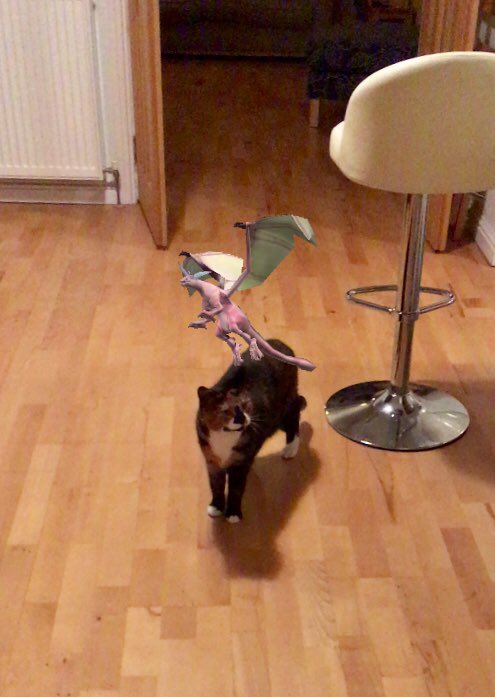
Niko is unimpressed…, CC BY, Lorna M. Campbell

The fun and games kicked off with Festival of Creative Learning in mid February.  My OER Service colleague Charlie ran a really fun and thought provoking 23 Things for Digital Confidence workshop.  The workshop challenged us to explore how we engage with technology in creative ways and we also got to play with some really cool augmented reality toys.  Oh, and there were dragons!  I took them home but I don’t think my cat was very impressed :}

Later in the week I helped to run a Get Blogging! workshop with Karen, Lila and Mark from DLAM, which guided students through the process of setting up a blog on Reclaim Hosting and provided them with some pointers on the benefits of blogging and topics they could write about.  I don’t usually get to work directly with undergraduate students so it was a really rewarding experience.  Their enthusiasm was infectious and it was great to see how proud and excited they were to leave at the end of the day with their very own brand new blog.  The fabulous feedback the students left was just the icing on the cake.  My slides from the day are here: Why Blog?

At the beginning of March we celebrated Open Education Week, I’ve already written a post about the activities we planned over the course of the week, and they all went really well.  We curated eight blog posts from staff, students and graduates on the Open.Ed blog over the course of the week, each bringing a unique perspective on engaging with open education. You can read a round-up of of these posts here.  I particularly like this quote from Martin Tasker, our very first Open Content Curation Intern, who is now building a career as a software engineer.

“In an age where where the world is both more connected and less trusting than ever, the onus is on institutions such as universities to use their reputations and resources to promote open education. As well as benefiting the public, it benefits the institutions themselves – there’s little better in the way of marketing than having potential applicants having already experienced some learning at your institution.” 

I’ve often quoted Martin’s Open Content Curation blog posts when I talk, and I’m sure I’ll be quoting his Open Education Week blog post, Reflecting on the Importance of Open Education, too.  

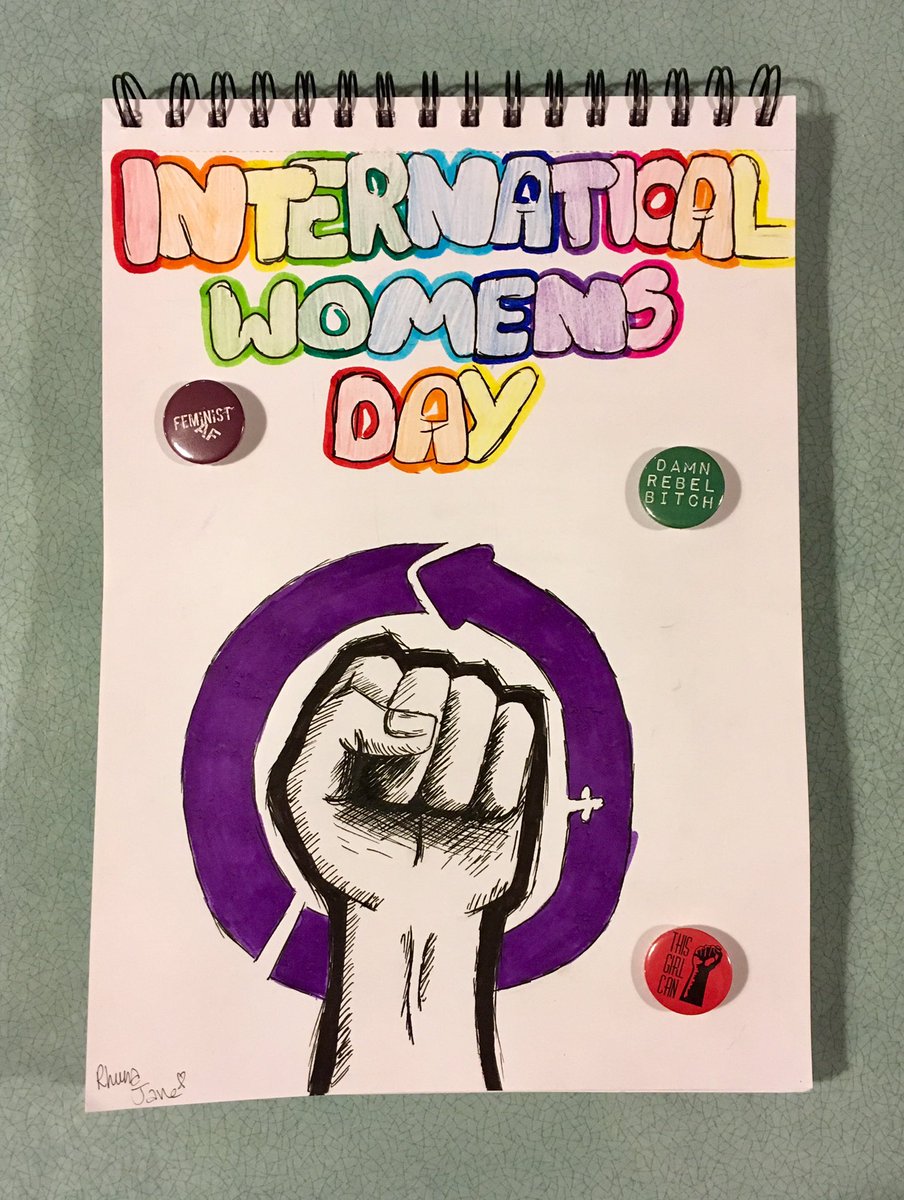
My daughter’s contribution to International Women’s Day, CC BY SA, RJ McCartney

International Women’s Day fell at the end of Open Education Week and Information Services marked the event by hosting a Women of Edinburgh Wikipedia Editathon and naming the Board Room in Argyle House after Brenda Moon, the first woman to head up a research university library in the 1980s, and who played a major role in bringing the University into the digital age. I spent part of the day updating the Wikipedia entry I’d previously written about Mary Susan McIntosh to include information about her work as a Women’s Rights Advocate campaigning for legal and financial rights for married and co-habiting women, defending the right to sexual expression, and arguing against censorship of pornography.  

The following week I was off down to UCL for their Open Education Symposium.  It was a privilege to be invited to share the University of Edinburgh’s strategic approach to Open Education, and it was great to hear about some of ways that openness is supported across UCL.  I particularly enjoyed hearing a group of Arts and Sciences BASc students reflecting on their positive experience of engaging with Wikibooks.  Their comments reflected those of our Edinburgh student who have participated in Wikipedia assignments and editathons. 

Somehow, in amongst all that, there was also several ALTC submissions, the launch of femedtech.net, and my daughter’s 13th birthday.  How the hell did that happen?! 

Spring into Open Education Week

Today marks the start of Open Education Week, the global celebration of the Open Education movement.  Last year my OER Service colleagues and I didn’t participate in Open Education Week as it coincided with the USS Strike so this year, we’re making up for lost time and we’ve got a whole pile of activities and events lined up. 

Open.Ed Spring Newsletter

We’ve published our latest Open.Ed newsletter to coincide with Open Education Week and to highlight events we’ll be running over the course of the week, along with other open activities and initiatives going on around the University.  You can read the latest edition of the newsletter here:  Welcome to the OER Service’s Spring Newsletter, and find back issues of the newsletter here Open.Ed Newsletter.

Open.Ed Blog Series

Over the course of the week, the Open.Ed Blog will be featuring a series of posts from students, staff, and open education practitioners from across the University of Edinburgh, covering a wide range of topics including Masters level OER assignments, Wikipedia and Translation Studies, tools for creating OERs, and much more. The series kicks off today with one post by me on Sustainable Support for OER and another by Jen Ross on Digital Futures for Learning: An OER assignment. 

Supporting Open Education and Open Knowledge at the University of Edinburgh

On Tuesday 5 March at 12.00-13.00, the OER Service will be hosting a free and informal lunchtime webinar during which we’ll be sharing our approaches to supporting Open Education and Open Knowledge at the University of Edinburgh.  Come and join me, Stuart Nicol (Education Design and Engagement), Ewan McAndrew (Wikimedian in Residence), Charlie Farley (OER Service), Rachael Mfoafo (EDE) and Anne-Marie Scott (DLAM) to talk about supporting open education through digital skills development, playful approaches to copyright literacy, embedding Wikipedia in the curriculum, and open approaches to MOOCs and distance learning at scale.  The webinar is free and open to all, joining details are available here.

Decolonise & Diversify the Curriculum with OER

This one-hour workshop on Tuesday 6 March at 12.00 – 13.00 will explore what it means to decolonise and diversify the curriculum with EUSA VP of Education Diva Mukherji. My lovely OER Service colleague Charlie Farley will also demonstrate how creating, using, and sharing OER can be one avenue towards diversifying and opening up curriculum materials. The workshop is open to University of Edinburgh staff and students, further information is available here. 

And of course I’ll be blogging and tweeting on the #OEWeek hashtag and hoping to catch some of the other fabulous activities going on over the course of the week too. 

Daffodils in George Square, CC BY, University of Edinburgh

Looking Behind the Curtain

Before Christmas by lovely former colleague R. John Robertson invited me to answer some questions about digital literacy for a course on Digital Literacy and Life that he’s teaching with Cindy Strong at Seattle Pacific University.  I’m late with these responses as usual, but it was a really interesting and thought provoking exercise because I’ve never taken the time to sit down and really reflect on how I understand digital literacy and what it means to me.

What is digital literacy?

I’ve never attempted to define digital literacy before, but now I think about it, I realise that I tend to conflate information literacy and digital literacy, primarily because so much of the information we now create, consume and interact with is mediated by digital technologies.   Certainly, there is a digital skills aspect to digital literacy, having the requisite skills to be able to use the tools that enable us to create and access information, but developing information literacies is arguably more important as it enables us to ask critical questions of this information regarding authorship, authenticity, ownership and perspective.

What impact does digital literacy have on your personal, professional, and spiritual life?

Digital literacy has a huge impact on both my personal and professional life.  I work for the OER Service, within Information Services at the University of Edinburgh, and helping colleagues to develop critical digital literacy skills is a large part of my job;  whether its running workshops on developing blogging skills to build your professional online profile, contributing to training sessions on understanding copyright and open licensing, or helping to run Wikipedia and Wikidata editathons.  Digital literacy is at the heart of what I do.

It’s not just about teaching people how to use digital tools, it’s about empowering them with the knowledge and confidence to have some degree of control over their digital presence and interactions.  Having the ability to curate and control our personal digital identities and online personas is a key aspect of digital literacy for me. It’s not all one way though, I’m constantly developing my own understanding of digital literacy and learning new digital skills through my professional practice and interactions with my peers.

I don’t regard myself as a spiritual person, but on a personal level, I believe that one of the most important aspects of digital literacy is that it gives us the ability to understand and to question how information is created, by whom, and for what purpose.  Digital literacy allows us to look behind the curtain to see the man (and it is invariably a man) who is pulling the levers and pushing the buttons.  Digital literacy helps to reveal how orthodoxies and narratives are created, and enables us to understand whose voices are included and whose are excluded.  Digital literacy helps to make structural inequality visible and if we choose to, it give us the tools to challenge these inequalities.

Who are you? (context matters)

I’m Lorna M. Campbell and I’m an open education practitioner.  I work in Edinburgh, live in Glasgow and come from the Outer Hebrides.  I’m a trustee of the Association for Learning Technology, Wikimedia UK and the Society for Nautical Research.  I was an archaeologist in a previous life, and I’m sometimes a naval historian.  I’m interested in fan culture and issues relating to gender and sexuality, particularly from a queer and historical perspective.  And I’m the mother of an almost-teenage daughter who understands the importance of citations on Wikipedia, because digital literacy begins at home â™ˇ

2018 – It All Adds Up

A recap of 2018 in numbers…..

3 Keynotes

I was honoured to be invited to present 3 open education keynotes this at the beginning of this year at OER18, the FLOSS UK Spring Conference and CELT18 at NUI Galway.  Each keynote presented different challenges and learning opportunities, particularly FLOSS UK where I had to get up on stage and talk to an all male conference (there were only 3 women in the room including me) about structural discrimination in the open domain. It was pretty terrifying and I couldn’t have done it without the support of the #femedtech community.  Indeed the #femedtech network has been one of of my main influences and inspirations this year and it’s been a real joy to see if go from strength to strength.  My OER18 keynote also resulted in my most impactful tweet ever with 16,592 impressions to date.  Predictably it wasn’t about open eduction, it was about shoes :}

Bessie Watson

To coincide with the centenary of women’s suffrage on the 6th February, I wrote a Wikipedia article about Bessie Watson the 9 year old suffragette from Edinburgh.  Bessie’s story really seemed to capture the imagination and it was great to be able to bring her amazing life to wider notice.

11 Days of Industrial Action

The USS Pension strike had a huge impact on the whole Higher Education sector early in the year.  I was grateful that I was in a position to be able to support the strike, which I know was much more difficult for many, many colleagues across the sector employed on part time and precarious contracts.  Although the strike was nominally about a single issue it really did galvanise action around a whole host of deeply problematic issues including workloads, pay, conditions, equality, precarity and the commercialisation of higher education.  It was a real inspiration to see so many staff and students getting behind the strike and to be able to join the strike rally in George Square in Glasgow.

USS Strike Rally, George Square, Glasgow, CC BY, Lorna M.Campbell

Repeal the 8th Campaign

Once again I was hugely inspired by the people of Ireland and the way they came together to repeal the 8th Amendment of the Irish Constitution, to recognise womens’ right to bodily autonomy and to amend abortion legislation.

AO3 an Inspiration in Open Source

In June I was delighted to listen online to Casey Fiesler’s amazing Open Repositories keynote Growing Their Own: Building an Archive and a Community for Fanfiction.  I’ve long been a fan of AO3 and have been endlessly frustrated, though not surprised, that this phenomenally successful open source initiative run on feminist principles isn’t more widely recognised and celebrated in the domain of open knowledge.  Casey’s brilliant keynote showed us how much we can potentially learn from AO3.

Wikimedia UK Partnership of the Year

In July the University of Edinburgh won Wikimedia UK’s Partnership of the Year Award for the 2nd time, for embedding Wikipedia in teaching and learning and for advocating for the role of Wikimedians in Residence in Higher Education.  None of this would be possible of course without the support of our own tireless Wikimedian in Residence, Ewan McAndrew.

Left to right: Stephanie (Charlie) Farley, Open Education Resources; Lorna Campbell, OER Service; Ewan McAndrew, Wikimedian in Residence; Anne-Marie Scott, Deputy Director of Learnng, Teaching & Web Services. CC BY, University of Edinburgh.

50!

The other significant event in July was my 50th birthday :}  The day itself was lovely, lazy and lowkey and I spent most of the month catching up with friends from all over the world online and in person.  It was wonderful.  My partner bought me glider lessons as a gift but sadly I haven’t taken them yet as I haven’t been able to get to the air field since….

RIP Magic Bus

After 13 fabulous, and admittedly often frustrating, years our VW T25 camper van died a death, though not before taking us on one last holiday to Galloway and then home to the Hebrides where I finally got to visit Traigh Mheilein beach in North Harris.  Traigh Mheilein is often described as the most beautiful beach in the Hebrides and boy does it live up to that reputation.

Traigh Mheilein, Isle of Harris, CC BY, Lorna M. Campbell

ALTC 25th Anniversary

In September I was back in Manchester for the 25th ALT Annual Conference.  As an organisation that truly embodies its core principles of collaboration, participation, independence and openness, ALT continues to be an inspiration right across the sector and I’m honoured to be able to play a small role in supporting the organisation through the ALT Board and the ALTC social media team.  The 25th conference was one of the best yet and my own personal highlights included thought provoking keynotes by Maren Deepwell and Amber Thomas, Melissa Highton‘s unflinchingly honest talk about developing and implementing a lecture recording policy at the height of the USS strikes, and Catherine Cronin and Frances Bell’s personal feminist retrospective of learning technology.  Catherine and Frances’ session also inspired me to take a step back and reflect on my own career as a learning technologist.

Wiki Loves Monuments

September means Wiki Loves Monuments and this year the competition was even more fun than last year, which I wouldn’t have thought possible!  Huge thanks to everyone who participated and who made the competition so much fun, particularly our Wikimedians in Scotland – Ewan, Sara and Delphine.  I uploaded 383 pictures and came 15th overall in the UK.  Most of these pictures were taken during our summer holiday so I really have to thank my parter and daughter for their patience :}

Naval History

I haven’t been writing much Naval History recently and indeed I’ll be stepping down from the Society of Nautical Research‘s Publications & Membership next year after 5 years in the chair.  However my colleague Heather and I did publish one short paper in The Trafalgar Chronicle, the journal of The 1805 Club, which this year focused on the lives of women and families at sea and on shore.  Our paper “I shall be anxious to know…”: Lives of the Indefatigable women, shone a spotlight on the personal lives of some of the women we encountered while researching our book Hornblower’s Historical Shipmates.

Blogging to Build Your Professional Profile

In October I built my 1st ever SPLOT!  As part of the roll out of the University of Edinburgh’s new academic blogging service I was tasked with developing a digital skills training workshop on professional blogging and what better way to do that than by practicing what we preach and building a blog!  Anne-Marie Scott set up the SPLOT template for me and it was all plain sailing from there.  The Blogging to Build Your Professional Profile workshop has already proved to be very popular and all the resources have been shared under Creative Commons licence so they can be reused and adapted. It was great working with LTW colleagues on this project, particularly Karen Howie, who a good friend from early CETIS days and an awesome person to work with.

#QueerArt20

In late November Gary Needham, senior lecturer in film and media at the University of Liverpool tagged me in the #QueerArt20 twitter challenge; one image a day, any medium, no credits or titles.  I’ve loved seeing the images other people have been posting and it really was a challenge to choose just 20 of my own to post. It was also a timely opportunity to reconnect with queer culture.  And talking of which…

120 Beats Per Minute

I didn’t see many memorable films this year but one that I did see, and which will stay with me for a long time was 120 Beats Per Minute a deeply moving and viscerally powerful film about queer activism set against the background of the AIDS crisis in Paris in the late 1980’s /  early 1990’s.  It’s a beautiful, painful and necessary film and I would urge you all to see it.

CETIS – The End of an Era

At the beginning of December I stepped down as a partner of CETIS LLP ending a 17 year association with the organisation in all its various incarnations.  I wouldn’t be where I am today without CETIS and I wish all the partners the very best for the future

….and the lows

Brexit has cast a noxious cloud of reckless xenophobia, bigotry and intolerance over us all, with the only glimmers of hope being a 2nd referendum and the more distant promise of Indy Ref 2.

It’s been equally been horrifying to watch the rise of right wing populist movements across the world.  Fascism might have a new acceptable ALT-Right face but it’s still fucking fascism.

I was heart broken by the death of Scott Hutchison in May.  He was a phenomenally talented writer and his songs uniquely captured the struggles so many face with alienation, depression, isolation and addiction.  Scott faced all these demons in true Scottish style; with scathing wit, self-effacing humour and heartbreaking poetry.  Just a few months before his death, I was packed into the Academy with hundreds of others for 10th anniversary tour of The Midnight Organ Fight.  It’s a night I won’t forget.

Frightened Rabbit, Barrowlands Ballroom, December 2016. CC BY Lorna M. Campbell

On an open education note, one of my frustrations this year is that, due to lack of time and focussing efforts elsewhere,  I had to neglect Open Scotland.  I really hope I’ll have an opportunity to revitalise the initiative next year as we still have a lot of work to do to persuade the Scottish Government of the benefits of open education.  This might seem like a trivial exercise when Scot Gov is facing the catastrophic challenge of Brexit, but surely we need open and equitable access to education and educational resources now more than ever.

I think I’ve exhausted my numbers now and they all add up to quite a year (sorry, that’s terrible) it just remains for me to wish you all the very best for 2019.

Open for all? Engaging with open education practice at the personal and institutional level

A couple of weeks ago I gave a webinar as part of Jane Secker’s new online course on Digital Literacies and Open Practice at City, University of London.  The lecture was called Open for all? Engaging with open education practice at the personal and institutional level and the recording is available here (Adobe Connect). The webinar provided an overview of open practice, reflected on my own experience of being an open practitioner, explored issues relating to equality, equity, privilege and inclusion, and included examples of how the University of Edinburgh supports open practice and the creation and use of OER.

In a stroke of good timing, my webinar took place a couple of days after a fantastic EDEN webinar by Catherine Cronin and Martin Weller called Open Education: What Now? which you can listen to here (Adobe Connect).  Many of the points Catherine and Martin raised really struck a chord with me, particularly this one, so I was great to have the opportunity to reflect on this in my own webinar.

“Where there is no policy or strategy around openness many individuals, students and staff feel that if they make a mistake they may be in peril, that the university may not have their back. So the absence of policy speaks very loudly to people within higher education institutions.”

Mini-series: Don’t panic! Content and copyright for lecture recording

CC0, @finnhackshaw, unsplash

This post previously appeared on the University of Edinburgh’s Teaching Matters blog.

Can I use copyright materials in my lectures? What about film clips? What if my lecture is recorded? How can I make sure I won’t get into trouble? Lorna Campbell and Charlie Farley, from the Educational Design and Engagement team in Learning, Teaching and Web Services, offer some answers to these frequently-posed questions…

Many of the questions and concerns that the OER Service receives from colleagues around the University relate to what kind of content can and can’t be used in lectures.  In order to address these concerns, the OER Service runs a wide range of digital skills training workshops and eventsaround open educational resources (OER) and the use of licensed content in learning, teaching and lecture recording.

The University purchases licenses through a number of agencies, to allow staff to use books, chapters, papers, films, and other resources in our closed teaching spaces. Closed teaching spaces are spaces that are only accessible to registered students and staff, e.g. lecture theatres, labs, tutorial rooms, and EASE authenticated online spaces such as Learn and Moodle. It’s okay to use these licensed resources in your recorded lectures as long as the recording is only shared with our registered students in authenticated spaces.

We also have access to a whole host of OER that we can use in a variety of exciting ways both inside our closed teaching spaces and in open online spaces.

OER are online resources used in the context of teaching and learning that have been released under a Creative Commons licence so they can be reused, remixed and re-purposed by others. The University has an OER Policy that encourages staff and students to use and create OER and you can find and access many of these resources through Open.Ed, our one stop shop for advice and guidance on OER and open licensed content.

The number one tip that we encourage everyone to develop as part of good teaching practice is to get into the habit of providing attribution for all the resources you use in your lectures, including images, diagrams, film clips, audio and text. To attribute a resource you should include title, creator, licence and, where possible, source URL.

If you’re showing a video or film during a recorded lecture, we recommend that you stop the recording at that point, show the film to your students, then resume the recording.  When you’re ready to share the recording, you can then provide a direct link to the film or video so your students can watch it in their own time.

If you’re recording a lecture that you would like to share outside of closed University teaching spaces, e.g. on Media Hopper Create, on a blog, or on the open web, you need to ensure that all the content has either been created by yourself, is outside of copyright protection (i.e. resources that are in the Public Domain by virtue of their copyright term expiring, or CC0 resources that have been placed in the public domain by creators who have chosen to relinquish their rights), or has been released under an open licence.

The University’s OER Service provides all kinds of advice and guidance and training on creating and using digital resources, and understanding copyright and open licensing, so don’t hesitate to get in touch with us though Open.Ed, come along and join some our free events, and sign up for the quarterly OER Service Newsletter.